FDA Accepts Resubmitted Application for a First-of-Its-Kind Cell Therapy Targeting EBV-Driven Lymphoma
What this article covers
- A Therapy Built for a Disease With No Approved Second-Line Option
- PTLD arises when EBV-infected B cells multiply out of control in people whose immune systems are deliberately suppressed after an organ or stem cell transplant. It spans a range of severity — from reactive-looking proliferations to aggressive, lymphoma-like disease — and in its EBV-positive form it can progress quickly and carries a meaningfully high mortality rate when first-line treatment fails.
- What the ALLELE Trial Actually Showed
- The FDA application rests on ALLELE, an open-label, multicenter, single-arm phase 3 trial of tabelecleucel in patients with EBV+ PTLD who had already failed at least one prior therapy, most often rituximab. 7%.
- Two Rejections, a Leadership Change, and a Reopened Path
- This resubmission is not tabelecleucel's first attempt at US approval, and understanding why matters for calibrating how confident patients and clinicians should be about March 2027. The FDA issued a complete response letter (CRL) in January 2025 centered on manufacturing-facility compliance issues at a third-party site — not on efficacy or safety.
- What This Means for Patients Right Now
- No one should read this as an approval. Tabelecleucel remains unavailable in the United States outside of expanded-access or clinical-trial settings, and the FDA's March 2027 target date is not a guarantee — the agency has reversed course on this exact application twice already.
- Bottom Line
- A therapy that has already been helping transplant patients in Europe for four years has cleared a major US regulatory hurdle after two rejections, and the FDA now has a formal deadline — March 31, 2027 — to decide whether EBV-positive PTLD patients in America will finally have an approved option after standard treatment fails. The clinical signal (roughly 51% response, with a striking survival gap favoring responders) is real but comes from a single-arm trial, so it should be read as encouraging rather than conclusive, and the drug's own regulatory history is a reminder that even strong data do not guarantee a straightforward path to approval.
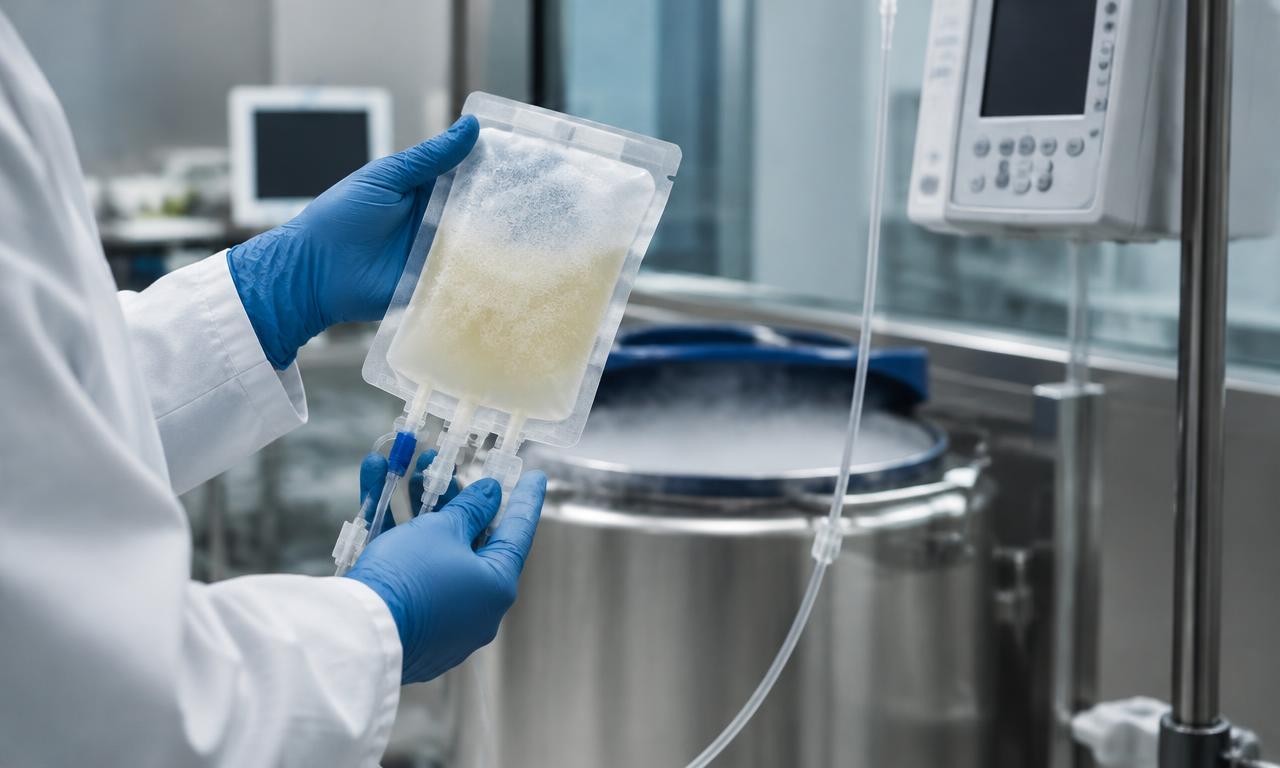
On October 14, 2026, the FDA accepted a resubmitted biologics license application for tabelecleucel (tab-cel, marketed in Europe as Ebvallo), an off-the-shelf allogeneic T-cell immunotherapy for Epstein-Barr virus-positive post-transplant lymphoproliferative disease (EBV+ PTLD). The acceptance, with a target decision date of March 31, 2027, caps an unusually public 20-month regulatory saga involving two prior rejections and a leadership change at the FDA's biologics center — and it puts the US closer than it has ever been to having an approved treatment for patients who relapse after standard therapy for this rare but often fatal transplant complication. The drug is not yet approved, and a third FDA review could still end in another rejection; this article explains what actually happened, what the clinical data show, and why the news is nonetheless a meaningful, well-documented step forward.
A Therapy Built for a Disease With No Approved Second-Line Option
PTLD arises when EBV-infected B cells multiply out of control in people whose immune systems are deliberately suppressed after an organ or stem cell transplant. It spans a range of severity — from reactive-looking proliferations to aggressive, lymphoma-like disease — and in its EBV-positive form it can progress quickly and carries a meaningfully high mortality rate when first-line treatment fails. Current first-line management generally involves reducing immunosuppression and giving rituximab, an antibody that depletes B cells. When that fails, there is currently no FDA-approved therapy specifically for this population in the United States.
Tabelecleucel is designed to fill that gap. It is an allogeneic, "off-the-shelf" cell therapy made from healthy donor T cells that have been trained to recognize EBV-infected cells; the T cells kill their targets in a manner restricted by HLA matching, so a bank of pre-made donor-derived cell lines can, in principle, be matched to many recipients without manufacturing a bespoke product for each patient — a meaningful logistical advantage over personalized cell therapies. The therapy has already been approved in the European Union since December 2022, where regulators described it as the first-ever therapy specifically for EBV+ PTLD and the first allogeneic, off-the-shelf T-cell immunotherapy to reach any market.
What the ALLELE Trial Actually Showed
The FDA application rests on ALLELE, an open-label, multicenter, single-arm phase 3 trial of tabelecleucel in patients with EBV+ PTLD who had already failed at least one prior therapy, most often rituximab. Among 75 evaluable patients, the overall response rate was 50.7% (95% CI, 38.9%–62.4%), with complete responses in 28.0% of patients and partial responses in 22.7%. Response rates were similar regardless of transplant type — 50.0% in the 26 patients with a prior hematopoietic cell transplant and 51.0% in the 49 patients with a prior solid organ transplant.
The survival data are where the results become genuinely striking, and also where the caveats matter most. Median overall survival was 18.4 months in the full study population, compared with just 3.7 months in patients who did not respond to treatment, and overall survival was not yet reached (not evaluable) in those who did respond. At 12 months, 78.7% of responders were alive, versus 28.2% of nonresponders. This is a dramatic separation between responders and nonresponders — but it comes from a single-arm trial with no randomized control group, meaning the comparison is internal to the trial rather than against an independent comparator arm, and it does not establish that the drug itself drives survival rather than reflecting that healthier, less advanced-disease patients are more likely to respond in the first place. On safety, treatment-emergent serious adverse events occurred in 62.7% of patients, though only 8.0% were judged treatment-related; notably, the trial reported no cases of cytokine release syndrome, infusion reactions, tumor flare, or the neurotoxicity syndrome (ICANS) sometimes seen with other T-cell therapies, such as CAR-T products.
Two Rejections, a Leadership Change, and a Reopened Path
This resubmission is not tabelecleucel's first attempt at US approval, and understanding why matters for calibrating how confident patients and clinicians should be about March 2027. The FDA issued a complete response letter (CRL) in January 2025 centered on manufacturing-facility compliance issues at a third-party site — not on efficacy or safety. After that clinical hold was lifted and the facility issues were resolved, the FDA accepted a resubmission with priority review in mid-2025. Then, in January 2026, the agency issued a second CRL, this time concluding that the pivotal ALLELE trial's design, conduct, and analysis were not sufficient to support approval under the accelerated pathway — a reversal that, according to contemporaneous reporting, departed from an earlier internal FDA consensus and drew criticism for inconsistency. The agency did not raise new safety concerns and confirmed the earlier manufacturing problems had been fixed.
In the weeks that followed, Vinay Prasad, the director of the FDA's Center for Biologics Evaluation and Research (CBER), departed the agency; Katherine Szarama has been serving as interim director. A subsequent Type A meeting in April 2026 produced agreement that a single-arm study using an appropriate historical control could, in fact, serve as adequate evidence — the regulatory position the developers had argued for all along. The partners resubmitted in September 2026 with an expanded data package, including longer ALLELE follow-up, expanded-access program data, a supportive separate study, and several years of real-world commercial experience in Europe. That resubmission is what the FDA accepted on October 14, 2026, alongside breakthrough therapy and orphan drug designations.
What This Means for Patients Right Now
No one should read this as an approval. Tabelecleucel remains unavailable in the United States outside of expanded-access or clinical-trial settings, and the FDA's March 2027 target date is not a guarantee — the agency has reversed course on this exact application twice already. What has changed is that the regulatory disagreement over how to evaluate a single-arm trial in a very rare disease appears to have been resolved in the sponsor's favor, and the clinical data, while uncontrolled, show a consistent and clinically meaningful pattern: roughly half of heavily pretreated patients responding, with responders living dramatically longer than nonresponders, and a safety profile notably free of the severe toxicities associated with some other cell-based immunotherapies.
Bottom Line
A therapy that has already been helping transplant patients in Europe for four years has cleared a major US regulatory hurdle after two rejections, and the FDA now has a formal deadline — March 31, 2027 — to decide whether EBV-positive PTLD patients in America will finally have an approved option after standard treatment fails. The clinical signal (roughly 51% response, with a striking survival gap favoring responders) is real but comes from a single-arm trial, so it should be read as encouraging rather than conclusive, and the drug's own regulatory history is a reminder that even strong data do not guarantee a straightforward path to approval.
Key Questions Answered
- Is tabelecleucel approved in the United States?
- No. The FDA accepted a resubmitted application on October 14, 2026, with a target decision date of March 31, 2027. It has been approved in the European Union since December 2022.
- What did the ALLELE trial show?
- Among 75 evaluable patients with EBV+ PTLD after failed prior therapy, the overall response rate was 50.7%, with 28.0% complete responses and median overall survival of 18.4 months.
- Why was tabelecleucel rejected twice before?
- A January 2025 letter cited third-party manufacturing issues; a January 2026 letter said the single-arm trial was insufficient. An April 2026 meeting agreed a historical control could suffice.
Sources
- FDA Accepts Resubmitted Tabelecleucel BLA for EBV-Positive PTLD, CancerNetwork, 2026 — https://www.cancernetwork.com/view/fda-accepts-resubmitted-tabelecleucel-bla-for-ebv-positive-ptld
- FDA Reverses Course on Atara, Pierre Fabre's Twice-Rejected Cell Therapy After Prasad's Exit, BioSpace, 2026 — https://www.biospace.com/fda/fda-reverses-course-on-atara-pierre-fabres-twice-rejected-cell-therapy-after-prasads-exit
- Atara Biotherapeutics Announces Second Quarter 2026 Financial Results and Operational Progress (SEC Form 8-K exhibit), Atara Biotherapeutics / SEC EDGAR, 2026 — https://www.sec.gov/Archives/edgar/data/0001604464/000119312526346857/atra-ex99_1.htm
- Tabelecleucel, Wikipedia (summarizing EMA approval details and mechanism), accessed 2026 — https://en.wikipedia.org/wiki/Tabelecleucel
- First Allogeneic Cancer Immunotherapy Hits Market, European Biotechnology, 2022 — https://european-biotechnology.com/latest-news/first-allogeneic-cancer-immunotherapy-hits-market/
- FDA Grants Priority Review for Atara's Tab-cel in Epstein-Barr Virus-Related Disease, Synapse/PatSnap, 2025 — https://synapse.patsnap.com/blog/fda-grants-priority-review-for-ataras-tab-cel%C2%AE-in-epstein-barr-virus-related-disease
Related Articles
- Research & Industry
ASCO Annual Meeting 2027: What to Expect From Oncology's Biggest Stage
The world's largest clinical oncology meeting returns to Chicago in June 2027, with cell therapy, immunotherapy, and antibody-drug conjugate research expected to headline the scientific program once again.
- Research & Industry
AACR IO 2027: What to Expect From the Immuno-Oncology Conference Coming to Los Angeles
AACR IO 2027 meets in Los Angeles February 28–March 3, focusing on cancer vaccines, engineered T cells and early clinical data—not confirmed treatment advances.
- Research & Industry
CAR-T Therapy for Autoimmune Disease in France: What's Actually Happening
France hosts investigational CAR-T trials for severe lupus, but September 2026 safety pauses underscore serious risks and the absence of an approved autoimmune therapy.