FDA Clears a Shortcut: A Widely Used Stem Cell Treatment for Knee Osteoarthritis Moves Toward a US Trial
What this article covers
- What This Article Covers
- Over the course of 2026, the South Korean biotech MEDIPOST has reached a series of milestones in bringing CARTISTEM, an umbilical cord blood-derived stem cell therapy for knee osteoarthritis that has been sold in Korea since 2012, toward the US market. The headline development: the FDA agreed to accept a single, streamlined pivotal trial — rather than the usual two independent Phase 3 studies — backed by years of foreign clinical and real-world data, and the first American patient has already been dosed.
- What Happened
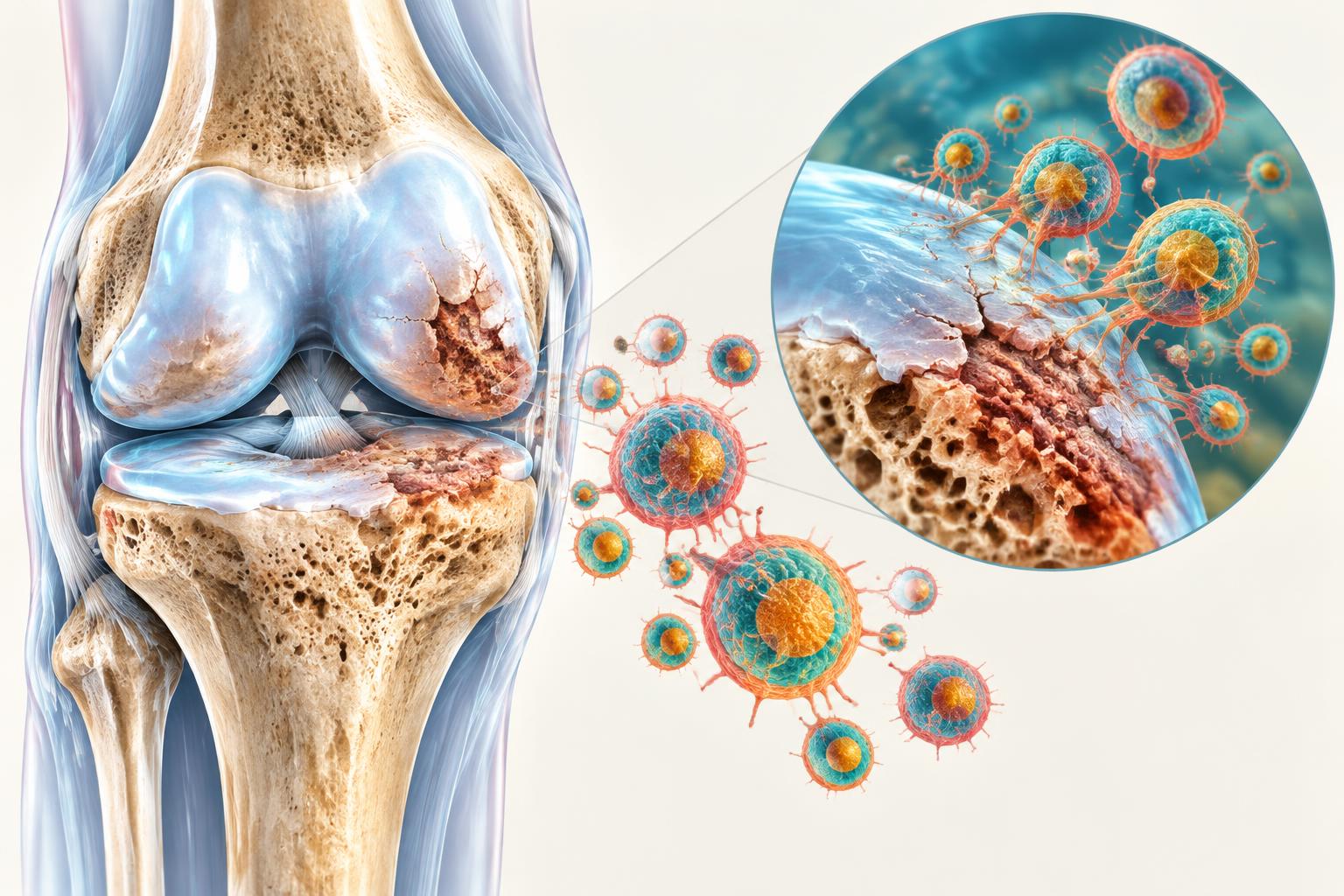
- CARTISTEM is an allogeneic (donor-derived), off-the-shelf mesenchymal stem cell product manufactured from umbilical cord blood, designed to be injected into damaged knee cartilage to reduce pain and improve function in osteoarthritis. It has been commercially available in South Korea since 2012 and is also in late-stage development in Japan, but it has never been evaluated or approved by the FDA, and it remains strictly investigational in the United States.
- What the Supporting Data Actually Show
- The case for a pared-down US trial design rests heavily on a Japanese Phase 3 study whose results were announced in May 2026. That trial randomized 130 patients with knee osteoarthritis across 13 sites to either CARTISTEM (59 patients) or an active comparator, hyaluronic acid injections (61 patients), and followed them for 52 weeks.
- Important Caveats and Limitations
- Several things are worth keeping in view. First, every figure and claim described above — the FDA's agreement to a single-trial pathway, the Japanese trial's topline results, the first-patient dosing — comes from MEDIPOST's own announcements as relayed by business and trade press, not from an FDA public statement, an SEC-equivalent regulatory filing with full data, or a peer-reviewed publication.
- Context: Why This Matters
- Knee osteoarthritis affects tens of millions of people in the US, and the only FDA-approved treatments for advanced disease remain pain management, viscosupplementation, and ultimately joint replacement surgery — there is no FDA-approved disease-modifying or cartilage-regenerating cell therapy. That gap has fueled a sprawling, loosely regulated market of cash-pay stem cell clinics, where osteoarthritis patients reportedly pay out of pocket anywhere from roughly $3,500 to $25,000 per knee for unapproved stem cell injections that are not covered by insurance or Medicare and lack the kind of controlled trial evidence CARTISTEM is now generating.
What This Article Covers
Over the course of 2026, the South Korean biotech MEDIPOST has reached a series of milestones in bringing CARTISTEM, an umbilical cord blood-derived stem cell therapy for knee osteoarthritis that has been sold in Korea since 2012, toward the US market. The headline development: the FDA agreed to accept a single, streamlined pivotal trial — rather than the usual two independent Phase 3 studies — backed by years of foreign clinical and real-world data, and the first American patient has already been dosed. This article explains what was actually agreed to, what the supporting data do and don't show, and why no stem cell therapy for arthritis is approved in the US yet.
What Happened
CARTISTEM is an allogeneic (donor-derived), off-the-shelf mesenchymal stem cell product manufactured from umbilical cord blood, designed to be injected into damaged knee cartilage to reduce pain and improve function in osteoarthritis. It has been commercially available in South Korea since 2012 and is also in late-stage development in Japan, but it has never been evaluated or approved by the FDA, and it remains strictly investigational in the United States.
In January 2026, MEDIPOST's US subsidiary closed $140 million in financing, led by Skylake Equity Partners and Crescendo Equity Partners, explicitly earmarked to fund a US Phase 3 trial. Then, according to company statements reported in June 2026, the FDA agreed that a single pivotal US trial — rather than the two independent confirmatory trials the agency typically requires for a new biologic — could be sufficient to support a Biologics License Application, provided it is supplemented by MEDIPOST's existing Korean clinical and long-term real-world evidence and Japanese trial data. Under this revised design, the US trial's planned enrollment dropped from roughly 600 to about 300 patients, with an expected 3-to-6-month shorter timeline and an estimated 20–30% reduction in trial costs. On July 8, 2026, MEDIPOST announced that the first US participant had been dosed.
What the Supporting Data Actually Show
The case for a pared-down US trial design rests heavily on a Japanese Phase 3 study whose results were announced in May 2026. That trial randomized 130 patients with knee osteoarthritis across 13 sites to either CARTISTEM (59 patients) or an active comparator, hyaluronic acid injections (61 patients), and followed them for 52 weeks. MEDIPOST reported that the trial met all of its pre-specified primary and secondary efficacy endpoints, with improvements in pain, function, and cartilage regeneration that the company described as statistically significant compared with the hyaluronic acid control group. The company also described the safety profile as favorable, stating that all serious adverse events reported in the trial were assessed as unrelated to the treatment.
That is a genuinely encouraging result — meeting both primary and secondary endpoints against an active, clinically used comparator (rather than a true placebo) is a meaningfully higher bar than many earlier-stage cell therapy readouts clear. It is also worth underscoring what is still missing from public reporting: no specific pain scores, function scores, percentage improvements, effect sizes, or statistical values have been released in the coverage reviewed for this article. The numbers behind "statistically significant" and "met all endpoints" have not yet been published in a peer-reviewed journal or presented with full data at a major medical meeting, so independent verification of the magnitude of benefit is not yet possible.
Important Caveats and Limitations
Several things are worth keeping in view. First, every figure and claim described above — the FDA's agreement to a single-trial pathway, the Japanese trial's topline results, the first-patient dosing — comes from MEDIPOST's own announcements as relayed by business and trade press, not from an FDA public statement, an SEC-equivalent regulatory filing with full data, or a peer-reviewed publication. Second, CARTISTEM remains unapproved and investigational in the United States; the FDA's reported willingness to consider a single pivotal trial does not guarantee that trial will succeed, nor that an eventual BLA will be approved. Third, the Japanese pivotal trial used an active comparator, not a placebo, which is a reasonable design choice but means the results speak to comparative effectiveness against hyaluronic acid rather than to a placebo-controlled effect size. Finally, the US trial itself is only just getting underway — enrolling adults aged 18 to 75 with knee cartilage lesions and osteoarthritis — so no US efficacy or safety data exist yet.
Context: Why This Matters
Knee osteoarthritis affects tens of millions of people in the US, and the only FDA-approved treatments for advanced disease remain pain management, viscosupplementation, and ultimately joint replacement surgery — there is no FDA-approved disease-modifying or cartilage-regenerating cell therapy. That gap has fueled a sprawling, loosely regulated market of cash-pay stem cell clinics, where osteoarthritis patients reportedly pay out of pocket anywhere from roughly $3,500 to $25,000 per knee for unapproved stem cell injections that are not covered by insurance or Medicare and lack the kind of controlled trial evidence CARTISTEM is now generating. A legitimate, FDA-reviewed pathway to an approved product — with real efficacy and safety data from randomized trials — would be a meaningful step toward giving patients and physicians a vetted alternative to that unregulated landscape, and toward eventual insurance coverage discussions.
What's Next
MEDIPOST's near-term roadmap includes continuing to enroll the roughly 300-patient US pivotal trial at around 70 sites, while separately preparing a Japanese biologics license application later in 2026 on the strength of the completed Japanese Phase 3 results. Full, quantified results from the Japanese trial — and eventually from the US study — will be the real test of whether the encouraging topline signals hold up under peer review and independent scrutiny.
Bottom Line
This is a genuinely interesting regulatory and clinical development: an FDA pathway decision that, if it holds, could shorten and simplify the route to the first FDA-approved stem cell therapy for knee osteoarthritis, backed by a Phase 3 trial that reportedly beat an active comparator on all pre-specified endpoints. But "reportedly" is the operative word throughout — the quantitative data are not yet public, the US trial has only just begun dosing patients, and CARTISTEM remains unapproved and unproven in the United States. Patients considering any stem cell injection for knee arthritis today should understand that no such product currently carries FDA approval, and that cash-pay clinics offering these treatments are operating outside the kind of controlled evidence this trial program is still in the process of generating.
Key Questions Answered
- Is CARTISTEM FDA-approved?
- No. CARTISTEM remains investigational in the United States. The reported agreement to a single pivotal trial is not marketing approval or a guarantee of future approval.
- What did the Japanese trial reportedly find?
- MEDIPOST reported that its Phase 3 study met all pre-specified primary and secondary endpoints against hyaluronic acid at 52 weeks. Full quantitative results have not been made public in the reporting reviewed here.
- What happens next in the United States?
- The company plans to continue enrolling roughly 300 participants at around 70 sites. US efficacy and safety results are not available yet; full trial data will require independent scrutiny.
Sources
- Medipost Secures FDA Agreement on Single Pivotal Phase 3 Study with Confirmatory Evidence BLA Filing Strategy for Cartistem in the U.S. — The Asia Business Daily — 2026 — https://view.asiae.co.kr/en/article/2026060409051571177
- Medipost Administers First Patient in U.S. Phase 3 Trial of CARTISTEM for Knee Osteoarthritis — The Asia Business Daily — 2026 — https://view.asiae.co.kr/en/article/2026070808194419620
- U.S. Phase III Trial Expands Clinical Investigation of Stem Cell Therapy for Knee Cartilage Defects — PR Newswire / J-Stories — 2026 — https://jstories.media/?p=24030
- CARTISTEM Meets Primary and Secondary Endpoints in Japan Phase 3 Trial — ORTHOWORLD — 2026 — https://www.orthoworld.com/cartistem-meets-primary-and-secondary-endpoints-in-japan-phase-3-trial/
- MEDIPOST Inc. Announces $140 Million in Funding — BusinessWire — 2026 — https://www.businesswire.com/news/home/20260109323917/en/MEDIPOST-Inc.-Announces-$140-Million-in-Funding
- Stem Cell Therapy for Knees Enters US Trial, Hinting at a New FDA Path — BriefGlance — 2026 — https://briefglance.com/articles/stem-cell-therapy-for-knees-enters-us-trial-hinting-at-a-new-fda-path
Related Articles
- Research & Industry
What Does "IRB-Approved" Actually Mean? Why It Isn't the Same as FDA Approval
IRB approval is an ethics review, not proof a stem cell treatment works. Learn how it differs from IND clearance and FDA approval, and what to verify.
- Research & Industry
ASGCT 2027: A Preview of the World's Largest Gene and Cell Therapy Gathering
ASGCT’s 30th Annual Meeting is confirmed for May 3–7, 2027 in Philadelphia. What to watch in gene therapy, stem cell science and engineered immune cells.
- Research & Industry
Why Patient Testimonials Aren't Proof: Understanding the Limits of Anecdotal Evidence at Stem Cell Clinics
Why sincere patient stories cannot establish treatment efficacy, and how selection bias, placebo effects and natural symptom changes can mislead.