How Does CAR-T Cell Therapy for Large B-Cell Lymphoma Actually Work?
What this article covers
- What This Article Covers
- Three CD19-targeted CAR-T products — axicabtagene ciloleucel (Yescarta), tisagenlecleucel (Kymriah), and lisocabtagene maraleucel (Breyanzi) — have moved large B-cell lymphoma (LBCL) from a disease where relapse after standard chemoimmunotherapy was often fatal within months to one where a meaningful share of patients now achieve responses that hold up for years. This article covers what these engineered T cells are, how they find and kill lymphoma cells, what the pivotal ZUMA-1, JULIET, and TRANSCEND NHL 001 trials actually showed, and the real toxicities, relapse patterns, and access barriers involved.
- From Blood Draw to Living Drug
- Each of these three therapies starts the same way: a patient's own T cells are collected through apheresis, a process similar to a blood donation in which blood is drawn, T cells are filtered out, and the rest is returned to the patient. Those T cells are shipped to a manufacturing facility, where a disarmed virus inserts a gene encoding a chimeric antigen receptor (CAR) — a synthetic protein fusing an antibody fragment to internal T-cell signaling machinery.
- How the Engineered Cells Find and Kill Lymphoma
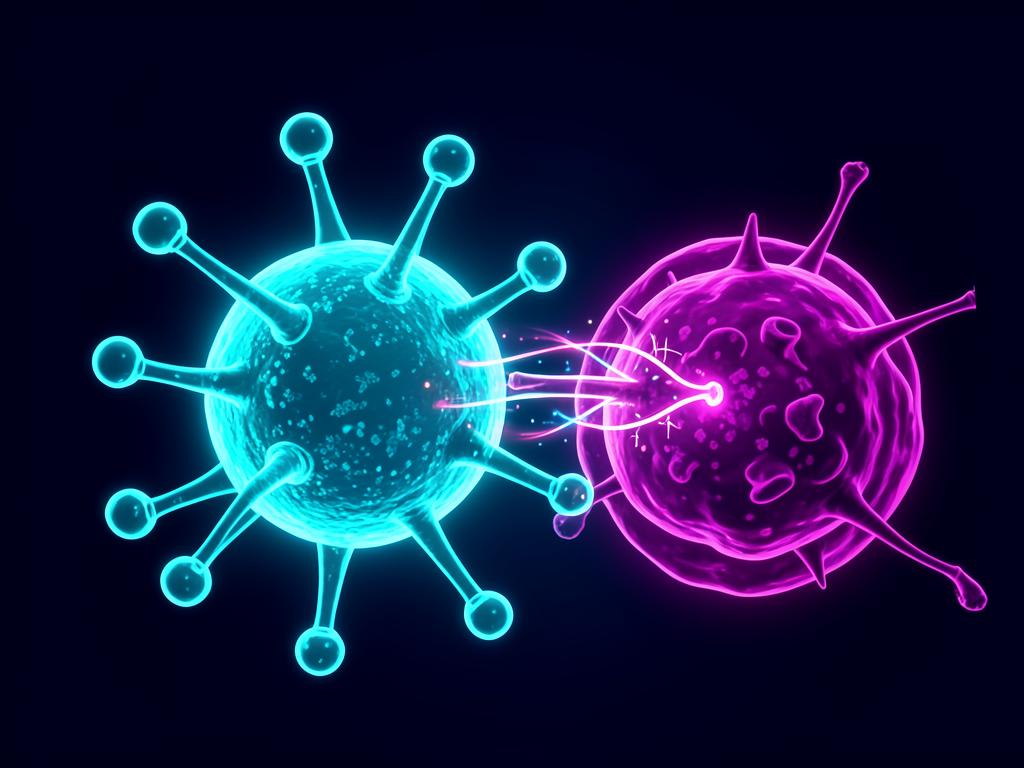
- The CAR itself is the key innovation. Its external portion is built from an antibody fragment engineered to bind CD19, a protein expressed on the surface of nearly all B cells, including the malignant B cells that make up large B-cell lymphoma.
- What the Pivotal Trials Actually Showed
- The strongest evidence for durability comes from ZUMA-1, the trial supporting Yescarta's original 2017 approval. In the pivotal cohort of patients with refractory large B-cell lymphoma, the objective response rate was 83%, with 58% achieving complete response.
- The Toxicities Are Real and Sometimes Severe
- This benefit does not come free. The same mechanism that makes CAR-T effective — a massive, rapid immune activation — also drives its two signature toxicities.
What This Article Covers
Three CD19-targeted CAR-T products — axicabtagene ciloleucel (Yescarta), tisagenlecleucel (Kymriah), and lisocabtagene maraleucel (Breyanzi) — have moved large B-cell lymphoma (LBCL) from a disease where relapse after standard chemoimmunotherapy was often fatal within months to one where a meaningful share of patients now achieve responses that hold up for years. This article covers what these engineered T cells are, how they find and kill lymphoma cells, what the pivotal ZUMA-1, JULIET, and TRANSCEND NHL 001 trials actually showed, and the real toxicities, relapse patterns, and access barriers involved.
From Blood Draw to Living Drug
Each of these three therapies starts the same way: a patient's own T cells are collected through apheresis, a process similar to a blood donation in which blood is drawn, T cells are filtered out, and the rest is returned to the patient. Those T cells are shipped to a manufacturing facility, where a disarmed virus inserts a gene encoding a chimeric antigen receptor (CAR) — a synthetic protein fusing an antibody fragment to internal T-cell signaling machinery. The cells are grown in culture until there are hundreds of millions of them, tested for quality, and shipped back to the treating center. According to the National Cancer Institute, this process typically takes about three to five weeks from blood draw to infusion. Before reinfusion, patients receive a short course of lymphodepleting chemotherapy, which clears out existing immune cells and makes room for the CAR-T cells to expand. Because manufacturing takes weeks and the disease can progress quickly, many patients need "bridging" chemotherapy or radiation in the interim just to keep the lymphoma controlled long enough to receive the product.
How the Engineered Cells Find and Kill Lymphoma
The CAR itself is the key innovation. Its external portion is built from an antibody fragment engineered to bind CD19, a protein expressed on the surface of nearly all B cells, including the malignant B cells that make up large B-cell lymphoma. The receptor's internal portion contains signaling and co-stimulatory domains — borrowed from natural T-cell receptor machinery — that fire when the CAR binds its target. Unlike a normal T-cell receptor, which needs an antigen processed and presented by specialized molecules, a CAR recognizes CD19 directly on the cell surface. When a CAR-T cell binds a CD19-positive lymphoma cell, the signaling domains trigger the T cell to activate, release cytotoxic granules that kill the lymphoma cell, and multiply further — turning a single infusion into a self-amplifying, living drug that can persist and keep hunting lymphoma cells for months.
What the Pivotal Trials Actually Showed
The strongest evidence for durability comes from ZUMA-1, the trial supporting Yescarta's original 2017 approval. In the pivotal cohort of patients with refractory large B-cell lymphoma, the objective response rate was 83%, with 58% achieving complete response. Five-year follow-up data published in Blood in 2023, based on 101 patients followed for a median of more than five years, showed a five-year overall survival rate of 42.6%, with the authors describing the survival-curve plateau as consistent with "curative potential" in a population that historically survived only months. Patients who achieved complete response fared even better, with 64.4% surviving to five years. Tisagenlecleucel's JULIET trial enrolled a more heavily pretreated, higher-risk population and reported a lower overall response rate of 53.1%, with roughly 40% achieving complete response; among responders, relapse-free survival at six months was 73.5%. Lisocabtagene maraleucel's TRANSCEND NHL 001 trial reported an overall response rate of 73% and a complete response rate of 53%, with two-year follow-up showing a median duration of response of roughly 23 months and close to half of responders still in remission at two years. Taken together, these trials mark a genuine inflection point: patients with aggressive lymphoma who had exhausted standard chemoimmunotherapy now have a real chance — roughly one in three to one in two — of a response lasting years rather than months. Based on later randomized trials (ZUMA-7 and TRANSFORM), Yescarta and Breyanzi are also FDA-approved as second-line therapy for LBCL refractory to, or relapsing within 12 months of, first-line chemoimmunotherapy; all three remain approved for relapsed/refractory disease after two or more prior lines of therapy.
The Toxicities Are Real and Sometimes Severe
This benefit does not come free. The same mechanism that makes CAR-T effective — a massive, rapid immune activation — also drives its two signature toxicities. Cytokine release syndrome (CRS), caused by a surge of inflammatory cytokines as CAR-T cells expand and attack tumor cells, occurred in roughly 90-94% of patients across the pivotal LBCL trials in any grade, with severe (grade 3 or higher) CRS in about 7-13% of patients depending on trial and product. Neurologic toxicity, sometimes still called immune effector cell-associated neurotoxicity syndrome (ICANS), occurred in roughly 75-87% of patients in any grade, with severe neurologic events in 25-31% of patients in the Yescarta trials. Both are managed with supportive care, the interleukin-6 blocker tocilizumab, and corticosteroids, and both are usually reversible within one to two weeks — but both can also be fatal in rare cases, which is why infusions happen only at specialized, FDA-certified treatment centers equipped to manage these complications around the clock.
Why Some Patients Relapse, and Who Can't Access the Therapy
Not every patient responds, and relapse remains a real risk among those who do. One documented escape route is antigen loss: because the CAR recognizes CD19 specifically, lymphoma cells that stop expressing CD19 — through mutation, alternative splicing, or lineage switching — can become invisible to the engineered T cells and regrow unchecked. Other relapses occur even in CD19-positive disease, likely reflecting CAR-T cells that lose potency or persistence over time. Beyond biology, access is its own barrier: the multi-week manufacturing timeline excludes patients whose disease is progressing too fast to wait, and the therapy is expensive — current estimates put a full Yescarta treatment course, including the cell product plus hospitalization and monitoring, at several hundred thousand dollars per patient. Care is also concentrated at a limited number of certified academic centers, creating geographic and logistical barriers for patients who live far away or lack needed caregiver support.
Bottom Line
CD19-directed CAR-T therapy is one of the genuine successes of modern cancer immunotherapy: in patients with relapsed or refractory large B-cell lymphoma who previously had few good options, it produces objective responses in roughly half to over 80% of patients depending on the product and trial, and a meaningful subset last for years, with ZUMA-1's five-year data specifically supporting the idea that some patients may be effectively cured. That said, this is not a low-risk treatment — cytokine release syndrome and neurotoxicity are common and occasionally severe or fatal, not everyone responds, some who do will relapse through antigen loss or other mechanisms, and the weeks-long manufacturing process, six-figure cost, and concentration of care at specialized centers keep the therapy out of reach for many who might benefit. Patients and families considering CAR-T for lymphoma should discuss candidacy, expected response for their specific situation, and realistic toxicity risk with a certified treatment center rather than relying on trial averages alone.
Sources
- Axicabtagene Ciloleucel CAR T-Cell Therapy in Refractory Large B-Cell Lymphoma — New England Journal of Medicine, 2017 — https://www.nejm.org/doi/full/10.1056/NEJMoa1707447
- Five-year follow-up of ZUMA-1 supports the curative potential of axicabtagene ciloleucel in refractory large B-cell lymphoma — Blood (American Society of Hematology), 2023 — https://ashpublications.org/blood/article/141/19/2307/494672/Five-year-follow-up-of-ZUMA-1-supports-the
- Tisagenlecleucel in Adult Relapsed or Refractory Diffuse Large B-Cell Lymphoma (JULIET trial) — New England Journal of Medicine, 2019 — https://www.nejm.org/doi/full/10.1056/NEJMoa1804980
- Long-term clinical outcomes of tisagenlecleucel in patients with relapsed or refractory aggressive B-cell lymphomas (JULIET) — Lancet Oncology, 2021 (PubMed) — https://pubmed.ncbi.nlm.nih.gov/34516954/
- Two-year follow-up of lisocabtagene maraleucel in relapsed or refractory large B-cell lymphoma in TRANSCEND NHL 001 — PubMed — https://pubmed.ncbi.nlm.nih.gov/37890149/
- Axicabtagene Ciloleucel as Second-Line Therapy for Large B-Cell Lymphoma (ZUMA-7) — New England Journal of Medicine, 2022 — https://www.nejm.org/doi/full/10.1056/NEJMoa2116133
- CAR T Cells: Engineering Immune Cells to Treat Cancer — National Cancer Institute — https://www.cancer.gov/about-cancer/treatment/research/car-t-cells
- FDA Approves Axicabtagene Ciloleucel for Second-Line Treatment of Large B-Cell Lymphoma — U.S. Food and Drug Administration, 2022 — https://www.fda.gov/drugs/resources-information-approved-drugs/fda-approves-axicabtagene-ciloleucel-second-line-treatment-large-b-cell-lymphoma
Related Articles
- Clinical Applications
First CAR-T Therapy for an Autoimmune Disease Edges Toward FDA Approval: What Kyverna's Stiff Person Syndrome Data Show
Kyverna's Phase 2 KYSA-8 trial of miv-cel in stiff person syndrome reported a 46% walk-test improvement and a rolling BLA is underway — but the FDA hasn't ruled.
- Clinical Applications
Can Radiation Therapy Make Immunotherapy Work Better? The Science of the Abscopal Effect
The PACIFIC trial proved radiation plus checkpoint immunotherapy can extend survival in stage III lung cancer — but true abscopal responses remain rare, and several later trials came back negative.
- Clinical Applications
CAR-T Cell Therapy for Pediatric Brain Tumors: What Early Trials Show
GD2 and B7-H3 CAR-T trials at Stanford and Seattle Children's have produced real tumor shrinkage and functional recovery in children with diffuse midline glioma — alongside serious brainstem swelling risk and no approvals.