Checking a Stem Cell Clinic's Medical Credentials: What Board Certification and State Licensing Actually Tell You (and Don't)
What this article covers
- WHAT THIS ARTICLE COVERS
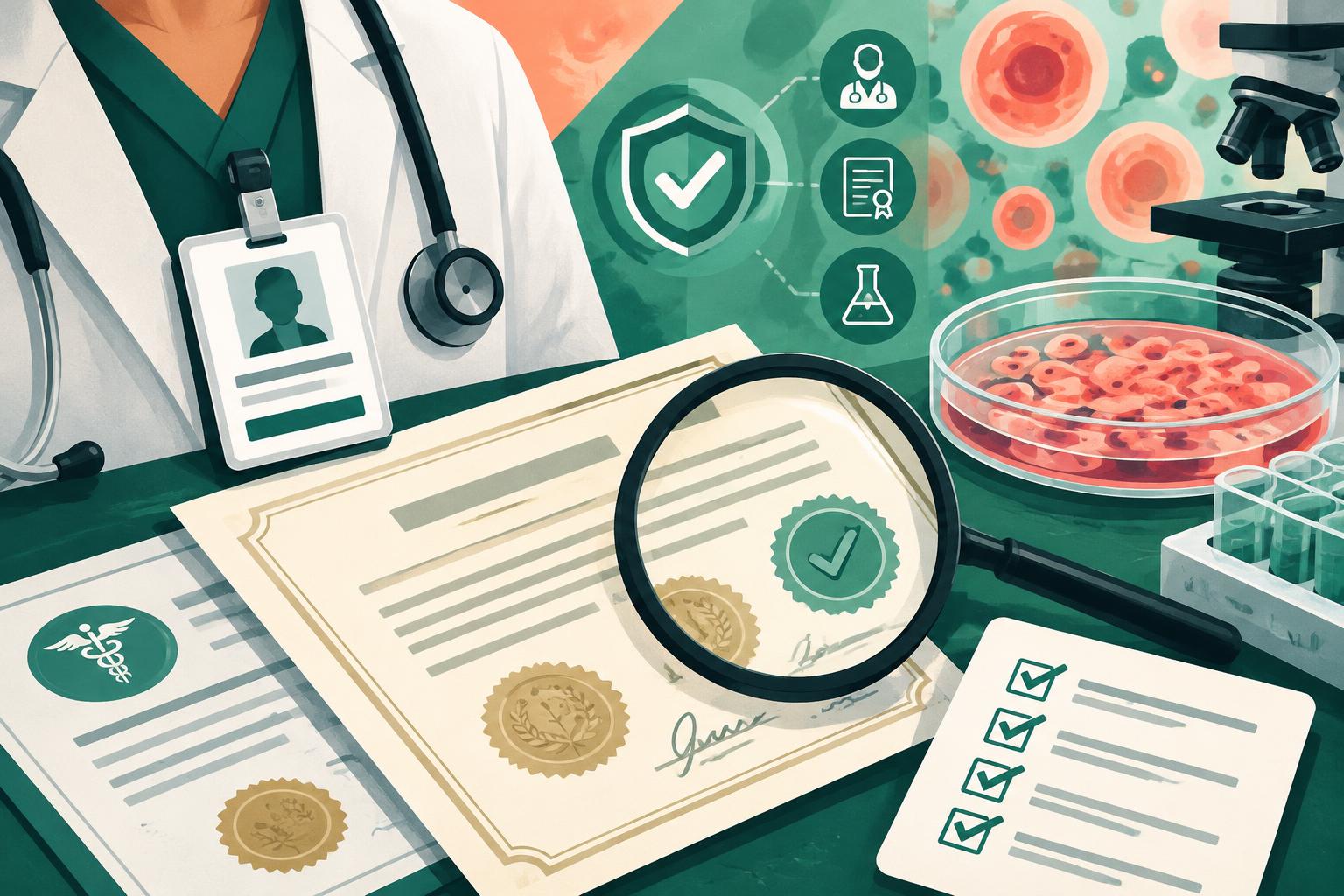
- Before you commit to any stem cell treatment, it's worth spending twenty minutes confirming who, exactly, will be treating you. Board certification and state medical licensing are two of the most useful, free, and publicly verifiable facts you can check about a physician — but both are easy to misread, and neither one tells you whether the specific treatment being offered is proven to work.
- What Board Certification Actually Means
- Board certification means a physician has completed an accredited residency in a specialty and passed a rigorous examination administered by one of the member boards of the American Board of Medical Specialties (ABMS), the body that oversees physician certification in the United States. It's a meaningful signal of specialty-specific training — but it is specialty-specific.
- Checking State Medical Licensing and Disciplinary History
- Board certification is voluntary; a state medical license is not. S.
- What Credentials Don't Tell You
- This is the part that matters most.
- Presentation Red Flags Worth Noticing
- How a clinic displays credentials can be as informative as the credentials themselves:
WHAT THIS ARTICLE COVERS
Before you commit to any stem cell treatment, it's worth spending twenty minutes confirming who, exactly, will be treating you. Board certification and state medical licensing are two of the most useful, free, and publicly verifiable facts you can check about a physician — but both are easy to misread, and neither one tells you whether the specific treatment being offered is proven to work. This article walks through how to verify a doctor's board certification and license status using official lookup tools, what those credentials do and don't establish, and the presentation red flags that are worth noticing along the way.
What Board Certification Actually Means
Board certification means a physician has completed an accredited residency in a specialty and passed a rigorous examination administered by one of the member boards of the American Board of Medical Specialties (ABMS), the body that oversees physician certification in the United States. It's a meaningful signal of specialty-specific training — but it is specialty-specific. A doctor can be genuinely, legitimately board-certified in, say, emergency medicine or radiology and have no formal training in orthopedics, rheumatology, or any field connected to the joint, spine, or autoimmune condition the clinic is marketing stem cell injections for. Certification in one specialty does not transfer expertise to another.
To verify a certification, use ABMS's own consumer tool, Certification Matters (certificationmatters.org), which the ABMS directs patients to from its site. You can search by physician name to confirm whether, and in which specialty, a doctor holds current ABMS certification. If a clinic names a specific board on its website, check that the board is actually an ABMS member board — ABMS maintains that not all organizations calling themselves "boards" are member boards, and it has publicly taken action against entities that falsely claim ABMS affiliation.
Checking State Medical Licensing and Disciplinary History
Board certification is voluntary; a state medical license is not. Every physician practicing medicine in the U.S. must hold an active license from the medical board of the state where they practice, and that license can be suspended, restricted, or revoked for cause. The Federation of State Medical Boards (FSMB) operates a consumer-facing lookup, DocInfo (docinfo.org), that lets you search a physician's license status, the states they're licensed in, and — importantly — any public disciplinary actions on record. Individual state medical board websites offer the same lookup directly and are worth checking too, since disciplinary detail can vary by state.
What to look for:
- Is the license currently active, and in the state where the clinic operates?
- Are there any board actions — probation, restriction, suspension, or revocation — and if so, what was the stated reason?
- Does the name and practice location on the license match what the clinic advertises?
A clean license check is reassuring, but it's a floor, not a ceiling: it tells you the physician hasn't been formally disciplined, not that every treatment they offer is appropriate or evidence-based.
What Credentials Don't Tell You
This is the part that matters most. Credential checks answer "is this a real, licensed doctor with the training they claim," not "is this treatment safe or effective for my condition." Three gaps are worth being explicit about:
- Specialty mismatch. A board-certified physician practicing outside their trained specialty is still "board-certified" — the certification is simply irrelevant to the procedure being performed.
- Non-recognized "boards." Some certificates come from self-designated organizations that sound official (often with "American Board of," "National Board of," or similar names) but are not ABMS member boards and have not gone through ABMS's evaluation process. ABMS itself notes it has no information about these boards' certification requirements and cannot verify them. A certificate from one of these isn't necessarily meaningless, but it is not the same assurance as ABMS board certification, and it's reasonable to ask the clinic directly whether a credential is ABMS-recognized.
- Credentials don't vouch for the treatment. A fully licensed, legitimately board-certified physician can still offer a stem cell product or procedure that lacks FDA approval and has not been shown safe or effective for the condition being treated. The FDA has repeatedly warned that many regenerative medicine products marketed for orthopedic, neurological, and other conditions are not FDA-approved and may carry real safety risks, regardless of who is administering them. Checking whether the specific product or procedure has FDA approval, or is being delivered under a legitimate FDA-cleared clinical trial (searchable at ClinicalTrials.gov), is a separate — and necessary — step from checking the provider's credentials.
Presentation Red Flags Worth Noticing
How a clinic displays credentials can be as informative as the credentials themselves:
- Vague or decorative credential language ("doctor trained in regenerative medicine") without naming a specific, checkable board or license number.
- Prominently displayed certificates from organizations you can't find as ABMS member boards, especially when ABMS certification isn't mentioned at all.
- Physician bios that emphasize media appearances, patient testimonials, or marketing awards rather than training and licensure details.
- Reluctance to confirm which physician will actually perform or supervise your specific procedure.
None of these automatically indicate wrongdoing, but they're worth asking direct questions about before proceeding.
Bottom Line
Verifying board certification and state licensing is a fast, free, and genuinely useful first step in evaluating a stem cell clinic — and one too many patients skip. But it's one piece of a larger picture. A real license and a real board certification confirm a baseline of training and accountability; they say nothing about whether the specific treatment on offer is backed by evidence or approved for your condition. Treat credential verification as necessary groundwork, then separately check the regulatory status of the treatment itself before making a decision.
Key Questions Answered
- Where can patients verify certification and licensing?
- Certification Matters verifies ABMS board certification. DocInfo and individual state medical boards provide license status and public disciplinary records.
- Is board certification the same as a medical license?
- No. Board certification is voluntary and specialty-specific. Physicians must hold an active medical license in the state where they practice.
- Do credentials prove a stem cell treatment is safe or effective?
- No. Credentials establish training and accountability, not treatment efficacy. The specific treatment’s evidence and regulatory status must be checked separately.
Sources
- Certification Matters – American Board of Medical Specialties (ABMS) consumer verification tool, abms.org, 2026, https://www.abms.org/verify-certification/
- Boards Outside of ABMS – FAQ, American Board of Medical Specialties, 2026, https://www.abms.org/faq/boards-outside-of-abms/
- DocInfo – Federation of State Medical Boards consumer license and disciplinary-action lookup, fsmb.org, 2026, https://www.docinfo.org/
- Information for Consumers – Federation of State Medical Boards, fsmb.org, 2026, https://www.fsmb.org/guide-to-medical-regulation-in-the-united-states/information-for-consumers/
- Consumer Alert on Regenerative Medicine Products Including Stem Cells and Exosomes – U.S. Food and Drug Administration, fda.gov, 2026, https://www.fda.gov/vaccines-blood-biologics/consumers-biologics/consumer-alert-regenerative-medicine-products-including-stem-cells-and-exosomes
- Important Patient and Consumer Information About Regenerative Medicine Therapies – U.S. Food and Drug Administration, fda.gov, 2026, https://www.fda.gov/vaccines-blood-biologics/consumers-biologics/important-patient-and-consumer-information-about-regenerative-medicine-therapies
Related Articles
- Research & Industry
ISCT 2027: Cell and Gene Therapy's World Meeting Heads to Toronto
ISCT 2027 meets May 12–15 in Toronto. Explore its cell and gene therapy focus, past program tracks and why conference discussion is not proof of efficacy.
- Research & Industry
TERMIS-AM 2026: What to Know About the Americas' Leading Regenerative Medicine Conference
TERMIS-AM 2026's dates, New Orleans venue, 20th-anniversary program and research scope, with a clear distinction between scientific progress and patient-ready treatments.
- Research & Industry
What to Ask About Complications and Adverse Event Reporting Before Choosing a Stem Cell Clinic
Published stem cell complications, FDA MedWatch and ISSCR guidance, with practical questions about follow-up, informed consent and adverse event reporting before treatment.