EU Regulators Back Earlier Use of Talvey Plus Daratumumab in Multiple Myeloma: What the Phase 3 MonumenTAL-3 Data Actually Show
What this article covers
- What Changed, and Why It Matters
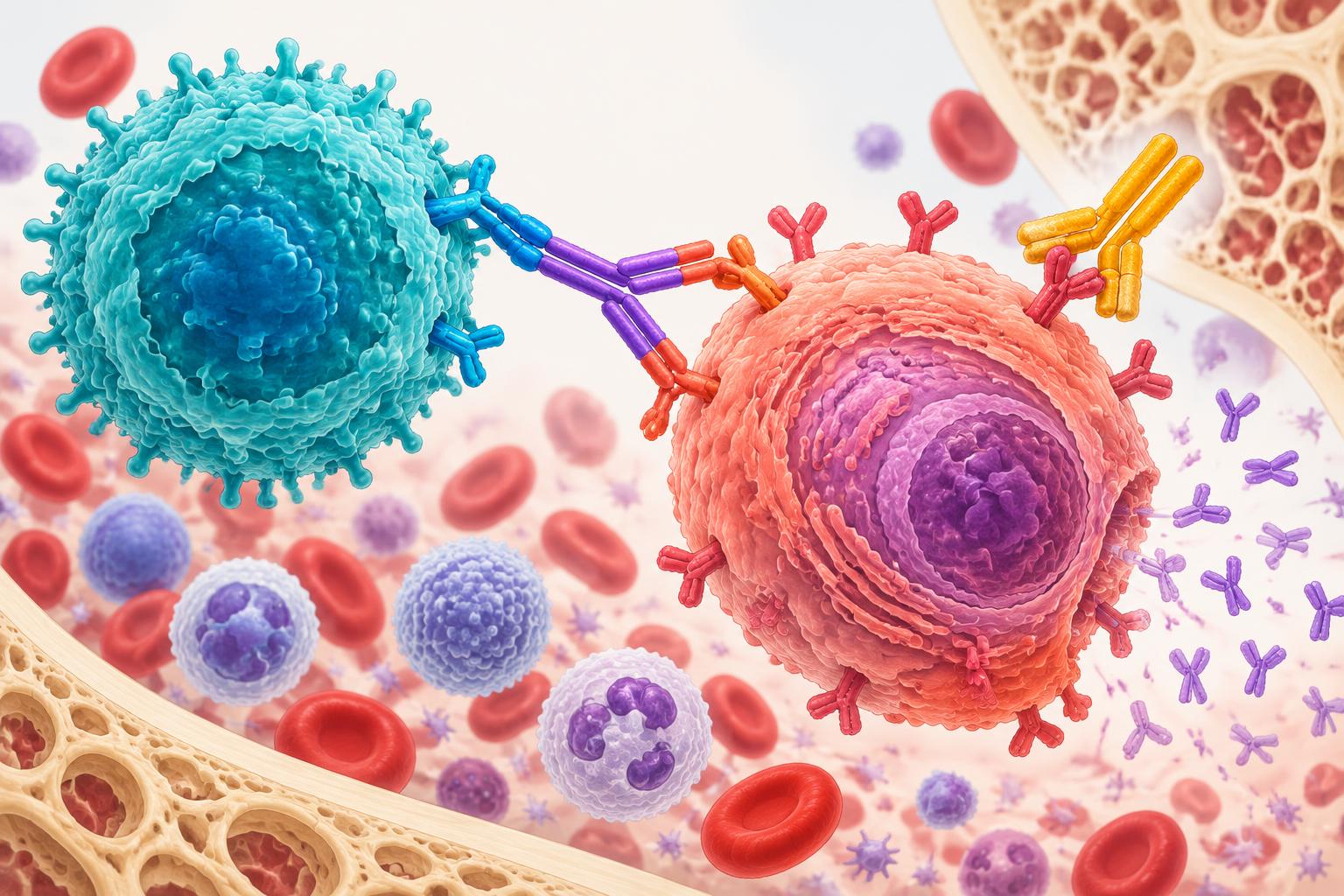
- Talquetamab is a bispecific T-cell engaging antibody — a lab-made molecule that binds simultaneously to CD3 on a patient's own T-cells and to GPRC5D, a protein highly expressed on multiple myeloma cells but largely absent from healthy B-cells. In practical terms, it works by physically dragging T-cells into contact with myeloma cells and triggering an immune attack.
- What the MonumenTAL-3 Trial Found
- The recommendation rests on MonumenTAL-3 (NCT05455320), a Phase 3 trial that randomized 864 patients with relapsed or refractory multiple myeloma to one of three arms: talquetamab plus daratumumab and pomalidomide (Tal-DP), talquetamab plus daratumumab alone (Tal-D), or the standard-of-care combination of daratumumab, pomalidomide, and dexamethasone (DPd). At a median follow-up of roughly two years, both talquetamab combinations sharply outperformed standard care.
- The Caveats That Still Apply
- This is a recommendation, not a final approval — the European Commission's decision typically follows within about two months of a positive CHMP opinion, and it isn't guaranteed. 8%), and infections — a known risk with T-cell engaging therapies and an expected consequence of suppressing myeloma cells that also support normal antibody production — occurred in the majority of patients across all three arms.
- Bottom Line
- The MonumenTAL-3 data represent a genuinely strong result — more than halving the risk of disease progression and meaningfully extending survival compared with standard treatment — and the CHMP's recommendation could bring that benefit to patients much earlier in their myeloma journey, pending final European Commission approval. The combination isn't risk-free, and multiple myeloma remains, for now, a chronic and largely incurable disease even with these advances, but mature, randomized, placebo-controlled-style data of this magnitude is exactly the kind of evidence that earns cautious optimism in oncology.
On October 16, 2026, the European Medicines Agency's Committee for Medicinal Products for Human Use (CHMP) recommended expanding the approved use of Johnson & Johnson's bispecific antibody Talvey (talquetamab), combined with daratumumab, to patients with relapsed or refractory multiple myeloma who have had just one prior line of therapy — a substantially earlier point in treatment than its current approval allows. The recommendation is backed by strong, mature Phase 3 data, and it's a genuinely encouraging development for a blood cancer that remains incurable for most patients. Here's what the trial actually found, and what comes next.
What Changed, and Why It Matters
Talquetamab is a bispecific T-cell engaging antibody — a lab-made molecule that binds simultaneously to CD3 on a patient's own T-cells and to GPRC5D, a protein highly expressed on multiple myeloma cells but largely absent from healthy B-cells. In practical terms, it works by physically dragging T-cells into contact with myeloma cells and triggering an immune attack. Daratumumab, a long-established myeloma drug, targets a different protein, CD38, and appears to further sensitize the immune system to talquetamab's effect when the two are combined. Talquetamab already carries conditional EU and accelerated FDA approval as a standalone drug for heavily pretreated patients who've exhausted several other treatment lines. The new CHMP recommendation would move the daratumumab combination much earlier — to patients who've had just one prior therapy — meaning, if finalized, far more myeloma patients could access it sooner in their treatment course, before the disease has had as many chances to become treatment-resistant.
What the MonumenTAL-3 Trial Found
The recommendation rests on MonumenTAL-3 (NCT05455320), a Phase 3 trial that randomized 864 patients with relapsed or refractory multiple myeloma to one of three arms: talquetamab plus daratumumab and pomalidomide (Tal-DP), talquetamab plus daratumumab alone (Tal-D), or the standard-of-care combination of daratumumab, pomalidomide, and dexamethasone (DPd). At a median follow-up of roughly two years, both talquetamab combinations sharply outperformed standard care. Progression-free survival was dramatically better: the risk of progression or death was reduced by about 72% with Tal-DP (hazard ratio 0.28) and about 67% with Tal-D (hazard ratio 0.33), both highly statistically significant. At 24 months, 81.3% of patients on Tal-DP and 77.6% on Tal-D had not progressed, compared with a substantially lower rate on standard treatment. Overall survival also favored both talquetamab combinations, with roughly a 50% reduction in the risk of death and 24-month survival rates near 88–89%. Response rates were similarly strong — about 88% of patients responded to either talquetamab combination, versus 77.6% on standard care — and deep responses were notably more common: 71.1% (Tal-DP) and 68.9% (Tal-D) achieved a complete response or better, compared with 34.5% on standard treatment, and roughly half of talquetamab-treated patients reached undetectable disease by sensitive molecular testing (MRD-negativity), versus about 16% on standard care.
The Caveats That Still Apply
This is a recommendation, not a final approval — the European Commission's decision typically follows within about two months of a positive CHMP opinion, and it isn't guaranteed. The safety profile also isn't free of trade-offs: serious (grade 3 or 4) side effects were more common with the triple combination (Tal-DP, at 94.9%) than with the standard regimen (91.5%) or the two-drug talquetamab combination (Tal-D, at 74.8%), and infections — a known risk with T-cell engaging therapies and an expected consequence of suppressing myeloma cells that also support normal antibody production — occurred in the majority of patients across all three arms. Fatal adverse events were actually less frequent with both talquetamab arms (1.8% and 4.0%) than with standard care (4.6%), though these are small percentage differences in a relatively short follow-up window. As with any T-cell engaging bispecific, talquetamab carries labeled risks for cytokine release syndrome and neurologic side effects that require specialized monitoring, particularly during the first doses.
Bottom Line
The MonumenTAL-3 data represent a genuinely strong result — more than halving the risk of disease progression and meaningfully extending survival compared with standard treatment — and the CHMP's recommendation could bring that benefit to patients much earlier in their myeloma journey, pending final European Commission approval. The combination isn't risk-free, and multiple myeloma remains, for now, a chronic and largely incurable disease even with these advances, but mature, randomized, placebo-controlled-style data of this magnitude is exactly the kind of evidence that earns cautious optimism in oncology.
Key Questions Answered
- Is the earlier-line Talvey combination finally approved in the EU?
- The October 16, 2026 CHMP opinion is a recommendation, not a final approval. A European Commission decision is still required.
- What did MonumenTAL-3 report for progression-free survival?
- In 864 randomized patients, progression or death risk was reduced by about 72% with Tal-DP and 67% with Tal-D versus standard care, with hazard ratios of 0.28 and 0.33.
- What safety trade-offs remain?
- Grade 3 or 4 side effects and infections remain important. Talquetamab also carries labeled cytokine release syndrome and neurologic risks requiring specialized monitoring, especially during initial doses.
Sources
- CHMP recommends approval of Johnson & Johnson's TALVEY (talquetamab) plus daratumumab in earlier line treatment of relapsed/refractory multiple myeloma — Johnson & Johnson press release, October 16, 2026, https://www.jnj.com/media-center/press-releases/chmp-recommends-approval-of-johnson-johnsons-talvey-talquetamab-plus-daratumumab-in-earlier-line-treatment-of-relapsed-refractory-multiple-myeloma
- Talquetamab Plus Daratumumab Earns CHMP Backing in R/R Myeloma — OncLive, October 2026, https://www.onclive.com/view/talquetamab-plus-daratumumab-earns-chmp-backing-in-r-r-myeloma
- Meeting highlights: Committee for Medicinal Products for Human Use (CHMP), 12–15 October 2026 — European Medicines Agency, https://www.ema.europa.eu/en/news/meeting-highlights-committee-medicinal-products-human-use-chmp-12-15-october-2026
- CHMP post-authorisation summary of positive opinion for Talvey — European Medicines Agency, https://www.ema.europa.eu/en/documents/smop/chmp-post-authorisation-summary-positive-opinion-talvey-vr-0000339914_en.pdf
Related Articles
- Research & Industry
ASCO Gastrointestinal Cancers Symposium 2027: What's Coming to GI Oncology's Flagship Research Meeting
ASCO GI 2027 runs January 21–23 in San Francisco and online, highlighting immunotherapy progress in GI cancers while distinguishing meeting previews from published findings.
- Research & Industry
CAR-T Therapy for Autoimmune Disease in the United Kingdom: What's Actually Happening
The UK is running some of the world's most closely watched early CAR-T trials for lupus. What the nine-patient CARLYSLE results show, what's still unproven, and why it remains trial-only.
- Research & Industry
FDA Review Resumes for Off-the-Shelf Cell Therapy Aimed at a Rare, Often-Fatal Transplant Complication
Tabelecleucel’s September 2026 FDA resubmission, ALLELE response and safety data, prior rejection reasons and continuing lack of U.S. approval.