Ivonescimab Beats Pembrolizumab on Overall Survival in a Head-to-Head Lung Cancer Trial: What HARMONi-2 Actually Showed
What this article covers
- What This Article Covers
- A late-breaking analysis presented at the IASLC 2026 World Conference on Lung Cancer delivered a genuinely significant result for one of oncology's most closely watched new drug classes: in a head-to-head Phase 3 trial, a first-in-class bispecific antibody called ivonescimab beat pembrolizumab (Keytruda) — the reigning standard-of-care immunotherapy for first-line advanced lung cancer — on overall survival, the gold-standard endpoint in cancer research. This article explains what ivonescimab is, what the HARMONi-2 trial actually found, and the real caveats that keep this an important but not yet fully settled result.
- A Genuinely Encouraging Result, Presented Where It Counts
- The HARMONi-2 trial enrolled 398 patients with PD-L1-positive, treatment-naive advanced non-small cell lung cancer (NSCLC) who had no targetable EGFR or ALK mutations, randomizing them to receive either ivonescimab or pembrolizumab as first-line therapy. 009).
- What Ivonescimab Actually Is
- Ivonescimab is a first-in-class bispecific antibody, meaning it's engineered to simultaneously target two different pathways with a single molecule. It combines PD-1 checkpoint blockade — the same basic immune-activating mechanism behind pembrolizumab and other established checkpoint inhibitors — with VEGF inhibition, a mechanism that restricts a tumor's ability to grow new blood vessels.
- Where the Real Caveats Belong
- This is a trial result worth taking seriously, and the overall-survival benefit in particular is the kind of outcome oncologists weight most heavily — but several caveats matter and shouldn't get lost in the excitement. The trial enrolled patients exclusively in China, so how the results generalize to more genetically and environmentally diverse patient populations elsewhere remains to be confirmed in additional studies.
- Why This Trial Matters Beyond One Drug
- Pembrolizumab has been the first-line standard for PD-L1-positive advanced NSCLC for years, and head-to-head trials that actually beat it — rather than simply adding another drug on top of it — are rare. 009) behind it, is the kind of data point that tends to accelerate both regulatory interest and the broader field's investment in PD-1/VEGF bispecific approaches as a drug class, not just this one molecule.
What This Article Covers
A late-breaking analysis presented at the IASLC 2026 World Conference on Lung Cancer delivered a genuinely significant result for one of oncology's most closely watched new drug classes: in a head-to-head Phase 3 trial, a first-in-class bispecific antibody called ivonescimab beat pembrolizumab (Keytruda) — the reigning standard-of-care immunotherapy for first-line advanced lung cancer — on overall survival, the gold-standard endpoint in cancer research. This article explains what ivonescimab is, what the HARMONi-2 trial actually found, and the real caveats that keep this an important but not yet fully settled result.
A Genuinely Encouraging Result, Presented Where It Counts
The HARMONi-2 trial enrolled 398 patients with PD-L1-positive, treatment-naive advanced non-small cell lung cancer (NSCLC) who had no targetable EGFR or ALK mutations, randomizing them to receive either ivonescimab or pembrolizumab as first-line therapy. At the August 2026 data cutoff, patients on ivonescimab had a median overall survival of 30.8 months, compared with 22.6 months for patients on pembrolizumab — a difference of more than eight months in median survival, corresponding to a 27% lower relative risk of death (hazard ratio 0.73; 95% CI 0.57–0.95; p=0.009). That's a substantial, statistically significant improvement over a drug that is itself already considered a major standard of care, and it's the kind of head-to-head overall-survival win against an active comparator — rather than against a placebo — that is genuinely uncommon in lung cancer research. The data were presented as a late-breaking abstract on September 13, 2026, at the IASLC World Conference on Lung Cancer in Seoul, South Korea, one of the field's most rigorous venues for new oncology data.
What Ivonescimab Actually Is
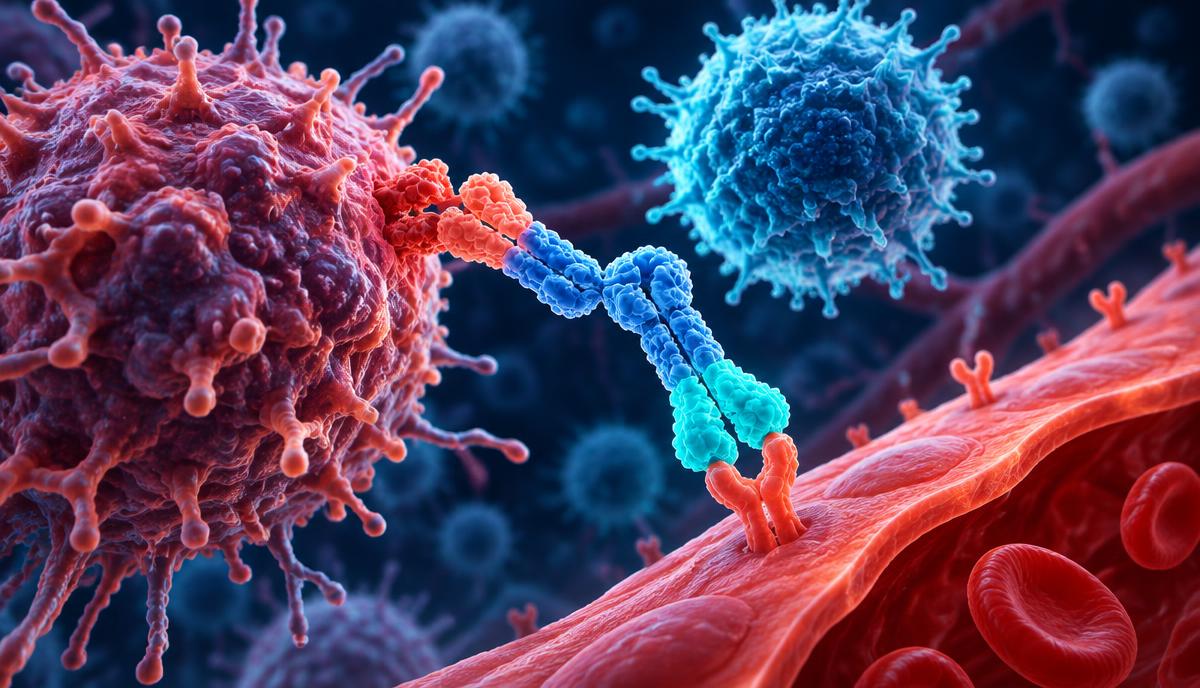
Ivonescimab is a first-in-class bispecific antibody, meaning it's engineered to simultaneously target two different pathways with a single molecule. It combines PD-1 checkpoint blockade — the same basic immune-activating mechanism behind pembrolizumab and other established checkpoint inhibitors — with VEGF inhibition, a mechanism that restricts a tumor's ability to grow new blood vessels. The combined approach is designed to attack the tumor on two fronts simultaneously: unleashing the immune system's T cells while also starving the tumor of the vascular supply it needs to grow and spread. Developed by Akeso in China and partnered outside China with Summit Therapeutics, ivonescimab has drawn significant attention in the oncology field since earlier trial data first emerged.
Where the Real Caveats Belong
This is a trial result worth taking seriously, and the overall-survival benefit in particular is the kind of outcome oncologists weight most heavily — but several caveats matter and shouldn't get lost in the excitement. The trial enrolled patients exclusively in China, so how the results generalize to more genetically and environmentally diverse patient populations elsewhere remains to be confirmed in additional studies. Safety also came at a real cost: treatment-related adverse events occurred in 93.4% of patients on ivonescimab versus 84.9% on pembrolizumab, and serious adverse events were more frequent as well (29.9% versus 21.6%), even though rates of immune-related adverse events specifically were comparable between the two arms at around 34%. And critically, ivonescimab is not approved by the FDA; it received regulatory approval in China for this specific patient population in April 2025, but it remains investigational in the United States and most of the rest of the world, meaning it is not currently an option available to patients outside of China or ongoing clinical trials.
Why This Trial Matters Beyond One Drug
Pembrolizumab has been the first-line standard for PD-L1-positive advanced NSCLC for years, and head-to-head trials that actually beat it — rather than simply adding another drug on top of it — are rare. A positive overall-survival result against an active standard-of-care comparator, with real statistical rigor (p=0.009) behind it, is the kind of data point that tends to accelerate both regulatory interest and the broader field's investment in PD-1/VEGF bispecific approaches as a drug class, not just this one molecule. Multiple other companies are pursuing similar dual-mechanism bispecifics, and a confirmed overall-survival win in a Phase 3 trial, presented at a major international congress rather than only in a press release, gives the broader approach genuine scientific credibility.
Bottom Line
Ivonescimab's overall-survival advantage over pembrolizumab in the HARMONi-2 trial is a legitimately exciting, well-documented result for a first-in-class PD-1/VEGF bispecific antibody in first-line lung cancer — a true head-to-head win against an established standard of care, not just an incremental improvement. At the same time, it remains a China-only trial population with a higher rate of adverse events, and the drug is not yet FDA-approved or available to patients in the United States or most other countries. The honest read is that this is a genuinely promising step for the PD-1/VEGF bispecific approach as a treatment class, worth watching closely as further data and regulatory filings emerge — but not yet a change in the standard of care available to patients outside China.
Sources
- Late-Breaking HARMONi-2 Analysis Shows Ivonescimab Significantly Improves Overall Survival Versus Pembrolizumab in PD-L1-Positive Advanced NSCLC, International Association for the Study of Lung Cancer (IASLC), 2026 — https://www.iaslc.org/iaslc-news/press-release/late-breaking-harmoni-2-analysis-shows-ivonescimab-significantly-improves
- Ivonescimab Versus Pembrolizumab in First-Line PD-L1-Positive NSCLC: Positive Overall Survival Results from HARMONi-2 Presented at WCLC 2026, PR Newswire / Summit Therapeutics — https://www.prnewswire.com/news-releases/ivonescimab-versus-pembrolizumab-in-first-line-pd-l1-positive-nsclc-positive-overall-survival-results-from-harmoni-2-presented-at-wclc-2026-302876953.html
- Late-breaking HARMONi-2 analysis shows ivonescimab significantly improves overall survival versus pembrolizumab in PD-L1-Positive Advanced NSCLC, EurekAlert! — https://www.eurekalert.org/news-releases/1142920
- The 5 Most Impactful Phase 3 Cancer Trial Results From September 2026, CURE Today, 2026 — https://curetoday.com/view/the-5-most-impactful-phase-3-cancer-trial-results-from-september-2026
Related Articles
- Research & Industry
CAR-T Therapy for Autoimmune Disease in Germany: What's Actually Happening
German university hospitals are studying CAR-T for severe autoimmune disease. Early remissions are promising, but treatment remains investigational.
- Research & Industry
68th ASH Annual Meeting: What to Watch as Hematology's Biggest Gathering Returns in December 2026
ASH returns to New Orleans December 12–15, 2026. What blood cancer and cell-therapy readers can expect, and why early conference results require caution.
- Research & Industry
SITC 2026: A Preview of Cancer Immunotherapy's Largest Annual Gathering
SITC's 41st Annual Meeting runs November 4–8, 2026 in Phoenix. Confirmed details, expected themes, registration and ways to follow the event.