Myth vs. Fact: Do Injected Stem Cells "Know" Where to Go?
What this article covers
- The Pulmonary First-Pass Effect
- , Stem Cells and Development, 2009): the pulmonary capillary bed is narrow enough that many relatively large infused MSCs get mechanically trapped on the first pass.
- Cardiac Retention and Delivery Route
- , General Thoracic and Cardiovascular Surgery, 2021).
- Paracrine Signaling
- The leading explanation for observed benefit: paracrine signaling — MSCs act more like a mobile pharmacy, releasing growth factors, cytokines, and extracellular vesicles (including exosomes) that recruit the body's own repair processes, calm local inflammation, and support blood vessel formation (Yin, Wang & Zhao, Biomarker Research, 2019).
- Homing Is Real but Limited
- Homing is real but narrower than the myth: chemokine signaling pathways like SDF-1/CXCR4 are genuine biological mechanisms that can draw some MSCs toward injury or inflammation, enhanced through cell priming, hypoxia conditioning, or biomaterials, but on its own it's weak and inconsistent; how much occurs depends on delivery route, cell source, and disease model.
- Bottom Line
- The idea that injected stem cells intelligently navigate to damaged tissue and rebuild it is an oversimplification not supported by current biodistribution data; most benefit is thought to come from paracrine signaling rather than cells physically migrating and replacing damaged tissue; true chemokine-driven homing exists but is limited, inconsistent, and dependent on delivery route and cell type.
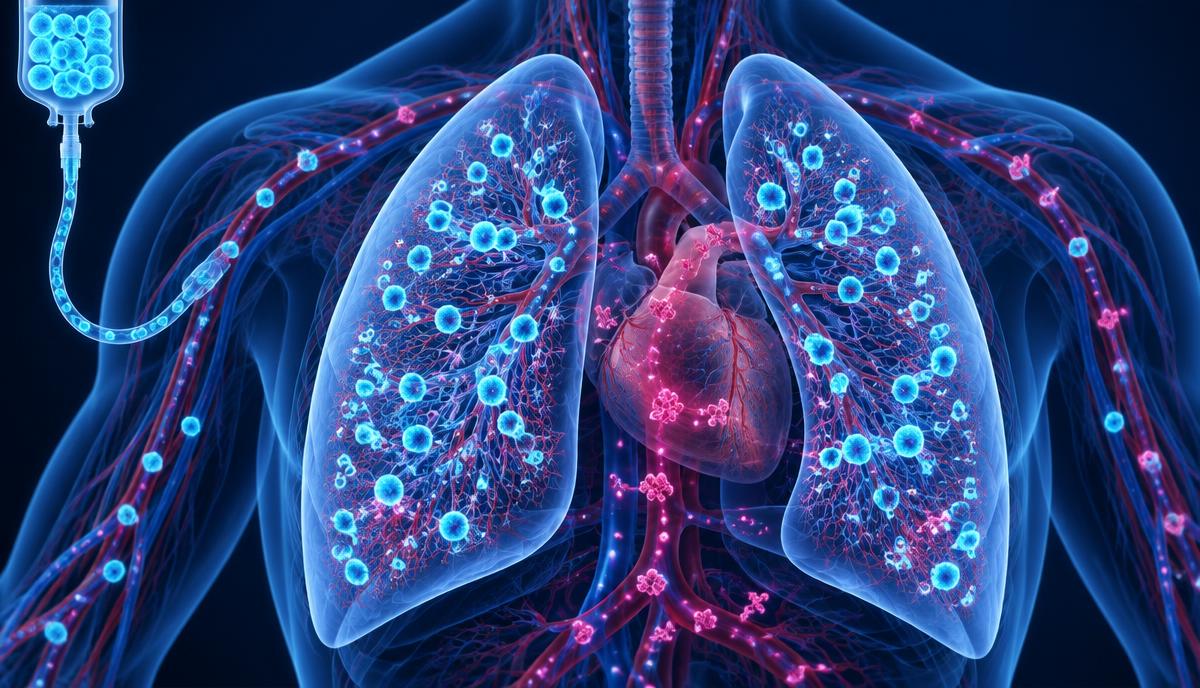
A common claim in stem cell marketing is that infused cells act like tiny repair crews traveling through the bloodstream, "finding" the injured knee, heart, or organ, and rebuilding tissue from within. Biodistribution studies tracking labeled cells after infusion show a more complicated picture: most intravenously infused MSCs never reach the target tissue at all, a large share gets trapped in the lungs within minutes, and the benefit observed is now mostly attributed to chemical signals cells release rather than cells physically relocating and rebuilding.
The Pulmonary First-Pass Effect
The "pulmonary first-pass effect" (Fischer et al., Stem Cells and Development, 2009): the pulmonary capillary bed is narrow enough that many relatively large infused MSCs get mechanically trapped on the first pass.
A traumatic brain injury model study found only an estimated 1.5–3.7% of IV-infused MSCs crossed the lungs to reach arterial circulation, ~0.3% reached the carotid artery, and only about 0.0005% reached brain tissue itself, with no motor or cognitive outcome improvement (Harting et al., Journal of Neurosurgery, 2009).
Cardiac Retention and Delivery Route
Cardiac studies: cardiac retention estimated around only 1% even at peak acute heart injury; intramyocardial injection retains more locally than intravenous or intracoronary, though still losing most of the dose (Jiang et al., General Thoracic and Cardiovascular Surgery, 2021).
Paracrine Signaling
The leading explanation for observed benefit: paracrine signaling — MSCs act more like a mobile pharmacy, releasing growth factors, cytokines, and extracellular vesicles (including exosomes) that recruit the body's own repair processes, calm local inflammation, and support blood vessel formation (Yin, Wang & Zhao, Biomarker Research, 2019).
Homing Is Real but Limited
Homing is real but narrower than the myth: chemokine signaling pathways like SDF-1/CXCR4 are genuine biological mechanisms that can draw some MSCs toward injury or inflammation, enhanced through cell priming, hypoxia conditioning, or biomaterials, but on its own it's weak and inconsistent; how much occurs depends on delivery route, cell source, and disease model.
Bottom Line
The idea that injected stem cells intelligently navigate to damaged tissue and rebuild it is an oversimplification not supported by current biodistribution data; most benefit is thought to come from paracrine signaling rather than cells physically migrating and replacing damaged tissue; true chemokine-driven homing exists but is limited, inconsistent, and dependent on delivery route and cell type.
Key Questions Answered
- Why are infused MSCs trapped in the lungs?
- The "pulmonary first-pass effect" (Fischer et al., Stem Cells and Development, 2009): the pulmonary capillary bed is narrow enough that many relatively large infused MSCs get mechanically trapped on the first pass.
- What is paracrine signaling?
- The leading explanation for observed benefit: paracrine signaling — MSCs act more like a mobile pharmacy, releasing growth factors, cytokines, and extracellular vesicles (including exosomes) that recruit the body's own repair processes, calm local inflammation, and support blood vessel formation (Yin, Wang & Zhao, Biomarker Research, 2019).
- Is MSC homing real?
- Homing is real but narrower than the myth: chemokine signaling pathways like SDF-1/CXCR4 are genuine biological mechanisms that can draw some MSCs toward injury or inflammation, enhanced through cell priming, hypoxia conditioning, or biomaterials, but on its own it's weak and inconsistent; how much occurs depends on delivery route, cell source, and disease model.
Sources
- Pulmonary passage is a major obstacle for intravenous stem cell delivery: the pulmonary first-pass effect, Fischer UM et al., Stem Cells and Development, 2009 — https://pubmed.ncbi.nlm.nih.gov/19099374/
- Intravenous mesenchymal stem cell therapy for traumatic brain injury: Laboratory investigation, Harting MT et al., Journal of Neurosurgery, 2009 — https://pmc.ncbi.nlm.nih.gov/articles/PMC2889620
- Exosomes from mesenchymal stem/stromal cells: a new therapeutic paradigm, Yin K, Wang S, Zhao RC, Biomarker Research, 2019 — https://pmc.ncbi.nlm.nih.gov/articles/PMC6450000
- Modifying strategies for SDF-1/CXCR4 interaction during mesenchymal stem cell transplantation, Jiang Q et al., General Thoracic and Cardiovascular Surgery, 2021 — https://pmc.ncbi.nlm.nih.gov/articles/PMC8732940
Related Articles
- Fundamentals
What Is Tissue Engineering? How Stem Cells and Scaffolds Work Together to Rebuild Tissue
How cells, scaffolds and signals combine to engineer tissue — from bladder and cornea grafts to the unresolved challenges of blood supply and manufacturing.
- Fundamentals
Types of Eye Disease: Which Ones Are Being Studied With Stem Cell Therapy?
Eye disease is many conditions. Map retinal degeneration, corneal disease, diabetic retinopathy and glaucoma against where stem cell research actually stands.
- Fundamentals
Protecting Cardiovascular Health As You Age: What the Evidence Actually Shows
What large trials show about protecting your heart as you age — and an honest look at where experimental stem cell therapies for cardiovascular disease stand.