What Are Immune-Related Adverse Events (irAEs)? How Checkpoint Inhibitors Can Trigger Autoimmune-Like Side Effects
What this article covers
- Why Checkpoint Inhibitors Cause Autoimmune-Like Toxicity
- PD-1, PD-L1, and CTLA-4 are "checkpoint" proteins that normally dial down T-cell activity once a threat has passed, preventing the immune system from turning on the body's own cells. Cancer cells often hijack these checkpoints to hide from immune attack.
- How Common Are irAEs?
- irAEs are not a rare or edge-case complication — they are the expected trade-off of taking the brakes off the immune system. Research syntheses of clinical trial data report that any-grade irAEs occur in roughly two-thirds to three-quarters of patients: about 66% of patients on anti-PD-1/PD-L1 monotherapy, roughly 72% on anti-CTLA-4 monotherapy, and a similar or higher share on combination regimens, according to a 2023 review in Frontiers in Immunology.
- Which Organs Are Affected, and What Do irAEs Look Like?
- Skin toxicity (rash, itching, occasionally vitiligo) is the most frequently reported irAE, affecting an estimated 7–18% of patients. Endocrine irAEs — most often thyroid dysfunction, but also adrenal insufficiency and hypophysitis — affect roughly 10% of patients and are often permanent, requiring lifelong hormone replacement even after the underlying inflammation resolves.
- Grading irAEs: From Mild to Life-Threatening
- Oncologists grade irAEs using the same Common Terminology Criteria for Adverse Events (CTCAE) scale used across oncology, from Grade 1 (mild, little disruption to daily life) through Grade 5 (death). Grade 2 (moderate) symptoms typically interfere with daily activities; Grade 3 (severe) often requires hospitalization; and Grade 4 (life-threatening) requires urgent intervention.
- How Are irAEs Treated?
- Management follows severity-based guidelines from ASCO and other oncology societies. For Grade 1 toxicity, checkpoint inhibitor therapy usually continues with close monitoring and no steroids.
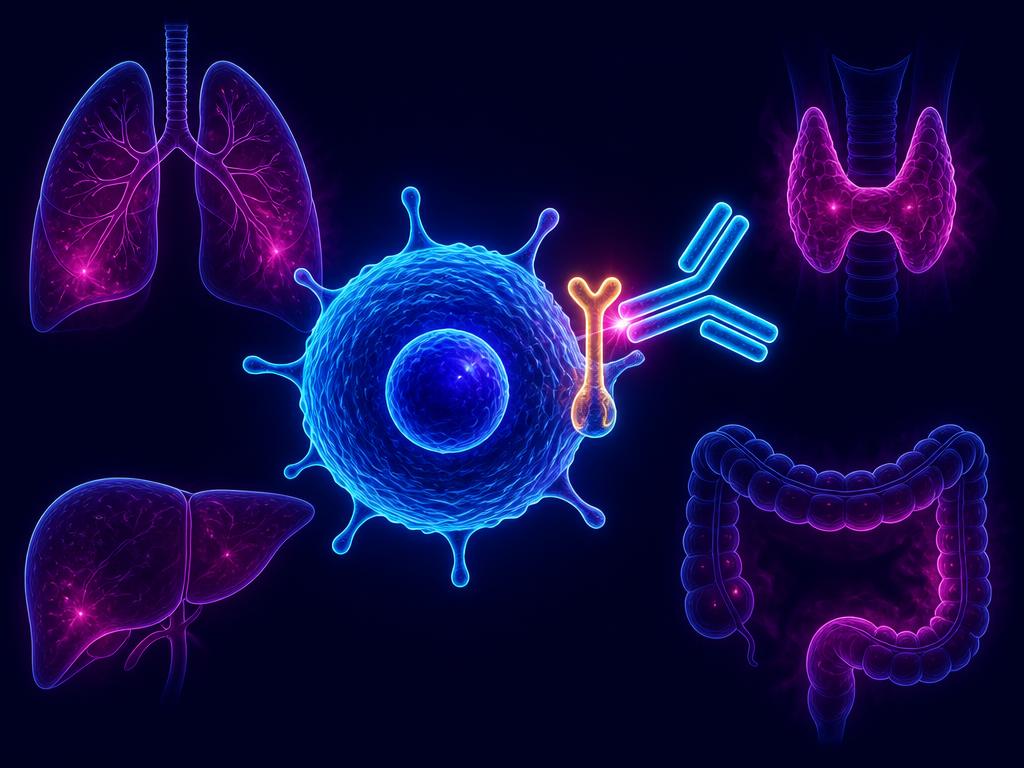
Checkpoint inhibitors — drugs that block PD-1, PD-L1, or CTLA-4 — have transformed treatment for melanoma, lung cancer, kidney cancer, and a growing list of other tumors by releasing the brakes that keep T cells from attacking cancer. But those same brakes normally protect healthy tissue from the immune system, so releasing them can let T cells attack the colon, lungs, liver, skin, or hormone glands as if they were foreign. This article explains what immune-related adverse events (irAEs) are, how common and how severe they actually are, how doctors grade and manage them, and what current evidence does — and doesn't — say about a possible link between developing irAEs and treatment working better.
Why Checkpoint Inhibitors Cause Autoimmune-Like Toxicity
PD-1, PD-L1, and CTLA-4 are "checkpoint" proteins that normally dial down T-cell activity once a threat has passed, preventing the immune system from turning on the body's own cells. Cancer cells often hijack these checkpoints to hide from immune attack. Checkpoint inhibitor drugs block that hijacking, unleashing T cells against the tumor — but the same loss of restraint can let T cells lose tolerance for normal, healthy tissue. The result is inflammation that looks and behaves like an autoimmune disease: colitis resembling inflammatory bowel disease, pneumonitis resembling interstitial lung disease, hepatitis, skin rashes, and endocrine gland inflammation (thyroiditis, hypophysitis, adrenalitis, and autoimmune diabetes). This is a distinct mechanism from cytokine release syndrome or neurotoxicity seen with CAR T-cell therapy — irAEs stem from a breakdown in self-tolerance rather than a cytokine storm from rapidly proliferating engineered cells.
How Common Are irAEs?
irAEs are not a rare or edge-case complication — they are the expected trade-off of taking the brakes off the immune system. Research syntheses of clinical trial data report that any-grade irAEs occur in roughly two-thirds to three-quarters of patients: about 66% of patients on anti-PD-1/PD-L1 monotherapy, roughly 72% on anti-CTLA-4 monotherapy, and a similar or higher share on combination regimens, according to a 2023 review in Frontiers in Immunology. Severity matters more than frequency, though. Grade 3-or-higher (severe) irAEs occur in about 14% of patients on PD-1/PD-L1 monotherapy versus roughly 24% on CTLA-4 monotherapy, with combination therapy (e.g., nivolumab plus ipilimumab) carrying meaningfully higher risk than either drug alone — one meta-analysis found combination therapy raised the odds of all-grade colitis roughly tenfold and high-grade colitis more than twelvefold compared with PD-1 monotherapy. In short: most patients will notice something, most of what they notice will be mild, but the risk of a serious event rises substantially when CTLA-4 blockade is added to the regimen.
Which Organs Are Affected, and What Do irAEs Look Like?
Skin toxicity (rash, itching, occasionally vitiligo) is the most frequently reported irAE, affecting an estimated 7–18% of patients. Endocrine irAEs — most often thyroid dysfunction, but also adrenal insufficiency and hypophysitis — affect roughly 10% of patients and are often permanent, requiring lifelong hormone replacement even after the underlying inflammation resolves. Gastrointestinal irAEs (diarrhea and colitis) are common and can range from mild loose stools to severe, hospitalization-requiring colitis. Pneumonitis (lung inflammation) affects roughly 3% of patients on monotherapy but rises with combination therapy, and hepatitis affects an estimated 1–3% of patients on a single checkpoint inhibitor but as many as 20% on combination therapy, per figures cited by the Cancer Research Institute. Rarer but more dangerous irAEs include myocarditis (heart muscle inflammation) and neurologic toxicity; these occur far less often but carry a disproportionately high risk of severe outcomes.
Grading irAEs: From Mild to Life-Threatening
Oncologists grade irAEs using the same Common Terminology Criteria for Adverse Events (CTCAE) scale used across oncology, from Grade 1 (mild, little disruption to daily life) through Grade 5 (death). Grade 2 (moderate) symptoms typically interfere with daily activities; Grade 3 (severe) often requires hospitalization; and Grade 4 (life-threatening) requires urgent intervention. This grading isn't just descriptive — it directly determines what happens to a patient's cancer treatment next.
How Are irAEs Treated?
Management follows severity-based guidelines from ASCO and other oncology societies. For Grade 1 toxicity, checkpoint inhibitor therapy usually continues with close monitoring and no steroids. For Grade 2, therapy is typically paused and moderate-dose corticosteroids (about 0.5–1 mg/kg/day of prednisone or equivalent) are started, with treatment potentially resuming once symptoms return to Grade 1 or better. Grade 3 toxicity generally means discontinuing the checkpoint inhibitor and starting high-dose corticosteroids (roughly 1–2 mg/kg/day), tapered slowly over four to six weeks; if there's no improvement within 48–72 hours, oncologists add second-line immunosuppressants such as infliximab, mycophenolate mofetil, vedolizumab, or tocilizumab depending on the organ involved. Grade 4 toxicity usually means permanently stopping the checkpoint inhibitor, with the notable exception of endocrinopathies, which can often be managed indefinitely with hormone replacement rather than requiring the cancer treatment itself to stop for good. The encouraging reality is that the large majority of irAEs — the mild-to-moderate cases that make up most of the roughly two-thirds to three-quarters of patients affected — resolve with this stepped approach and prompt recognition.
The Rare but Real Fatality Risk
Severe irAEs are uncommon, and fatal ones are rarer still, but they are real and worth stating plainly. A systematic review and meta-analysis published in JAMA Oncology, analyzing 112 clinical trials and over 19,000 patients, found fatal toxicity rates of about 0.36% with anti-PD-1 drugs, 0.38% with anti-PD-L1 drugs, 1.08% with anti-CTLA-4 monotherapy, and 1.23% with combination PD-1/CTLA-4 therapy. The organs responsible for fatal cases differ by drug class: colitis accounted for the majority of CTLA-4-related deaths, pneumonitis was the leading cause with PD-1/PD-L1 monotherapy, and myocarditis featured prominently in combination-therapy deaths despite being a rare event overall — myocarditis carries the highest fatality rate of any single irAE once it occurs, underscoring why cardiac symptoms during checkpoint inhibitor therapy are treated as a medical emergency.
A Possible Silver Lining, Held to the Same Evidence Standard
One of the more genuinely encouraging threads of ongoing research is the observation, in several retrospective studies, that patients who develop irAEs sometimes have better outcomes than those who don't. A 2026 study in Frontiers in Immunology following 385 checkpoint inhibitor patients found that the 47% who developed an irAE had a median overall survival of about 57 months versus roughly 42 months for those who didn't (adjusted hazard ratio 0.673) — consistent with the idea that a more immunologically active patient may fight both the tumor and normal tissue more vigorously. That said, this remains an association, not a proven causal relationship, and researchers including those at the National Cancer Institute have been explicit that "there isn't any definitive evidence yet" that having an irAE is a reliable sign treatment is working. Many patients benefit substantially from checkpoint inhibitors without ever developing a noticeable irAE, so the absence of side effects should never be read as a sign that treatment has failed.
Bottom Line
irAEs are a common, mechanistically distinct consequence of releasing the immune system's brakes with checkpoint inhibitors, and most cases are mild-to-moderate, reversible, and manageable with the same stepped protocol of holding therapy and using corticosteroids that oncology teams apply across organ systems. Severe and fatal irAEs are real risks — myocarditis, severe colitis, and pneumonitis account for the small but non-negligible fatality rates seen in large meta-analyses, and vigilant monitoring during and after treatment matters. At the same time, the field's growing (though still unproven) interest in irAEs as a possible marker of a more active anti-tumor immune response is a genuinely hopeful thread, and it should be communicated honestly: promising, but not yet something patients or clinicians can rely on.
Key Questions Answered
- How common are immune-related adverse events?
- Any-grade irAEs occur in roughly two-thirds to three-quarters of patients — about 66% on anti-PD-1/PD-L1 monotherapy and roughly 72% on anti-CTLA-4 monotherapy. Severe (grade 3 or higher) events are much less common: about 14% with PD-1/PD-L1 monotherapy versus roughly 24% with CTLA-4 monotherapy.
- How are irAEs treated?
- Management is severity-based. Grade 1 usually continues therapy with monitoring. Grade 2 typically pauses therapy and adds moderate-dose corticosteroids. Grade 3 generally means discontinuing the inhibitor and starting high-dose steroids tapered over four to six weeks, adding second-line immunosuppressants such as infliximab or tocilizumab if there's no improvement in 48-72 hours. Grade 4 usually means permanently stopping — except endocrinopathies, often managed with hormone replacement.
- How often are irAEs fatal?
- A JAMA Oncology meta-analysis of 112 trials and over 19,000 patients found fatal toxicity rates of about 0.36% with anti-PD-1, 0.38% with anti-PD-L1, 1.08% with anti-CTLA-4 monotherapy, and 1.23% with combination PD-1/CTLA-4 therapy. Colitis, pneumonitis, and myocarditis were the leading causes depending on drug class.
- Does having an irAE mean the treatment is working?
- It's an association, not a proven cause. A 2026 Frontiers in Immunology study of 385 patients found median overall survival of about 57 months among those who developed an irAE versus roughly 42 months among those who didn't. But researchers including those at the National Cancer Institute say there isn't definitive evidence yet, and many patients benefit without ever developing a noticeable irAE.
Sources
- Investigating the Side Effects of Cancer Immunotherapy — National Cancer Institute (Cancer Currents Blog), 2019 — https://www.cancer.gov/news-events/cancer-currents-blog/2019/cancer-immunotherapy-investigating-side-effects
- Side Effects of Immunotherapy: What to Know — Cancer Research Institute, 2025 — https://www.cancerresearch.org/immunotherapy-side-effects
- Management of Immune-Related Adverse Events in Patients Treated With Immune Checkpoint Inhibitor Therapy: ASCO Guideline Update — Journal of Clinical Oncology (ASCO), 2021 — https://ascopubs.org/doi/10.1200/JCO.21.01440
- Immune-related adverse events of immune checkpoint inhibitors: a review — Frontiers in Immunology, 2023 — https://www.frontiersin.org/journals/immunology/articles/10.3389/fimmu.2023.1167975/full
- Fatal Toxic Effects Associated With Immune Checkpoint Inhibitors: A Systematic Review and Meta-analysis — JAMA Oncology, 2018 — https://jamanetwork.com/journals/jamaoncology/fullarticle/2701721
- Development of immune-related adverse events is associated with improved survival outcomes in cancer patients receiving immune checkpoint inhibitors — Frontiers in Immunology, 2026 — https://www.frontiersin.org/journals/immunology/articles/10.3389/fimmu.2026.1910109/full
Related Articles
- Fundamentals
How Are CAR-T Cells Actually Engineered? Inside the Vector and Gene-Editing Process
What a chimeric antigen receptor really is, how viral vectors splice its gene into a T cell's DNA, and how CRISPR is being used to build off-the-shelf CAR-T.
- Fundamentals
What Does Minimal Residual Disease (MRD) Testing Actually Mean for Cancer Immunotherapy Patients?
MRD testing can find a single cancer cell among a million healthy ones — and it's reshaping both monitoring after CAR-T and the FDA's approval pathway. But MRD-negative is a detection limit, not a cure.
- Fundamentals
What Is Antigen Escape, and Why Do Some Cancers Stop Responding to CAR-T Therapy?
When a cancer stops responding to CAR-T therapy, the T cells often aren't the problem — the tumor itself has changed. This is antigen escape, a distinct resistance mechanism from T-cell exhaustion, and researchers are now building next-generation CAR-T therapies specifically to close the door on it.