What Is Stem Cell Cryopreservation? How Cells Are Frozen, Stored, and Thawed Without Being Destroyed
What this article covers
- Why Freezing Normally Kills Cells
- " As ice crystals form outside and eventually inside a cell, they can physically puncture and shred delicate structures like the cell membrane and internal organelles — direct mechanical damage that a cell often cannot survive intact. A second, subtler problem happens at the same time: as pure water is pulled out of solution to form ice, everything dissolved in the remaining liquid — salts, proteins, sugars — becomes more and more concentrated.
- What Cryoprotectants Actually Do
- The breakthrough that made modern cell banking possible was the cryoprotective agent (CPA) — a class of chemicals added to the freezing solution before cooling begins. Dimethyl sulfoxide, or DMSO, is the most widely used cryoprotectant in stem cell and cord blood banking.
- Slow Freezing vs. Vitrification
- Labs generally use one of two broad strategies to get cells from body temperature down to storage temperature. The first, controlled-rate (slow) freezing, cools cells gradually — often around 1°C per minute — using comparatively modest cryoprotectant concentrations.
- Where and How Frozen Cells Are Stored
- Once frozen, stem cell products are typically kept in liquid nitrogen at temperatures approaching -196°C in the liquid phase, or around -140°C in the colder regions of vapor-phase nitrogen storage. At these temperatures, biological and chemical activity is essentially frozen in place, which is why properly stored cells can, in principle, remain stable for very long periods.
- How Long Can Cells Really Stay Frozen?
- This is one of the genuinely reassuring parts of the science. Long-term follow-up studies on banked cord blood — some of the oldest continuously stored human stem cell products in the world — have found that cells can remain viable and functional for remarkably long stretches.
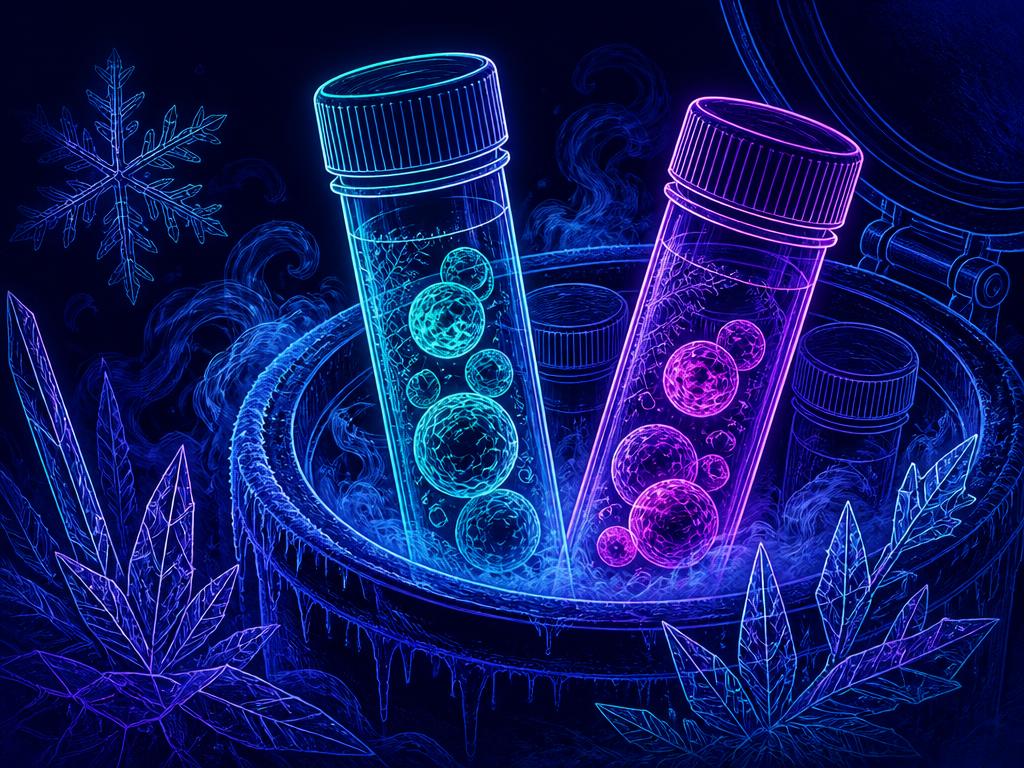
Freezing a living cell sounds simple, but water expands and crystallizes as it turns to ice, and a naked cell caught in that process is usually torn apart from the inside. Making stem cells survive being frozen — and come back to life, dividing and functioning normally, sometimes decades later — required scientists to solve a specific physics problem: how to remove or reorganize the water inside and around a cell so ice never gets the chance to form in a damaging way. This article walks through that science in plain language: why freezing is normally lethal to cells, what cryoprotectant chemicals like DMSO actually do, the two main freezing strategies labs use, how cells are stored at nearly -196°C, and how researchers verify that cells actually survived the trip before ever using them.
Why Freezing Normally Kills Cells
Cells are mostly water, and when water freezes, it doesn't freeze "quietly." As ice crystals form outside and eventually inside a cell, they can physically puncture and shred delicate structures like the cell membrane and internal organelles — direct mechanical damage that a cell often cannot survive intact. A second, subtler problem happens at the same time: as pure water is pulled out of solution to form ice, everything dissolved in the remaining liquid — salts, proteins, sugars — becomes more and more concentrated. This is called osmotic or solute stress, and it can be just as damaging as the ice itself, disrupting the delicate chemical balance a cell needs to function. Left unprotected, most mammalian cells simply cannot survive this one-two punch of physical rupture and chemical shock.
What Cryoprotectants Actually Do
The breakthrough that made modern cell banking possible was the cryoprotective agent (CPA) — a class of chemicals added to the freezing solution before cooling begins. Dimethyl sulfoxide, or DMSO, is the most widely used cryoprotectant in stem cell and cord blood banking. It works partly by lowering the freezing point of the surrounding water through hydrogen bonding, which reduces the amount of water available to form damaging ice crystals, and partly by increasing the permeability of the cell membrane so that water can move out of the cell more easily during cooling, helping the cell dehydrate gradually rather than being crushed by ice forming inside it.
DMSO is effective, but it isn't perfect, and researchers are candid about its trade-offs. At the concentrations needed for effective freezing, DMSO can be toxic to cells if left at warm temperatures too long, and when cryopreserved products are thawed and infused directly into patients (as with cord blood or bone marrow transplants), residual DMSO has been linked to infusion-related side effects, and in rare cases more serious reactions have been reported in the clinical literature. This is why many transplant centers wash DMSO out of the product after thawing, and why researchers are actively studying lower-DMSO protocols and DMSO-free alternatives, such as trehalose (a natural sugar some organisms use to survive extreme drying and cold) and other macromolecular protectants. None of these alternatives has fully replaced DMSO yet, and the field still treats this as an area of active refinement rather than a solved problem.
Slow Freezing vs. Vitrification
Labs generally use one of two broad strategies to get cells from body temperature down to storage temperature. The first, controlled-rate (slow) freezing, cools cells gradually — often around 1°C per minute — using comparatively modest cryoprotectant concentrations. This slow pace gives cells time to dehydrate in a controlled way before the surrounding solution solidifies, minimizing internal ice formation.
The second strategy, vitrification, takes the opposite approach: much higher cryoprotectant concentrations combined with extremely rapid cooling, fast enough that the solution turns into a glass-like solid rather than forming crystalline ice at all. Because there's no crystallization step, vitrification can avoid ice-crystal damage almost entirely, though it requires higher CPA concentrations and very precise, fast handling to work reliably. Both methods are used in stem cell research and banking today, and which one is preferred often depends on the specific cell type and application.
Where and How Frozen Cells Are Stored
Once frozen, stem cell products are typically kept in liquid nitrogen at temperatures approaching -196°C in the liquid phase, or around -140°C in the colder regions of vapor-phase nitrogen storage. At these temperatures, biological and chemical activity is essentially frozen in place, which is why properly stored cells can, in principle, remain stable for very long periods. Some facilities use liquid-phase storage for maximum cold stability, while others prefer vapor-phase storage in part to reduce contamination risks between samples.
How Long Can Cells Really Stay Frozen?
This is one of the genuinely reassuring parts of the science. Long-term follow-up studies on banked cord blood — some of the oldest continuously stored human stem cell products in the world — have found that cells can remain viable and functional for remarkably long stretches. A 2024 analysis from the José Carreras Cord Blood Bank followed units stored for up to 29 years and found that total nucleated cell viability remained around 89%, with CD34+ stem cell viability around 91%, and concluded that the length of cryopreservation had no significant detrimental effect on engraftment after transplantation. A separate analysis of over 1,100 cord blood units from a major Korean public bank similarly found that up to 19 years of cryopreservation did not impair the units' hematopoietic progenitor function. In other words, when the freezing, storage, and thawing process is done well, stem cells aren't just "preserved" in a fragile, degrading sense — they can come back out working essentially as they went in, even after decades in the tank.
How Scientists Confirm Cells Survived
Because so much rides on a cell product actually working after thaw, labs don't just assume success — they test for it. The most basic check is a viability assay, commonly trypan blue exclusion, which relies on the fact that cells with intact membranes exclude the blue dye while damaged cells absorb it, giving a quick visual or automated count of live versus dead cells. For blood-forming stem cells specifically, flow cytometry is often used to measure the percentage of viable cells carrying the CD34 marker, a more specific readout than a general viability stain. Beyond simple viability, potency and functional assays — such as colony-forming assays that check whether thawed cells can still grow and divide into new cell colonies — are used to confirm the cells aren't just alive, but still biologically capable of doing their job. This layered testing approach is part of why regulators and clinicians can have confidence in cryopreserved cell products before they're ever given to a patient.
Bottom Line
Cryopreservation works because scientists learned to outsmart ice itself — using chemical cryoprotectants like DMSO to reduce and reorganize the water inside cells, then cooling either slowly and steadily or fast enough to skip crystallization entirely, before locking cells away at nearly -196°C where biological time effectively stops. The trade-offs are real and still being refined, particularly around DMSO's toxicity and the search for gentler alternatives. But the core achievement is remarkably solid: decades of follow-up on banked cord blood show that properly frozen, stored, and thawed stem cells can remain viable and functional for 20, even nearly 30, years — and multiple layers of post-thaw testing exist specifically to confirm that before those cells are ever used.
Key Questions Answered
- Why does freezing normally kill cells?
- Ice crystals forming outside and inside a cell can physically puncture and shred the membrane and internal organelles. At the same time, as pure water is pulled out to form ice, dissolved salts, proteins, and sugars become increasingly concentrated — osmotic or solute stress that disrupts the cell's chemical balance.
- What does DMSO do?
- DMSO, the most widely used cryoprotectant in stem cell and cord blood banking, lowers the freezing point of the surrounding water through hydrogen bonding, reducing the water available to form damaging ice, and increases cell membrane permeability so water can leave the cell during cooling, letting it dehydrate gradually instead of being crushed by internal ice.
- What's the difference between slow freezing and vitrification?
- Controlled-rate (slow) freezing cools cells gradually — often about 1°C per minute — with modest cryoprotectant concentrations, giving cells time to dehydrate. Vitrification uses much higher cryoprotectant concentrations and extremely rapid cooling so the solution turns glass-like rather than forming crystalline ice at all.
- How long can stem cells stay frozen?
- A 2024 analysis from the José Carreras Cord Blood Bank followed units stored up to 29 years and found total nucleated cell viability around 89% and CD34+ viability around 91%, with no significant detrimental effect of storage length on engraftment. A separate analysis of over 1,100 Korean cord blood units found up to 19 years of cryopreservation did not impair progenitor function.
Sources
- Cryopreservation: An Overview of Principles and Cell-Specific Considerations — Journal of Investigative Surgery / PMC, National Library of Medicine, 2021 — https://pmc.ncbi.nlm.nih.gov/articles/PMC7995302/
- Strategies in developing dimethyl sulfoxide (DMSO)-free cryopreservation protocols for biotherapeutics — PMC, National Library of Medicine, 2022 — https://pmc.ncbi.nlm.nih.gov/articles/PMC9579275/
- Long-Term Stability of Cord Blood Units After 29 Years of Cryopreservation: Follow-Up Data From the José Carreras Cord Blood Bank — Stem Cells Translational Medicine / Oxford Academic, 2024 — https://academic.oup.com/stcltm/article/13/1/30/7344334
- Up to 19-year cryopreservation does not impair hematopoietic progenitor function in cord blood — PMC, National Library of Medicine, 2024 — https://pmc.ncbi.nlm.nih.gov/articles/PMC13505624/
- Dimethyl sulfoxide toxicity in umbilical cord blood transplantation in patients less than 4.5 kilos of weight — PMC, National Library of Medicine, 2023 — https://pmc.ncbi.nlm.nih.gov/articles/PMC9938455/
- DMSO removal reduces stem-cell infusion-related toxicity and allows excellent engraftment of cryopreserved unrelated cord blood and autologous stem cells — Biology of Blood and Marrow Transplantation (ASTCT journal), 2003 — https://www.astctjournal.org/article/S1083-8791(03)00587-1/fulltext
- Trypan Blue Viability as an Alternative to CD34-Specific Viability for Frozen-Thawed Hematopoietic Progenitor Cell Products — Biology of Blood and Marrow Transplantation (ASTCT journal), 2017 — https://www.astctjournal.org/article/S1083-8791(17)31223-5/fulltext
- Assessment and comparison of viability assays for cellular products — Cytotherapy / International Society for Cell & Gene Therapy (ISCT), 2023 — https://www.isct-cytotherapy.org/article/S1465-3249(23)01100-3/fulltext
- Trypan Blue Exclusion Test of Cell Viability — PMC, National Library of Medicine (NIH) — https://pmc.ncbi.nlm.nih.gov/articles/PMC6716531/
Related Articles
- Fundamentals
What Is RMAT Designation, and How Does It Speed Up Stem Cell Therapy Approval?
RMAT designation fast-tracks promising regenerative medicine products through FDA development — but it is not approval, and it doesn't certify a therapy works. Here's what the designation actually means.
- Fundamentals
What Is HLA Matching, and Why Does It Matter for Stem Cell Transplants?
HLA matching decides who can receive a donor stem cell transplant and how risky it is. Here's what HLA is, how matches are graded, and why MSC therapies skip it.
- Fundamentals
What Is Stem Cell Self-Renewal, and Why Does It Matter?
Self-renewal — not potency — is what makes a stem cell a stem cell. How symmetric and asymmetric division work, why niche signals matter, and what it means for manufacturing and cancer.