What Is the Tumor Microenvironment, and Why Does It Blunt Immunotherapy?
What this article covers
- What Makes Up the Tumor Microenvironment
- The TME includes cancer cells themselves, but also the blood vessels that feed them, the extracellular matrix (ECM) and fibroblasts that give tissue its structure, and a mix of immune cells — some meant to fight the tumor, others hijacked to protect it. Three immunosuppressive cell types are central to this story.
- Why Some Tumors Are "Cold" and Others Are "Hot"
- " Hot tumors are densely infiltrated by cytotoxic T cells, sometimes organizing into tertiary lymphoid structures, and sit inside a proinflammatory microenvironment — these are the tumors most likely to respond to checkpoint inhibitors. Cold tumors, by contrast, resist immune attack through what one recent review frames as three linked strategies: camouflage (poor antigen presentation, disrupted chemokine signaling, and physical barriers like abnormal blood vessels and fibrotic matrix that keep T cells out), coercion (active suppression via Tregs, TAMs, MDSCs, and metabolic byproducts that starve nearby immune cells), and cytoprotection (resistance to the cell-death pathways immune cells rely on to kill tumor cells).
- How the TME Physically and Metabolically Blocks Immune Attack
- Beyond cell-to-cell suppression, the TME creates a hostile physical and chemical terrain. As tumors grow beyond roughly 1–2 millimeters, oxygen diffusion becomes insufficient and regions of the tumor become hypoxic.
- Strategies to Remodel the TME
- This is where the field's genuine momentum lies, and it deserves real attention. Rather than treating the TME as a fixed obstacle, researchers are now developing a broad toolkit to convert cold tumors hot and make existing immunotherapies work in tumors that previously ignored them.
- Bottom Line
- The tumor microenvironment explains much of why immunotherapy's benefits remain uneven across cancer types and patients: it's not usually that the immune system can't recognize a tumor, but that the tumor has built a hostile, well-defended neighborhood around itself. The encouraging news is that this neighborhood is not immutable — vascular normalization is already improving outcomes in approved regimens, and a substantial pipeline of TME-targeted combination strategies is advancing through early and mid-stage trials.
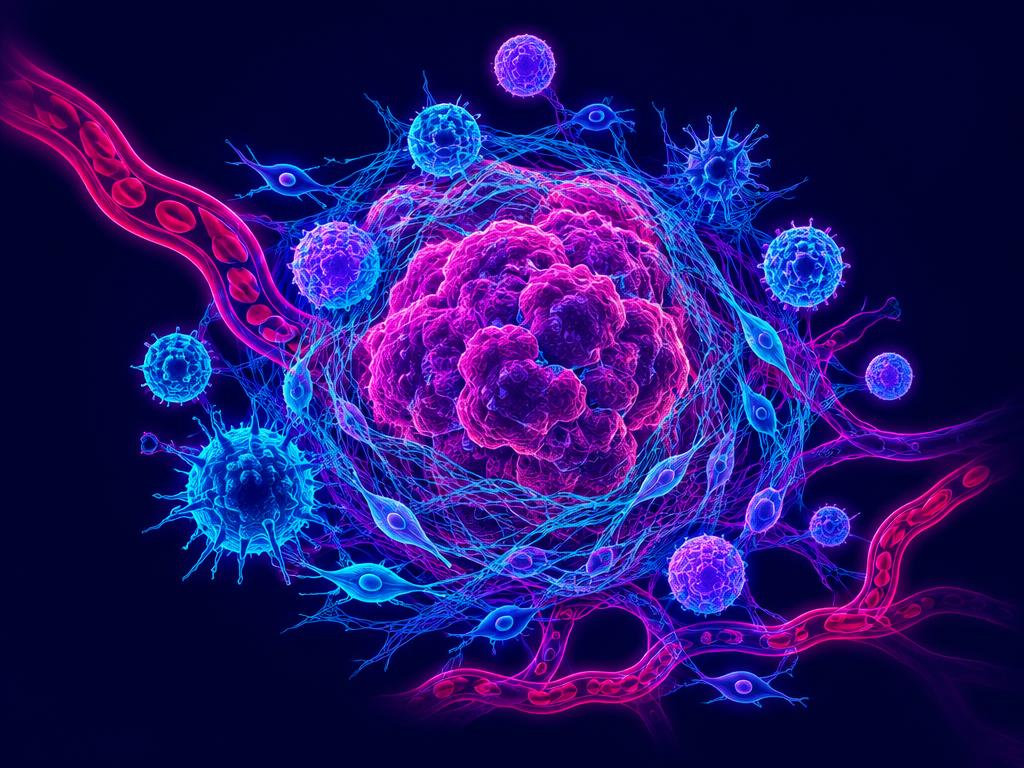
Checkpoint inhibitors and CAR-T cells can produce remarkable, durable remissions — but only in a subset of patients and cancer types. The reason usually isn't a flaw in the drug itself; it's the neighborhood the tumor has built around itself. Oncologists call this neighborhood the tumor microenvironment (TME): the ecosystem of immune cells, blood vessels, connective tissue, and chemical signals that surrounds and infiltrates a tumor. A researcher at MD Anderson Cancer Center offers a useful image: "You can think of the tumor as a house and the microenvironment as its yard" — the two are in constant, active dialogue. Many tumors don't just tolerate the immune system nearby; they actively reprogram that yard into a fortress that excludes, exhausts, or disables the very immune cells that immunotherapy is designed to unleash. Understanding the TME is the key to understanding why immunotherapy is not a single on/off switch, but a fight that plays out differently in every tumor's home turf — and why researchers increasingly believe the next major gains will come from remodeling the terrain, not just arming the soldiers.
What Makes Up the Tumor Microenvironment
The TME includes cancer cells themselves, but also the blood vessels that feed them, the extracellular matrix (ECM) and fibroblasts that give tissue its structure, and a mix of immune cells — some meant to fight the tumor, others hijacked to protect it. Three immunosuppressive cell types are central to this story. Regulatory T cells (Tregs) are normally responsible for keeping the immune system from attacking the body's own tissue; tumors recruit and expand Tregs to suppress the cancer-killing CD8+ T cells nearby. Myeloid-derived suppressor cells (MDSCs) are immature immune cells that repress T-cell responses, help build new blood vessels via VEGF, and promote metastasis. And tumor-associated macrophages (TAMs) — often polarized into an "M2," wound-healing-like state rather than an inflammatory one — suppress immune attack, support angiogenesis, and are linked to worse prognosis across many cancers. Layered on top of these cells is a dense stroma of cancer-associated fibroblasts and extracellular matrix that physically stiffens tissue, obstructs drug penetration, and helps wall the tumor off from immune surveillance.
Why Some Tumors Are "Cold" and Others Are "Hot"
Oncologists describe tumors on a spectrum from "hot" to "cold." Hot tumors are densely infiltrated by cytotoxic T cells, sometimes organizing into tertiary lymphoid structures, and sit inside a proinflammatory microenvironment — these are the tumors most likely to respond to checkpoint inhibitors. Cold tumors, by contrast, resist immune attack through what one recent review frames as three linked strategies: camouflage (poor antigen presentation, disrupted chemokine signaling, and physical barriers like abnormal blood vessels and fibrotic matrix that keep T cells out), coercion (active suppression via Tregs, TAMs, MDSCs, and metabolic byproducts that starve nearby immune cells), and cytoprotection (resistance to the cell-death pathways immune cells rely on to kill tumor cells). This framework helps explain a pattern oncologists see constantly in practice: two patients with what looks like "the same" cancer type can have wildly different responses to an identical checkpoint inhibitor, because one tumor is hot and the other is cold.
How the TME Physically and Metabolically Blocks Immune Attack
Beyond cell-to-cell suppression, the TME creates a hostile physical and chemical terrain. As tumors grow beyond roughly 1–2 millimeters, oxygen diffusion becomes insufficient and regions of the tumor become hypoxic. This triggers hypoxia-inducible factors (HIFs) that, paradoxically, help the tumor survive and spread — promoting new (but poorly organized) blood vessel growth while shifting tumor metabolism toward glycolysis, a process that floods the surrounding tissue with lactate and acidifies it, further disabling nearby immune cells. Compounding this, tumor blood vessels are notoriously abnormal: leaky, tortuous, and inefficient, a state that limits both drug delivery and immune cell trafficking into the tumor core. Meanwhile, tumor cells themselves often directly display PD-L1, the checkpoint ligand, on their surface — a signal that engages the PD-1 receptor on incoming T cells and switches them off on contact. PD-L1 expression is itself shaped by the microenvironment; inflammatory signals like interferon-gamma from nearby immune cells can actually induce tumor cells to upregulate PD-L1 as a defensive countermeasure, meaning the very immune attack a tumor faces can trigger its own shield.
Strategies to Remodel the TME
This is where the field's genuine momentum lies, and it deserves real attention. Rather than treating the TME as a fixed obstacle, researchers are now developing a broad toolkit to convert cold tumors hot and make existing immunotherapies work in tumors that previously ignored them. Vascular normalization is one of the clearest clinical successes to date: low-dose anti-angiogenic therapy can improve blood vessel structure enough to reduce hypoxia and improve immune cell infiltration, rather than simply starving the tumor. This isn't theoretical — it's already approved practice. In the pivotal IMbrave150 trial, adding the anti-VEGF antibody bevacizumab to the checkpoint inhibitor atezolizumab nearly doubled response rates (30% vs. 11%) and extended median overall survival to 19.2 months versus 13.4 months with sorafenib alone in unresectable liver cancer — a striking, real-world demonstration that remodeling the vascular microenvironment can meaningfully amplify immunotherapy's reach. Other strategies are earlier-stage but promising: STING agonists delivered directly into tumors are showing early clinical signals of boosting T-cell infiltration alongside PD-1 blockade; metabolic approaches targeting IDO1 or lactate handling aim to relieve the chemical suppression starving T cells; and even the gut microbiome is under active investigation, with fecal microbiota transplants from immunotherapy responders showing early ability to resensitize previously resistant patients. The clear trend across this research is that combination strategies — addressing the vasculature, the suppressive cells, and the metabolic environment together — outperform any single lever pulled alone.
Bottom Line
The tumor microenvironment explains much of why immunotherapy's benefits remain uneven across cancer types and patients: it's not usually that the immune system can't recognize a tumor, but that the tumor has built a hostile, well-defended neighborhood around itself. The encouraging news is that this neighborhood is not immutable — vascular normalization is already improving outcomes in approved regimens, and a substantial pipeline of TME-targeted combination strategies is advancing through early and mid-stage trials. The sober caveat is equally real: converting a genuinely cold tumor into a hot one remains one of oncology's hardest unsolved problems, and most TME-remodeling approaches beyond anti-angiogenic combinations are still investigational, with efficacy and safety data still maturing. For patients and families evaluating immunotherapy options, understanding the TME is less about a single test result and more about recognizing that where a tumor sits on the hot-to-cold spectrum — and what's actively suppressing immunity around it — is often as important as the immunotherapy drug itself.
Sources
- Tumor microenvironment — NCI Dictionary of Cancer Terms, National Cancer Institute — https://www.cancer.gov/publications/dictionaries/cancer-terms/def/tumor-microenvironment
- What Is the Tumor Microenvironment? 3 Things to Know — MD Anderson Cancer Center — https://www.mdanderson.org/cancerwise/what-is-the-tumor-microenvironment-3-things-to-know.h00-159460056.html
- Turning cold tumors into hot tumors to ignite immunotherapy — Molecular Cancer (Springer Nature), 2025 — https://link.springer.com/article/10.1186/s12943-025-02477-6
- Cold and hot tumors: immunological determinants, cancer-immunity cycle dysregulation, and nanotechnology-driven therapeutic approaches — PMC, 2025 — https://pmc.ncbi.nlm.nih.gov/articles/PMC13481959/
- Role of the tumor microenvironment in PD-L1/PD-1-mediated tumor immune escape — Molecular Cancer, 2019 — https://molecular-cancer.biomedcentral.com/articles/10.1186/s12943-018-0928-4
- Immunotherapy in hepatocellular carcinoma: evaluation and management of adverse events associated with atezolizumab plus bevacizumab — PMC, 2021 — https://pmc.ncbi.nlm.nih.gov/articles/PMC8327224/
- Atezolizumab plus Bevacizumab in Unresectable Hepatocellular Carcinoma (IMbrave150) — New England Journal of Medicine, 2020 — https://www.nejm.org/doi/full/10.1056/NEJMoa1915745
Related Articles
- Fundamentals
What Are Immune-Related Adverse Events (irAEs)? How Checkpoint Inhibitors Can Trigger Autoimmune-Like Side Effects
Checkpoint inhibitors release the immune system's brakes — and sometimes the immune system turns on healthy tissue. Here's how common irAEs really are, how oncologists grade and treat them, and what the survival association does and doesn't prove.
- Fundamentals
How Are CAR-T Cells Actually Engineered? Inside the Vector and Gene-Editing Process
What a chimeric antigen receptor really is, how viral vectors splice its gene into a T cell's DNA, and how CRISPR is being used to build off-the-shelf CAR-T.
- Fundamentals
What Does Minimal Residual Disease (MRD) Testing Actually Mean for Cancer Immunotherapy Patients?
MRD testing can find a single cancer cell among a million healthy ones — and it's reshaping both monitoring after CAR-T and the FDA's approval pathway. But MRD-negative is a detection limit, not a cure.