What Stem Cell Clinics Mean by "Outcomes Data" — And Why It Isn't the Same as Clinical Evidence
What this article covers
- What a Clinic Means by "Outcomes Data"
- When a stem cell clinic says it tracks "outcomes," it typically means it has collected some form of follow-up information from patients who received treatment there — often a questionnaire asking patients to rate their pain or function before and after the procedure, sometimes collected by phone or online survey weeks or months later. " It is real data in the sense that someone collected it, but it is observational, self-reported, and almost never independently verified, peer-reviewed, or published in a format other researchers can scrutinize.
- Why This Isn't the Same as Clinical Evidence
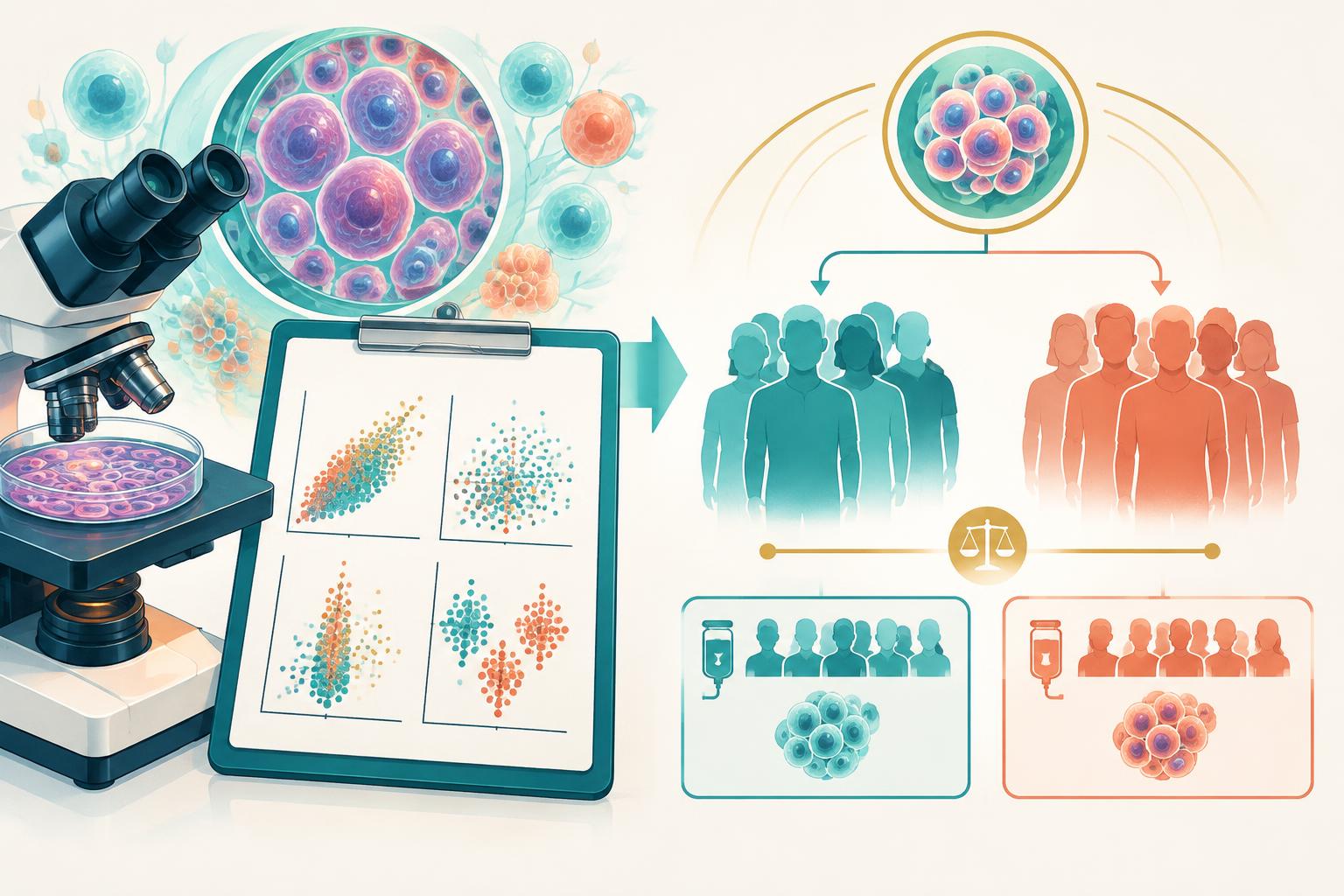
- A legitimate clinical trial — the kind the FDA and international regulators rely on to approve a treatment — is built specifically to rule out the many non-treatment reasons a patient might report feeling better. Clinic outcomes data typically lacks nearly all of these safeguards.
- What Legitimate Evidence Looks Like Instead
- gov (or an equivalent international registry), ideally randomized and controlled, with results published in a peer-reviewed journal where independent experts have scrutinized the study's methodology before publication. The strongest evidence typically comes from randomized controlled trials — where some patients receive the real treatment and others receive a placebo or standard-of-care comparison, with neither side knowing which they got — because this design is the best tool available for separating a treatment's real effect from the body's own capacity to heal, the placebo effect, and statistical noise.
- Questions to Ask a Clinic About Its Outcomes Claims
- If a clinic cites outcomes data or a success rate, it's reasonable to ask: Is this published anywhere a researcher outside the clinic can review it? Was there a control group?
- Bottom Line
- A clinic's internal outcomes tracking isn't meaningless, but it is a much weaker form of evidence than a peer-reviewed clinical trial, and it shouldn't be mistaken for proof that a treatment works. Before relying on a clinic's own numbers, ask whether that data has been independently reviewed, controlled, and published — and treat the absence of a good answer as useful information in itself.
Many stem cell clinics now cite "outcomes data," a "patient registry," or an internal "success rate" as evidence their treatment works — numbers that sound scientific and are often presented confidently on clinic websites. But a clinic's own outcomes tracking is a fundamentally different kind of evidence than a peer-reviewed clinical trial, and the difference matters enormously when you're deciding whether a treatment is likely to help you. This article explains what these terms actually mean, why they fall short of real clinical evidence, and what to ask instead.
What a Clinic Means by "Outcomes Data"
When a stem cell clinic says it tracks "outcomes," it typically means it has collected some form of follow-up information from patients who received treatment there — often a questionnaire asking patients to rate their pain or function before and after the procedure, sometimes collected by phone or online survey weeks or months later. Some clinics describe this as a "patient registry." It is real data in the sense that someone collected it, but it is observational, self-reported, and almost never independently verified, peer-reviewed, or published in a format other researchers can scrutinize.
Why This Isn't the Same as Clinical Evidence
A legitimate clinical trial — the kind the FDA and international regulators rely on to approve a treatment — is built specifically to rule out the many non-treatment reasons a patient might report feeling better. Clinic outcomes data typically lacks nearly all of these safeguards.
There is usually no control or comparison group, so there's no way to know whether patients would have improved anyway, through natural healing, physical therapy, or simply the passage of time. Most musculoskeletal conditions, for example, fluctuate and often improve somewhat on their own regardless of what treatment is given.
There is usually no blinding, meaning both the patient and the clinic staff collecting follow-up data know a treatment was given, which opens the door to the placebo effect — a well-documented phenomenon in which patients report real symptom improvement after any medical intervention, including sham or inactive ones, particularly for pain-related conditions.
Follow-up is typically short and incomplete. Clinics often report results from whichever patients responded to a follow-up survey, not from everyone treated — a pattern researchers call "response bias," since patients who didn't improve are often less likely to bother responding at all, skewing the reported numbers upward.
There's a financial incentive built into the reporting. A clinic reporting its own treatment's success, without independent oversight, has a direct commercial interest in a favorable number — a conflict of interest that peer review and independent trial monitoring are specifically designed to counteract.
What Legitimate Evidence Looks Like Instead
Real clinical evidence comes from trials registered on ClinicalTrials.gov (or an equivalent international registry), ideally randomized and controlled, with results published in a peer-reviewed journal where independent experts have scrutinized the study's methodology before publication. The strongest evidence typically comes from randomized controlled trials — where some patients receive the real treatment and others receive a placebo or standard-of-care comparison, with neither side knowing which they got — because this design is the best tool available for separating a treatment's real effect from the body's own capacity to heal, the placebo effect, and statistical noise.
Questions to Ask a Clinic About Its Outcomes Claims
If a clinic cites outcomes data or a success rate, it's reasonable to ask: Is this published anywhere a researcher outside the clinic can review it? Was there a control group? Who collected the follow-up data, and how many of the total patients treated actually responded? Is the "success" defined by an objective measure (like an imaging finding) or a self-reported survey? A clinic with genuinely strong results should be willing — and, ideally, eager — to have that data independently reviewed and published, since that's how legitimate findings become part of the broader scientific record.
Bottom Line
A clinic's internal outcomes tracking isn't meaningless, but it is a much weaker form of evidence than a peer-reviewed clinical trial, and it shouldn't be mistaken for proof that a treatment works. Before relying on a clinic's own numbers, ask whether that data has been independently reviewed, controlled, and published — and treat the absence of a good answer as useful information in itself.
Key Questions Answered
- What does a clinic usually mean by outcomes data?
- Typically, follow-up information from treated patients, often self-reported pain or function questionnaires. Such data is observational and often not independently reviewed or published.
- Why isn't an internal success rate proof a treatment works?
- Without controls, blinding, complete follow-up and independent oversight, natural improvement, placebo effects, response bias and financial conflicts can influence the reported results.
- What should readers ask about an outcomes claim?
- Ask whether the data is independently published, whether a control group was used, who collected follow-up, how many treated patients responded and how success was defined.
Sources
- ISSCR Patient Handbook on Stem Cell Therapies — International Society for Stem Cell Research, https://www.isscr.org/patient-handbook
- A Closer Look at Stem Cell Treatments — International Society for Stem Cell Research patient resource, https://www.closerlookatstemcells.org/
- Patient Information to Help Evaluate Stem Cell Therapies — Connecticut Department of Public Health, https://portal.ct.gov/DPH/Stem-Cell/Patient-Information-to-Help-Evaluate-Stem-Cell-Therapies
- Learn About Clinical Studies — ClinicalTrials.gov, U.S. National Library of Medicine, https://clinicaltrials.gov/about-site/learn-about-studies
Related Articles
- Research & Industry
ISCT 2027: Cell and Gene Therapy's World Meeting Heads to Toronto
ISCT 2027 meets May 12–15 in Toronto. Explore its cell and gene therapy focus, past program tracks and why conference discussion is not proof of efficacy.
- Research & Industry
Checking a Stem Cell Clinic's Medical Credentials: What Board Certification and State Licensing Actually Tell You (and Don't)
Verify board certification and state medical licensing using official tools. Understand specialty mismatch, disciplinary history and why credentials do not prove efficacy.
- Research & Industry
TERMIS-AM 2026: What to Know About the Americas' Leading Regenerative Medicine Conference
TERMIS-AM 2026's dates, New Orleans venue, 20th-anniversary program and research scope, with a clear distinction between scientific progress and patient-ready treatments.