Why Doesn't Immunotherapy Work Well for Pancreatic Cancer? What the Evidence Shows
What this article covers
- Why Pancreatic Tumors Are Biologically Built to Evade the Immune System
- Pancreatic cancer is frequently described by researchers as an immunologically "cold" tumor, and the biology behind that label is well documented. Most PDAC tumors carry a low tumor mutational burden (TMB), meaning they produce relatively few neoantigens — the abnormal proteins that flag cancer cells as foreign to T cells.
- What Checkpoint Inhibitor Trials Have Actually Shown
- The clinical record backs up the biology. In an early Phase II trial of single-agent ipilimumab (an anti-CTLA-4 checkpoint inhibitor) in locally advanced or metastatic pancreatic adenocarcinoma, researchers found essentially no objective tumor shrinkage in unselected patients.
- The Rare Subset That Does Respond: MSI-High and dMMR Pancreatic Cancer
- Here the picture genuinely brightens, at least for a small number of patients. A small fraction of pancreatic cancers — estimates cluster in the roughly 1% to 3% range — carry microsatellite instability-high (MSI-H) or mismatch repair-deficient (dMMR) tumors.
- Personalized mRNA Vaccines: The Most Genuinely Exciting Data in the Field
- The most scientifically compelling recent development in pancreatic cancer immunotherapy is not a checkpoint inhibitor at all — it's a personalized cancer vaccine. Researchers at Memorial Sloan Kettering Cancer Center, in partnership with BioNTech and Genentech, developed autogene cevumeran, an individualized mRNA vaccine manufactured for each patient from their own tumor's neoantigens after surgical removal of the cancer.
- Combination Strategies: Chemotherapy, CD40 Agonists, and Engineered Cell Therapies
- Because pancreatic tumors are immunologically cold rather than simply "invisible," researchers have increasingly focused on combination regimens designed to first make the tumor microenvironment more receptive to immune attack before or alongside checkpoint blockade. One of the more rigorously tested examples is the randomized Phase II PRINCE trial, published in Nature Medicine, which tested chemotherapy combined with nivolumab, with the CD40-agonist antibody sotigalimab, or with both, in 105 patients with previously untreated metastatic pancreatic cancer.
Checkpoint inhibitors have transformed treatment for melanoma, lung cancer, and several other tumor types, but pancreatic ductal adenocarcinoma (PDAC) has been largely left behind. Single-agent immunotherapy has produced almost no meaningful responses in typical pancreatic cancer patients, and only one checkpoint inhibitor carries FDA approval touching this disease — restricted to a small genetic subset that behaves nothing like typical pancreatic cancer. This article lays out, with real trial data, why pancreatic cancer resists immunotherapy, which patients genuinely do benefit, and where legitimate scientific progress — including personalized mRNA vaccines and novel combination regimens — is actually happening.
Why Pancreatic Tumors Are Biologically Built to Evade the Immune System
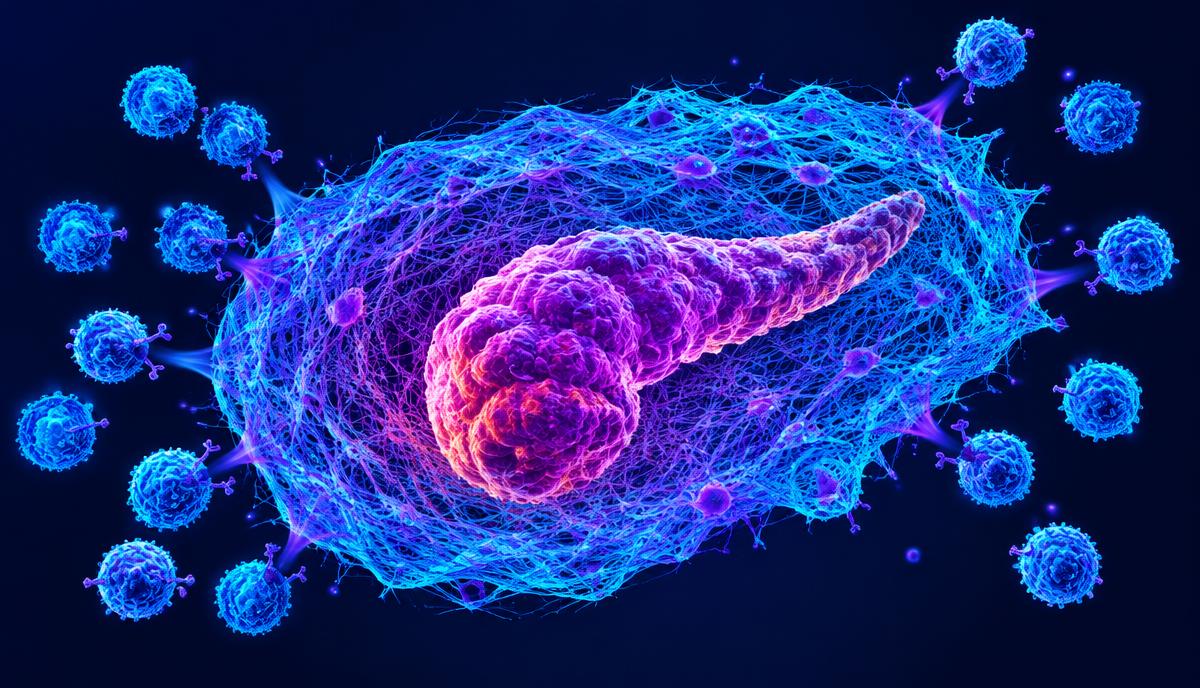
Pancreatic cancer is frequently described by researchers as an immunologically "cold" tumor, and the biology behind that label is well documented. Most PDAC tumors carry a low tumor mutational burden (TMB), meaning they produce relatively few neoantigens — the abnormal proteins that flag cancer cells as foreign to T cells. Checkpoint inhibitors work by releasing a brake on T cells that are already primed to attack a tumor; if there are too few tumor-specific T cells present in the first place, releasing that brake accomplishes little. Compounding this, PDAC tumors are surrounded by an unusually dense fibrotic stroma — a physical barrier of connective tissue, fibroblasts, and extracellular matrix that can both wall off immune cells from reaching cancer cells and actively recruit immunosuppressive cell populations (regulatory T cells, myeloid-derived suppressor cells, and tumor-associated macrophages) into the surrounding tissue. Reviews in journals including npj Precision Oncology and Molecular Cancer Therapeutics describe this combination — low antigenicity plus a physically and chemically suppressive microenvironment — as the central reason PDAC has proven so resistant to approaches that work well in "hotter" tumors like melanoma.
What Checkpoint Inhibitor Trials Have Actually Shown
The clinical record backs up the biology. In an early Phase II trial of single-agent ipilimumab (an anti-CTLA-4 checkpoint inhibitor) in locally advanced or metastatic pancreatic adenocarcinoma, researchers found essentially no objective tumor shrinkage in unselected patients. Subsequent single-agent PD-1/PD-L1 inhibitor trials in unselected PDAC populations told a similar story. Even the CheckMate 032 trial, which tested nivolumab alone and in combination with ipilimumab in previously treated pancreatic adenocarcinoma, failed to demonstrate the kind of durable responses seen in immunotherapy-responsive cancers. The consistent pattern across more than a decade of trials is that checkpoint blockade, given as monotherapy to a typical pancreatic cancer patient, essentially does not work. This is precisely why, unlike lung cancer or melanoma, there is no broad FDA approval for a checkpoint inhibitor in pancreatic cancer based on tumor type alone.
The Rare Subset That Does Respond: MSI-High and dMMR Pancreatic Cancer
Here the picture genuinely brightens, at least for a small number of patients. A small fraction of pancreatic cancers — estimates cluster in the roughly 1% to 3% range — carry microsatellite instability-high (MSI-H) or mismatch repair-deficient (dMMR) tumors. These tumors behave completely differently from typical PDAC: their DNA repair defects generate large numbers of mutations and neoantigens, giving the immune system far more to recognize and attack. This is the biological basis for pembrolizumab's tumor-agnostic FDA approval, first granted via accelerated approval in 2017 and converted to full approval in 2023, covering MSI-H/dMMR solid tumors — including pancreatic cancer — regardless of where in the body they originate.
The trial data behind that approval is worth reporting in full because it is a genuine, if modest, win for this patient subgroup. In the Phase II KEYNOTE-158 study, 22 patients with previously treated, noncolorectal MSI-H/dMMR pancreatic cancer received pembrolizumab, and 18.2% achieved an objective response, including one complete response — outcomes essentially unheard of with single-agent immunotherapy in unselected PDAC. For biomarker-matched patients who have exhausted standard chemotherapy options, that is a real and clinically meaningful chance at tumor shrinkage from a well-tolerated drug, and it is the reason universal mismatch-repair and microsatellite-instability testing is now recommended for advanced pancreatic cancer. It should be read honestly alongside the rest of the KEYNOTE-158 cohort, however: pancreatic cancer's 18.2% response rate trailed well behind MSI-H endometrial cancer (57.1%) and gastric cancer (45.8%) in the same trial, a reminder that even within this responsive genetic subset, pancreatic cancer remains a harder disease to control than other MSI-H tumor types.
Personalized mRNA Vaccines: The Most Genuinely Exciting Data in the Field
The most scientifically compelling recent development in pancreatic cancer immunotherapy is not a checkpoint inhibitor at all — it's a personalized cancer vaccine. Researchers at Memorial Sloan Kettering Cancer Center, in partnership with BioNTech and Genentech, developed autogene cevumeran, an individualized mRNA vaccine manufactured for each patient from their own tumor's neoantigens after surgical removal of the cancer. In a Phase I trial published in Nature (2023, with longer-term follow-up data reported in 2024), 16 patients with resected pancreatic cancer received the vaccine alongside chemotherapy and a checkpoint inhibitor. Half of them — 8 patients — mounted a measurable T cell immune response to the vaccine. The difference in outcomes between those responders and non-responders was striking: at longer-term follow-up, patients whose immune systems responded to the vaccine showed a substantially lower rate of cancer recurrence than those who did not, and vaccine-induced T cells were shown to persist for years in responding patients, correlating with continued clinical benefit. This is early-phase, small-cohort data — it has not yet been tested in a randomized controlled trial and cannot yet be described as a proven treatment — but it represents one of the first times researchers have shown that a pancreatic tumor can be taught to generate a durable, tumor-specific immune response at all. Larger randomized trials are now underway to determine whether this immune activation translates into a survival benefit that can be confirmed at scale.
Combination Strategies: Chemotherapy, CD40 Agonists, and Engineered Cell Therapies
Because pancreatic tumors are immunologically cold rather than simply "invisible," researchers have increasingly focused on combination regimens designed to first make the tumor microenvironment more receptive to immune attack before or alongside checkpoint blockade. One of the more rigorously tested examples is the randomized Phase II PRINCE trial, published in Nature Medicine, which tested chemotherapy combined with nivolumab, with the CD40-agonist antibody sotigalimab, or with both, in 105 patients with previously untreated metastatic pancreatic cancer. The results were mixed but informative: the nivolumab-plus-chemotherapy arm achieved a one-year overall survival rate of 57.7%, significantly beating the historical benchmark of 35% for chemotherapy alone, while the sotigalimab-containing arms did not reach statistical significance. The trial's own authors concluded that none of the regimens tested were ready for unselected patients, but identified biomarkers that could guide smarter, biomarker-selected trials going forward — a realistic and honest framing of where this research stands. Separately, early-phase work on CAR-T and CAR-NK cell therapies targeting antigens such as mesothelin is underway, including feasibility studies of mesothelin-targeted CAR-T cells as neoadjuvant treatment before surgery, though this approach remains investigational and has been complicated in practice by T cell dysfunction within the hostile pancreatic tumor environment.
The Honest State of Play
Taken as a whole, the evidence tells a genuinely mixed story, and readers deserve both halves of it. For the large majority of pancreatic cancer patients — those with microsatellite-stable, low-mutational-burden tumors, which describes roughly 97% to 99% of cases — checkpoint inhibitor monotherapy has not worked in any clinical trial to date, and no such approval exists for this population. That is the dominant, disappointing reality of pancreatic cancer immunotherapy today. At the same time, a small MSI-H/dMMR subset does have an FDA-approved, evidence-backed immunotherapy option with real response data behind it, and biomarker testing to identify these patients is now standard practice. Beyond that subset, personalized neoantigen vaccines and carefully selected combination regimens are producing genuinely encouraging early signals — not proof of benefit, but real reasons for continued, well-funded investigation. Patients and families should treat immunotherapy for pancreatic cancer as investigational for now outside the MSI-H/dMMR setting, discuss biomarker testing with their oncology team, and consider clinical trial enrollment as a legitimate way to access the most promising emerging approaches.
Bottom Line
Pancreatic cancer resists immunotherapy because most tumors are genetically quiet and physically shielded by dense stroma, and this is reflected in more than a decade of failed single-agent checkpoint inhibitor trials in unselected patients. The exception — MSI-H/dMMR pancreatic cancer, about 1% to 3% of cases — has an FDA-approved pembrolizumab option with a genuine, published response rate of 18.2% in KEYNOTE-158, though even this subgroup does not respond as well as other MSI-H tumor types. Outside that biomarker-defined group, the most promising developments are investigational: personalized mRNA neoantigen vaccines like autogene cevumeran have shown encouraging early immune and recurrence signals in small trials, and combination regimens pairing chemotherapy with immunotherapy or CD40 agonists have produced mixed but scientifically useful results. For most patients today, immunotherapy for pancreatic cancer remains a research frontier rather than a standard treatment, and clinical trial participation is the most evidence-based way to access it.
Sources
- Looking Beyond Checkpoint Inhibitor Monotherapy: Uncovering New Frontiers for Pancreatic Cancer Immunotherapy — Molecular Cancer Therapeutics (AACR), 2025 — https://aacrjournals.org/mct/article/24/1/18/750658/Looking-Beyond-Checkpoint-Inhibitor-Monotherapy
- Barriers and Opportunities in Pancreatic Cancer Immunotherapy — npj Precision Oncology, 2024 — https://www.nature.com/articles/s41698-024-00681-z
- Phase 2 Trial of Single Agent Ipilimumab (Anti-CTLA-4) for Locally Advanced or Metastatic Pancreatic Adenocarcinoma — PubMed, 2010 — https://pubmed.ncbi.nlm.nih.gov/20842054/
- Pembrolizumab in Noncolorectal MSI-H/dMMR Solid Tumors (KEYNOTE-158) — The ASCO Post, 2019 — https://ascopost.com/news/november-2019/pembrolizumab-in-noncolorectal-msi-hdmmr-solid-tumors/
- FDA Grants Full Approval to Pembrolizumab for Select Patients With MSI-H or dMMR Solid Tumors — OncLive, 2023 — https://www.onclive.com/view/fda-grants-full-approval-to-pembrolizumab-for-select-patients-with-msi-h-or-dmmr-solid-tumors
- RNA Neoantigen Vaccines Prime Long-Lived CD8+ T Cells in Pancreatic Cancer — Nature, 2024 — https://www.nature.com/articles/s41586-024-08508-4
- Investigational Pancreatic Cancer Vaccine Shows Lasting Results in Early Trial — Memorial Sloan Kettering Cancer Center, 2024 — https://www.mskcc.org/news/can-mrna-vaccines-fight-pancreatic-cancer-msk-clinical-researchers-are-trying-find-out
- Sotigalimab and/or Nivolumab With Chemotherapy in First-Line Metastatic Pancreatic Cancer (PRINCE Trial) — Nature Medicine, 2022 — https://www.nature.com/articles/s41591-022-01829-9
- Advances in Pancreatic Cancer Research — National Cancer Institute — https://www.cancer.gov/types/pancreatic/research
Related Articles
- Clinical Applications
What Does the FDA's CAR-T Boxed Warning on Secondary Cancers Actually Show?
The FDA's 2024 class-wide boxed warning on secondary T-cell cancers after CAR-T flagged a real signal — but the largest datasets since show the absolute risk is low and CAR-T's benefits still outweigh it.
- Clinical Applications
FDA Grants Breakthrough Therapy Designation to WU-CART-007 for Relapsed T-Cell Leukemia and Lymphoma: What the Phase 1 Data Show
An off-the-shelf CD7-targeted CAR-T produced a 91% response rate in evaluable Phase 1 patients — in cancers with no new FDA-approved therapy since 2005.
- Clinical Applications
EU Regulators Back Wider Use of Keytruda-Padcev Combination Before Bladder Cancer Surgery, Following Strong Survival Data
CHMP has recommended extending the perioperative pembrolizumab plus enfortumab vedotin regimen to all surgery-eligible muscle-invasive bladder cancer patients.