Anito-Cel Shows Deep, Durable Responses in Hard-to-Treat Multiple Myeloma: What the Phase 1 Data Actually Show
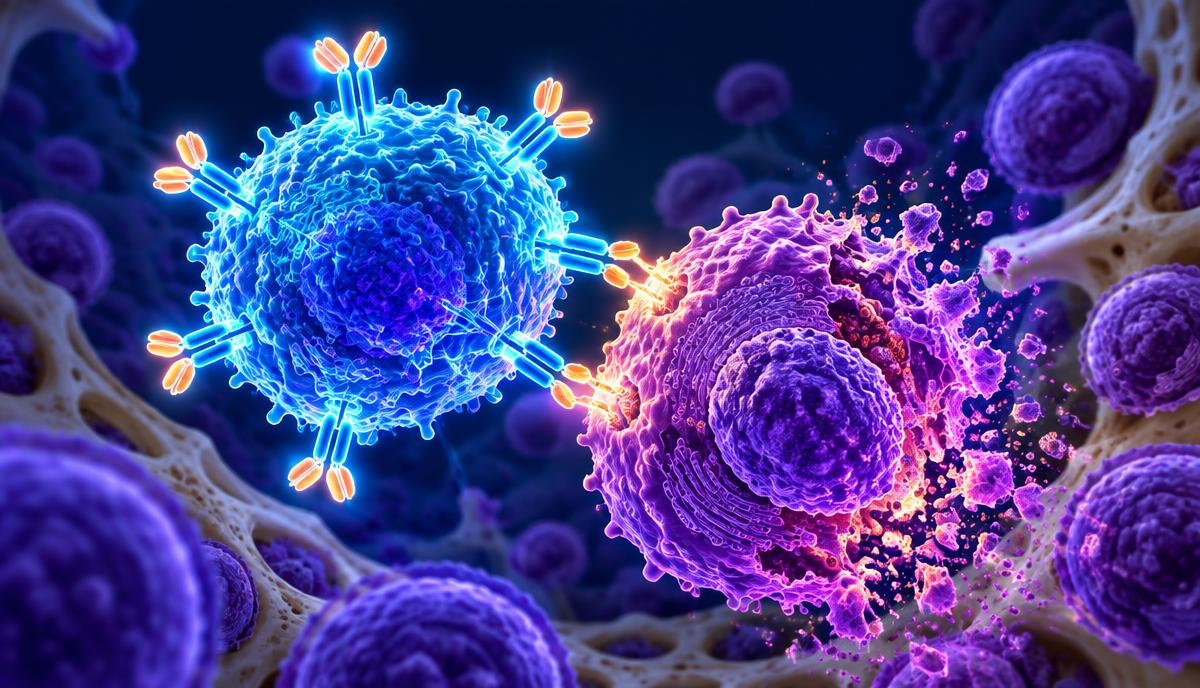
What this article covers
- Why Relapsed/Refractory Myeloma Needs Better Options
- Multiple myeloma is a cancer of plasma cells in the bone marrow, and while treatment has advanced enormously over the past two decades, it remains generally incurable with standard approaches. Most patients eventually relapse, and each successive relapse tends to respond less well to available drugs and for shorter periods.
- The Trial
- This Phase 1, single-arm, dose-exploration study enrolled 38 adults with relapsed and/or refractory multiple myeloma who had already been through multiple prior lines of therapy. It was sponsored by Kite/Gilead in collaboration with Arcellx, and conducted at Mass General Brigham Cancer Institute and University of Chicago Medicine, with Dr.
- The Data
- The efficacy numbers are strong by any standard for this disease stage: all 38 patients responded (100% overall response rate), and approximately 79% achieved a complete response or better. Progression-free survival was above 50% at roughly the two-year mark, and overall survival around 65% at roughly three years.
- Caveats and Limitations
- None of this makes anito-cel an established, approved treatment yet. This is a Phase 1 trial — the earliest stage of human testing, designed primarily to establish safety and a workable dose, not to prove efficacy in a statistically powered, controlled way.
- What's Next
- A larger Phase 2 registrational study, iMMagine-1, has already enrolled dozens more patients and reported encouraging early response and short-term survival data at recent American Society of Hematology (ASH) meetings. A Phase 3 confirmatory trial, iMMagine-3, has also opened, designed to compare anito-cel more rigorously in a larger, more statistically powered population.
On September 23, 2026, investigators from Mass General Brigham Cancer Institute and University of Chicago Medicine Comprehensive Cancer Center published long-term follow-up data from a Phase 1 trial of anitocabtagene autoleucel — "anito-cel" — a BCMA-directed CAR T-cell therapy developed by Kite, a Gilead Company, in partnership with Arcellx, Inc. The results, published in the New England Journal of Medicine and announced via a Mass General Brigham press release, are worth sitting with for a moment before the caveats arrive. All 38 patients enrolled in the trial — every one of them living with relapsed or refractory multiple myeloma that had already resisted standard therapies — responded to a single infusion of the therapy. Nearly 80% achieved a complete response, the deepest category of remission measurable by standard criteria. More than half remained progression-free two years after treatment, and roughly two-thirds were still alive three years out. Just as notably, serious immune-related and neurological complications were uncommon, and the study reported no delayed neurotoxicity — a side effect that has dogged other CAR T-cell products in this disease. This is genuinely encouraging news for a patient population that, historically, has had few durable options. It is also, importantly, a Phase 1 trial: 38 patients, one arm, no control group. Both things are true at once, and this article tries to hold them together honestly.
Why Relapsed/Refractory Myeloma Needs Better Options
Multiple myeloma is a cancer of plasma cells in the bone marrow, and while treatment has advanced enormously over the past two decades, it remains generally incurable with standard approaches. Most patients eventually relapse, and each successive relapse tends to respond less well to available drugs and for shorter periods. Patients who become "triple-class refractory" — no longer responding to an immunomodulatory drug, a proteasome inhibitor, and an anti-CD38 antibody — have historically faced a grim prognosis, with median survival often measured in months. BCMA-directed CAR T-cell therapy changed that calculus. Two BCMA CAR-T products are already FDA-approved and in routine use: Abecma (idecabtagene vicleucel, from Bristol Myers Squibb) and Carvykti (ciltacabtagene autoleucel, from Johnson & Johnson/Legend Biotech). Both have shown meaningful, sometimes durable, benefit and have since moved into earlier lines of therapy based on stronger trial data. But neither is free of drawbacks — cytokine release syndrome (CRS) and neurotoxicity, including immune effector cell-associated neurotoxicity syndrome (ICANS), remain real risks. Anito-cel is a distinct, newer entrant in this same BCMA-targeted class — it should not be confused with arlo-cel, a differently targeted (GPRC5D-directed) CAR-T from Bristol Myers Squibb being studied in the separate QUINTESSENTIAL trial.
The Trial
This Phase 1, single-arm, dose-exploration study enrolled 38 adults with relapsed and/or refractory multiple myeloma who had already been through multiple prior lines of therapy. It was sponsored by Kite/Gilead in collaboration with Arcellx, and conducted at Mass General Brigham Cancer Institute and University of Chicago Medicine, with Dr. Matthew Frigault (Mass General Brigham) and Dr. Michael R. Bishop (UChicago Medicine) among the lead investigators. Anito-cel is built on Arcellx's proprietary "D-Domain" binder technology rather than the single-chain antibody fragments used in earlier BCMA CAR-T constructs — a design intended to preserve potent tumor-killing activity while reducing the inflammatory signaling thought to drive CRS and neurotoxicity. Patients received the therapy across a range of dose levels, including a low-dose cohort that investigators highlighted as still producing strong responses. Median follow-up after infusion was roughly 34 months.
The Data
The efficacy numbers are strong by any standard for this disease stage: all 38 patients responded (100% overall response rate), and approximately 79% achieved a complete response or better. Progression-free survival was above 50% at roughly the two-year mark, and overall survival around 65% at roughly three years. Safety data were similarly reassuring: cytokine release syndrome occurred in most patients but was overwhelmingly low-grade; ICANS occurred in a minority of patients and was rarely severe; and no cases of delayed neurotoxicity — such as cranial nerve palsies or Parkinsonism, complications reported with some other BCMA-directed cell therapies — were observed. As Dr. Bishop put it: "Even at a low dose of anito-cel, we were seeing complete responses in the majority of patients right off the bat, and not a single patient developed severe toxicities." Dr. Frigault added: "The absence of neurotoxic and inflammatory side effects in this phase 1 study is particularly encouraging, given the serious and potentially lasting impact of these complications."
Caveats and Limitations
None of this makes anito-cel an established, approved treatment yet. This is a Phase 1 trial — the earliest stage of human testing, designed primarily to establish safety and a workable dose, not to prove efficacy in a statistically powered, controlled way. With only 38 patients and no comparator arm, the impressive percentages above come from a small, single-group sample conducted at just two academic cancer centers. And while this readout has cleared peer review in NEJM — a meaningfully higher bar than a conference abstract alone — it still represents one small trial's extended follow-up, not a large randomized comparison against existing standard-of-care BCMA CAR-T products. Anito-cel is not FDA-approved for any indication.
What's Next
A larger Phase 2 registrational study, iMMagine-1, has already enrolled dozens more patients and reported encouraging early response and short-term survival data at recent American Society of Hematology (ASH) meetings. A Phase 3 confirmatory trial, iMMagine-3, has also opened, designed to compare anito-cel more rigorously in a larger, more statistically powered population. Those studies, not this Phase 1 report, will determine whether anito-cel's early promise translates into a therapy that regulators can evaluate for approval.
Bottom Line
The Phase 1 data on anito-cel are a genuinely hopeful signal for a patient population that badly needs better, safer options — a 100% response rate, a near-80% complete response rate, and multi-year survival figures in this heavily pretreated group are not numbers to wave away, and the apparent absence of delayed neurotoxicity is a real point in the therapy's favor. But this remains early-stage, single-arm evidence from 38 patients at two centers. It is a strong reason to watch the Phase 2 and Phase 3 trials closely — not yet a reason to treat anito-cel as a proven, available alternative to existing FDA-approved BCMA CAR-T therapies.
Sources
- Novel CAR-T therapy shows promising safety and durable responses in hard-to-treat multiple myeloma — Mass General Brigham, September 23, 2026 — https://news.massgeneralbrigham.org/en/car-t-therapy-safety-durable-responses-multiple-myeloma
- Phase 1 Study of Anito-cel, a d-Domain BCMA CAR T Cell for Refractory or Recurrent Myeloma — The New England Journal of Medicine, September 23, 2026 — https://www.nejm.org/doi/full/10.1056/NEJMoa2603527
- Novel CAR-T therapy shows promising safety and durable responses in hard-to-treat multiple myeloma — Medical Xpress, September 2026 — https://medicalxpress.com/news/2026-09-car-therapy-safety-durable-responses.html
- Phase 1 Study of Anitocabtagene Autoleucel for the Treatment of Patients with Relapsed and/or Refractory Multiple Myeloma (RRMM): Efficacy and Safety with 34-Month Median Follow-up — Blood (American Society of Hematology), December 2024 — https://ashpublications.org/blood/article/144/Supplement%201/4825/533294/Phase-1-Study-of-Anitocabtagene-Autoleucel-for-the
- Kite Announces New Data for Pivotal iMMagine 1 Study at ASH 2025, Highlighting Anito-cel's Opportunity in Relapsed or Refractory Multiple Myeloma — Gilead/Kite, December 6, 2025 — https://www.gilead.com/news/news-details/2025/kite-announces-new-data-for-pivotal-immagine-1-study-at-ash-2025-highlighting-anito-cels-opportunity-in-relapsed-or-refractory-multiple-myeloma
Related Articles
- Clinical Applications
What Does the FDA's CAR-T Boxed Warning on Secondary Cancers Actually Show?
The FDA's 2024 class-wide boxed warning on secondary T-cell cancers after CAR-T flagged a real signal — but the largest datasets since show the absolute risk is low and CAR-T's benefits still outweigh it.
- Clinical Applications
Why Doesn't Immunotherapy Work Well for Pancreatic Cancer? What the Evidence Shows
Most pancreatic tumors are genetically quiet and walled off by dense stroma, so checkpoint inhibitors rarely work — except in the small MSI-H/dMMR subset. Personalized mRNA vaccines are the most promising lead.
- Clinical Applications
FDA Grants Breakthrough Therapy Designation to WU-CART-007 for Relapsed T-Cell Leukemia and Lymphoma: What the Phase 1 Data Show
An off-the-shelf CD7-targeted CAR-T produced a 91% response rate in evaluable Phase 1 patients — in cancers with no new FDA-approved therapy since 2005.