Can Stem Cells Help With Alopecia Areata?
What this article covers
- Overview
- Alopecia areata affects both sexes and all ages, with a lifetime incidence risk estimated at roughly 2% in a Mayo Clinic population study using Rochester Epidemiology Project data. It ranges from small, coin-sized patches that often regrow on their own to alopecia totalis (complete scalp hair loss) and alopecia universalis (loss of all body hair), which are far less likely to resolve untreated.
- How It's Thought to Work
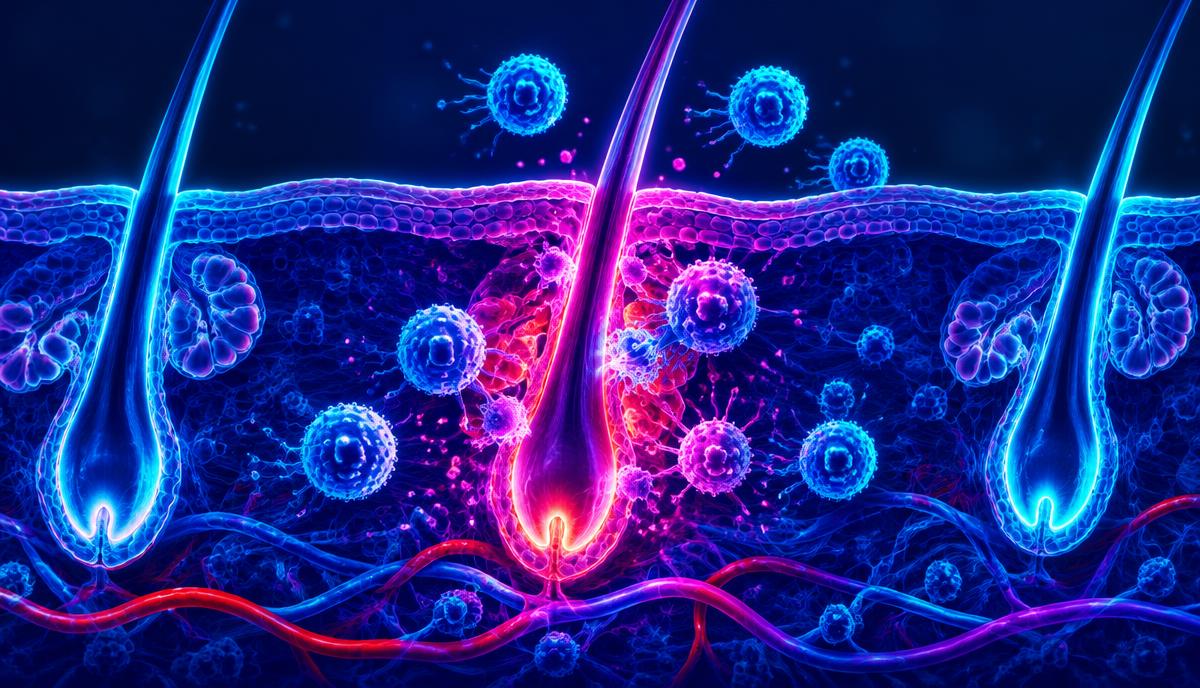
- Alopecia areata develops when hair follicles lose a protective state called "immune privilege," allowing T cells to infiltrate and attack the follicle as if it were foreign tissue. MSCs and related cells are of interest here because they are known to secrete growth factors and immune-signaling molecules — things like TGF-β1, HGF, and VEGF — that can dial down inflammatory T-cell activity, encourage regulatory immune pathways, and potentially help restore the follicle's protected status.
- What the Evidence Shows
- The most notable human data comes from a 2015 open-label trial published in BMC Medicine, in which nine patients with longstanding, often severe alopecia areata underwent "Stem Cell Educator" therapy — a single procedure exposing a patient's own immune cells to cord-blood-derived stem cells outside the body before returning them. Eight of the nine patients showed at least partial hair regrowth, including two who achieved complete regrowth sustained at two years, alongside measurable shifts in immune markers like TGF-β1 and Th2 cytokines, and no significant adverse events.
- Bottom Line
- Alopecia areata is one of the more genuinely interesting conditions in regenerative medicine because small human studies — not just lab or animal work — have shown real, measurable hair regrowth alongside favorable immune changes. That's a meaningfully stronger evidence base than many conditions marketed by stem cell clinics.
Alopecia areata is an autoimmune disease in which the immune system attacks hair follicles, causing patchy or, in severe cases, total hair loss. Because the condition is driven by a misdirected immune response rather than follicle destruction, researchers have long wondered whether cell-based therapies that can calm or redirect immune activity — including mesenchymal stem cells (MSCs), related cord-blood-derived cells, and their secreted exosomes — might help hair regrow. This article looks at what small early-stage human studies have actually found, how that compares with FDA-approved drug options, and why the evidence, while genuinely encouraging in places, remains far from proof that any stem cell product works.
Overview
Alopecia areata affects both sexes and all ages, with a lifetime incidence risk estimated at roughly 2% in a Mayo Clinic population study using Rochester Epidemiology Project data. It ranges from small, coin-sized patches that often regrow on their own to alopecia totalis (complete scalp hair loss) and alopecia universalis (loss of all body hair), which are far less likely to resolve untreated. For decades, options were limited to corticosteroid injections, topical immunotherapy, and other immune-suppressing approaches with mixed, often temporary results. That changed in 2022, when the FDA approved baricitinib (Olumiant), a JAK inhibitor, as the first systemic drug specifically approved for severe alopecia areata, and the agency has since expanded JAK inhibitor approvals to additional patients. Worth being direct about what that means here: the only FDA-approved medical treatments for alopecia areata today are oral JAK-inhibitor drugs, not stem cells, exosomes, or any other cell-based product.
How It's Thought to Work
Alopecia areata develops when hair follicles lose a protective state called "immune privilege," allowing T cells to infiltrate and attack the follicle as if it were foreign tissue. MSCs and related cells are of interest here because they are known to secrete growth factors and immune-signaling molecules — things like TGF-β1, HGF, and VEGF — that can dial down inflammatory T-cell activity, encourage regulatory immune pathways, and potentially help restore the follicle's protected status. Separately, these same secreted factors are thought to directly stimulate dormant hair follicle stem cells and dermal papilla cells to re-enter the growth phase. Exosomes, the tiny vesicles cells use to pass these signals to one another, have become a particular focus because they may be able to deliver similar paracrine effects without transplanting any live cells at all.
What the Evidence Shows
The most notable human data comes from a 2015 open-label trial published in BMC Medicine, in which nine patients with longstanding, often severe alopecia areata underwent "Stem Cell Educator" therapy — a single procedure exposing a patient's own immune cells to cord-blood-derived stem cells outside the body before returning them. Eight of the nine patients showed at least partial hair regrowth, including two who achieved complete regrowth sustained at two years, alongside measurable shifts in immune markers like TGF-β1 and Th2 cytokines, and no significant adverse events. A separate 2018 study in Stem Cell Research & Therapy reported encouraging results using a patient's own adipose-derived stromal vascular fraction. These are genuinely promising signals worth taking seriously. At the same time, both studies were small, uncontrolled, and open-label, with no placebo or sham-treatment comparison group, which matters enormously in a disease known for spontaneous regrowth. A 2025 systematic review of exosome-based approaches for alopecia areata found the evidence base still consists mostly of case reports and small series rather than randomized trials. No stem cell or exosome product has completed a large, placebo-controlled trial for alopecia areata, and none is FDA-approved for this use.
Who Might Be a Candidate
- Someone whose alopecia areata has not responded adequately to standard treatments like corticosteroids or JAK inhibitors
- Someone interested specifically in enrolling in a registered clinical trial (such as those listed on ClinicalTrials.gov) rather than a commercial, unregulated procedure
- Someone who understands this remains investigational and is not a substitute for dermatologist-guided standard care
- Someone without active infections, uncontrolled autoimmune flares, or other conditions that might raise procedural risk, as assessed by a physician
Bottom Line
Alopecia areata is one of the more genuinely interesting conditions in regenerative medicine because small human studies — not just lab or animal work — have shown real, measurable hair regrowth alongside favorable immune changes. That's a meaningfully stronger evidence base than many conditions marketed by stem cell clinics. But "promising small study" is not the same as "proven treatment." No stem cell, stromal vascular fraction, or exosome product has been tested in a rigorous, placebo-controlled trial for alopecia areata, and none carries FDA approval for it. Anyone considering this route should treat it as experimental, ideally pursued through a registered clinical trial, and should discuss it with a dermatologist alongside already-approved options like JAK inhibitors.
Key Questions Answered
- Are any stem cell treatments FDA-approved for alopecia areata?
- No. The only FDA-approved medical treatments for alopecia areata today are oral JAK-inhibitor drugs, not stem cells, exosomes, or any other cell-based product.
- What did the Stem Cell Educator trial find?
- In a 2015 open-label BMC Medicine trial, eight of nine patients with longstanding alopecia areata showed at least partial hair regrowth after Stem Cell Educator therapy, including two with complete regrowth sustained at two years, with no significant adverse events — but the study was small, uncontrolled, and open-label.
- Why are MSCs and exosomes being studied for alopecia areata?
- MSCs secrete factors like TGF-β1, HGF, and VEGF that can dial down inflammatory T-cell activity and potentially restore the follicle's immune privilege; exosomes may deliver similar paracrine effects without transplanting live cells.
Sources
- Hair regrowth in alopecia areata patients following Stem Cell Educator therapy — BMC Medicine, 2015 — https://bmcmedicine.biomedcentral.com/articles/10.1186/s12916-015-0331-6
- Cellular therapy with human autologous adipose-derived adult cells of stromal vascular fraction for alopecia areata — Stem Cell Research & Therapy, 2018 — https://stemcellres.biomedcentral.com/articles/10.1186/s13287-018-0889-y
- Exosome-Based Therapies for Alopecia Areata: A Systematic Review of Clinical and Experimental Evidence — PMC, 2025 — https://pmc.ncbi.nlm.nih.gov/articles/PMC12785886
- Lifetime incidence risk of alopecia areata estimated by Rochester Epidemiology Project, 1990-2009 — Journal of Investigative Dermatology, 2014 — https://doi.org/10.1038/jid.2013.464
- FDA Approves First Systemic Treatment for Alopecia Areata (baricitinib/Olumiant) — U.S. Food and Drug Administration, 2022 — https://www.fda.gov/news-events/press-announcements/la-fda-aprueba-el-primer-tratamiento-sistemico-para-la-alopecia-areata
Related Articles
- Clinical Applications
Can Stem Cells Help With Beta-Thalassemia?
Beta-thalassemia is one of the few conditions stem cells already cure: matched-sibling HSCT and the FDA-approved gene therapies Zynteglo and Casgevy, with real caveats.
- Clinical Applications
Can Stem Cells Help With Dry Eye Disease?
Early MSC and exosome studies for dry eye report improved symptoms and tear function, but the evidence remains small and no product is FDA-approved.
- Clinical Applications
Can Stem Cells Help With Fibromyalgia?
Fibromyalgia and stem cells: review early animal evidence, the unfinished human trial, regulatory cautions and why the approach remains unproven.