Myth: More Stem Cells Injected Always Means Better Results
What this article covers
- What This Article Covers
- A number gets thrown around often in stem cell marketing: "X million cells per treatment," implied as a selling point — the more cells, the more powerful the therapy. This article looks at what dose-response research in mesenchymal stem cell (MSC) trials actually shows, and why cell count, on its own, is a poor proxy for treatment quality.
- The Myth
- The claim shows up in ads, consultations, and clinic comparisons: a treatment using a higher stated cell count is automatically the stronger, more effective option, and a lower count is a sign of a "watered-down" or inferior product. Patients are sometimes encouraged to choose a provider, or pay more, based on this single number, as though stem cell dosing worked like a straightforward volume dial — more cells in, more benefit out.
- What the Evidence Actually Shows
- A widely cited analysis published in Stem Cells Translational Medicine reviewed 914 registered MSC clinical trials through 2018 and specifically examined the handful of trials that reported dose-comparison data. Among trials using intravenous MSC infusion that reported positive outcomes, most fell into a minimum effective dose range of roughly 70 to 190 million cells per patient per dose — and where studies directly compared doses, a narrower window of about 100 to 150 million cells showed the best results, with both lower and considerably higher IV doses performing worse.
- Why More Isn't Automatically Better
- There are real biological reasons a bigger dose can underperform or introduce new risk rather than simply adding benefit. MSCs are relatively large cells, and when infused intravenously they are prone to becoming physically trapped in the dense capillary bed of the lungs before ever reaching target tissue — a well-documented phenomenon sometimes called the pulmonary first-pass effect.
- What's Genuinely True Within the Myth
- None of this means dose is irrelevant — the opposite is true, which is part of why the myth persists. Falling below a minimum effective threshold does appear to genuinely undermine outcomes in the trials that have measured it, so an unusually low, unverified, or undisclosed cell count is a legitimate reason for caution.
What This Article Covers
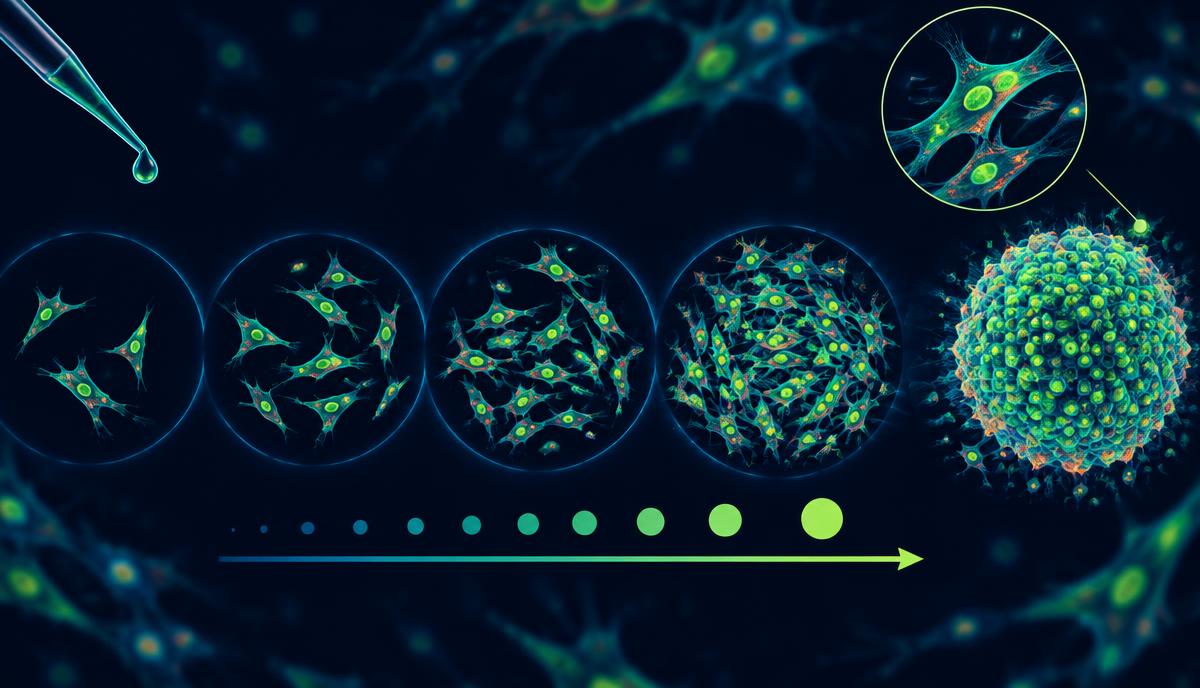
A number gets thrown around often in stem cell marketing: "X million cells per treatment," implied as a selling point — the more cells, the more powerful the therapy. This article looks at what dose-response research in mesenchymal stem cell (MSC) trials actually shows, and why cell count, on its own, is a poor proxy for treatment quality.
The Myth
The claim shows up in ads, consultations, and clinic comparisons: a treatment using a higher stated cell count is automatically the stronger, more effective option, and a lower count is a sign of a "watered-down" or inferior product. Patients are sometimes encouraged to choose a provider, or pay more, based on this single number, as though stem cell dosing worked like a straightforward volume dial — more cells in, more benefit out.
The Reality
What the Evidence Actually Shows
A widely cited analysis published in Stem Cells Translational Medicine reviewed 914 registered MSC clinical trials through 2018 and specifically examined the handful of trials that reported dose-comparison data. Among trials using intravenous MSC infusion that reported positive outcomes, most fell into a minimum effective dose range of roughly 70 to 190 million cells per patient per dose — and where studies directly compared doses, a narrower window of about 100 to 150 million cells showed the best results, with both lower and considerably higher IV doses performing worse. Two outlier trials used doses of 900 million cells or more, without showing a corresponding jump in benefit. The authors' summary was blunt: "too many or too few cells are not optimal" — describing an inverted-U, not a straight line.
Why More Isn't Automatically Better
There are real biological reasons a bigger dose can underperform or introduce new risk rather than simply adding benefit. MSCs are relatively large cells, and when infused intravenously they are prone to becoming physically trapped in the dense capillary bed of the lungs before ever reaching target tissue — a well-documented phenomenon sometimes called the pulmonary first-pass effect. A 2025 clinical safety paper in Regenerative Therapy, offering practical recommendations for IV MSC administration, notes this size-related entrapment risk directly and calls for screening infusions for cell clumping and monitoring patients for breathing difficulty and signs of thromboembolism — precautions that matter more, not less, as cell numbers climb. In short, pushing a dose upward can raise the chance of an adverse event without a matching gain in effect.
What's Genuinely True Within the Myth
None of this means dose is irrelevant — the opposite is true, which is part of why the myth persists. Falling below a minimum effective threshold does appear to genuinely undermine outcomes in the trials that have measured it, so an unusually low, unverified, or undisclosed cell count is a legitimate reason for caution. The nuance the myth erases is that effective dosing looks like a defined, evidence-based range specific to the condition, delivery route, and cell type — not an open-ended "more is better" scale. That a maturing research base is now able to identify these ranges at all is itself an encouraging sign of the field moving from anecdote toward precision.
It's also worth separating this from the regulatory question entirely: cell count claims say nothing about whether a product has been through FDA-regulated manufacturing or testing. The FDA has repeatedly warned that many marketed stem cell products, regardless of the cell numbers advertised, have not been shown to be safe or effective for the conditions they are sold to treat.
Bottom Line
A higher stated cell count is not a reliable measure of a stem cell treatment's quality or power, and in intravenous MSC therapy specifically, the best-supported outcomes cluster in a defined mid-range dose rather than rising indefinitely with more cells. Patients are better served asking what dose was used relative to published, condition-specific evidence — and whether that evidence exists at all — than asking simply "how many cells."
Sources
- Kabat M, Bobkov I, Kumar S, Grumet M. "Trends in Mesenchymal Stem Cell Clinical Trials 2004-2018: Is Efficacy Optimal in a Narrow Dose Range?" Stem Cells Translational Medicine, 2020. https://academic.oup.com/stcltm/article/9/1/17/6406756
- Terai S, et al. "Recommendations for the Safe Implementation of Intravenous Administration of Mesenchymal Stromal Cells." Regenerative Therapy, 2025. https://pmc.ncbi.nlm.nih.gov/articles/PMC11968263/
- U.S. Food and Drug Administration. "Consumer Alert on Regenerative Medicine Products Including Stem Cells and Exosomes." FDA.gov, 2020 (updated 2024). https://www.fda.gov/vaccines-blood-biologics/consumers-biologics/consumer-alert-regenerative-medicine-products-including-stem-cells-and-exosomes
- International Society for Stem Cell Research. "The ISSCR Guide to Stem Cell Treatments." isscr.org. https://www.isscr.org/treatment-guide
Related Articles
- Clinical Applications
Stem Cell-Derived Retina Cells Show Sustained Vision Gains Three Years After a Single Treatment for Geographic Atrophy
Three-year OpRegen follow-up suggests durable vision gains in a small geographic atrophy trial. The treatment remains investigational and lacks randomized efficacy data.
- Clinical Applications
Can Stem Cells Help With Chemotherapy-Induced Peripheral Neuropathy?
MSC and exosome research for chemotherapy-induced neuropathy shows promise in mice, but no human treatment is validated. Here is what evidence and ASCO guidance say.
- Clinical Applications
Can Stem Cells Help With Crohn's Disease?
Crohn’s stem cell research: why the ADMIRE-CD II trial reversed early promise for perianal fistulas, and why HSCT for luminal disease remains high-risk.