Can Stem Cells Help With Stress Urinary Incontinence?
What this article covers
- What This Article Covers
- Stress urinary incontinence (SUI) — the involuntary leakage of urine during coughing, laughing, exercise, or other physical exertion — has become one of the most actively studied targets for cell-based regenerative medicine, with multiple industry-sponsored clinical trials spanning more than a decade. This article explains the biological rationale behind injecting muscle-derived or mesenchymal cells into the urethral sphincter, walks through what the largest randomized trial to date actually found, and is explicit about where the evidence stands: no cell therapy is FDA-approved for SUI, and the most advanced candidate recently missed its primary efficacy endpoint in a Phase 3 trial, even as it produced a genuinely encouraging signal in one specific patient group.
- What Is Stress Urinary Incontinence?
- SUI occurs when the muscles and tissues supporting the urethra and bladder neck — primarily the urethral sphincter and pelvic floor — can no longer generate enough resistance to keep urine in during moments of increased abdominal pressure. It's extremely common, affecting a large share of women after childbirth or menopause, and a meaningful share of men after prostate surgery, where the procedure itself can damage the external sphincter.
- How It's Thought to Work
- The leading cell therapy candidate uses autologous muscle-derived cells (branded as iltamiocel, also referred to as AMDC-USR): a small sample of a patient's own thigh muscle (vastus lateralis) is biopsied, the muscle progenitor cells are isolated and expanded in a lab over several weeks, and the resulting cell suspension is injected directly into the urethral sphincter muscle in a brief outpatient procedure. The theory is that these cells engraft into the damaged sphincter and differentiate into new muscle fibers, physically rebuilding contractile tissue and restoring closure pressure — rather than just bulking the area mechanically, the way traditional urethral bulking agents do.
- What the Evidence Shows
- This is one of the better-documented areas of cell therapy specifically because a large, rigorously designed trial has actually completed and been published. , Neurourology and Urodynamics, 2024).
- Who Might Be a Candidate
- Outside of enrolled clinical trials, this remains investigational — there is no commercially available, FDA-approved stem cell product for SUI to be a "candidate" for.
What This Article Covers
Stress urinary incontinence (SUI) — the involuntary leakage of urine during coughing, laughing, exercise, or other physical exertion — has become one of the most actively studied targets for cell-based regenerative medicine, with multiple industry-sponsored clinical trials spanning more than a decade. This article explains the biological rationale behind injecting muscle-derived or mesenchymal cells into the urethral sphincter, walks through what the largest randomized trial to date actually found, and is explicit about where the evidence stands: no cell therapy is FDA-approved for SUI, and the most advanced candidate recently missed its primary efficacy endpoint in a Phase 3 trial, even as it produced a genuinely encouraging signal in one specific patient group.
What Is Stress Urinary Incontinence?
SUI occurs when the muscles and tissues supporting the urethra and bladder neck — primarily the urethral sphincter and pelvic floor — can no longer generate enough resistance to keep urine in during moments of increased abdominal pressure. It's extremely common, affecting a large share of women after childbirth or menopause, and a meaningful share of men after prostate surgery, where the procedure itself can damage the external sphincter. Standard treatments include pelvic floor physical therapy, pessaries, urethral bulking agents, and surgery (slings or artificial sphincters). These work well for many patients, but a substantial subset — particularly those who've already had surgery and still leak — are left with few good options, which is exactly the gap regenerative approaches are trying to fill.
How It's Thought to Work
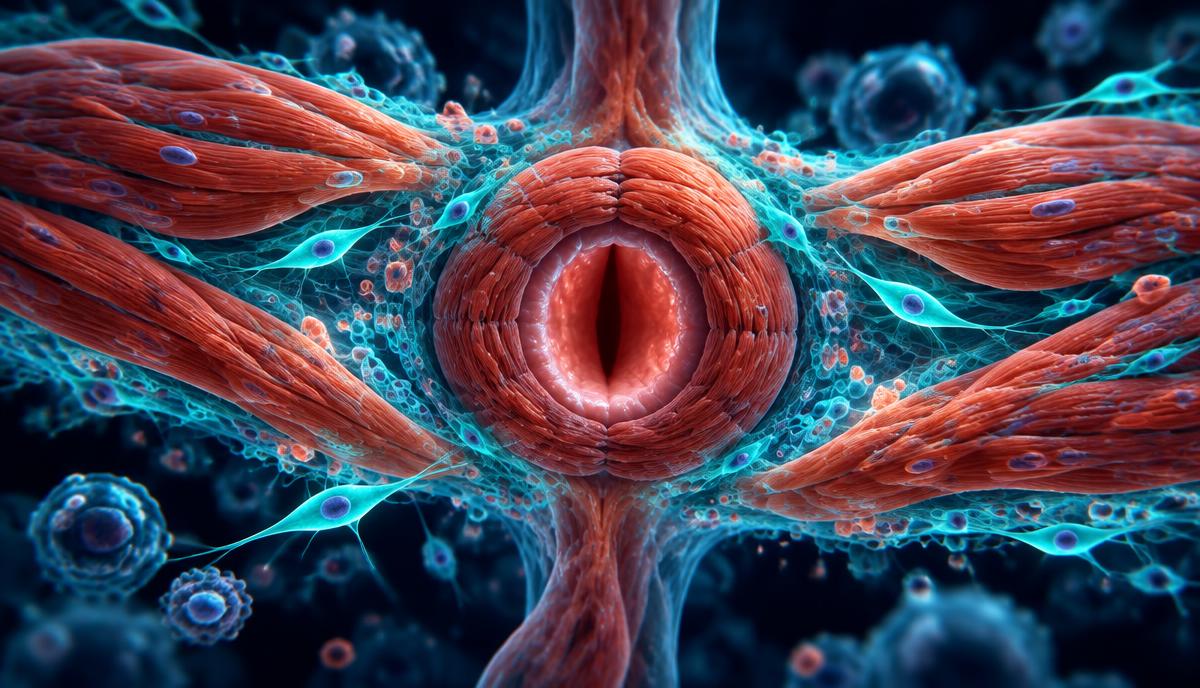
The leading cell therapy candidate uses autologous muscle-derived cells (branded as iltamiocel, also referred to as AMDC-USR): a small sample of a patient's own thigh muscle (vastus lateralis) is biopsied, the muscle progenitor cells are isolated and expanded in a lab over several weeks, and the resulting cell suspension is injected directly into the urethral sphincter muscle in a brief outpatient procedure. The theory is that these cells engraft into the damaged sphincter and differentiate into new muscle fibers, physically rebuilding contractile tissue and restoring closure pressure — rather than just bulking the area mechanically, the way traditional urethral bulking agents do. A parallel line of research uses mesenchymal stem cells (MSCs), which are thought to work less through direct engraftment and more through paracrine signaling — secreting growth factors that recruit the body's own repair processes, reduce local inflammation, and support new blood vessel and nerve growth in the damaged tissue.
What the Evidence Shows
This is one of the better-documented areas of cell therapy specifically because a large, rigorously designed trial has actually completed and been published. The pivotal Phase 3 CELLEBRATE trial, run by Cook MyoSite and conducted at academic centers including Vanderbilt University Medical Center, randomized 297 women with SUI (199 to iltamiocel, 98 to placebo) in a double-blind, placebo-controlled design (Kaufman et al., Neurourology and Urodynamics, 2024). The headline result was a miss: the proportion of patients achieving the primary endpoint — at least a 50% reduction in stress incontinence episodes — was not statistically different between groups (52% with iltamiocel versus 53.6% with placebo). That's an important, sobering finding, and it means this therapy is not, on the whole trial population, clearly better than placebo.
But the data held a notably more promising thread. Among the subgroup of women who had already undergone prior SUI surgery and were still leaking — precisely the hardest-to-treat patients with the fewest remaining options — a significantly greater proportion of iltamiocel recipients achieved a deeper, ≥75% reduction in leakage episodes compared to placebo (40% versus 16%, p=0.037). Among those responders, benefit appeared durable, with roughly 78% and 65% of the ≥50% and ≥75% responders, respectively, still showing that level of improvement at 24 months. Safety was reassuring throughout: treatment-related adverse events occurred in 9.5% of iltamiocel patients versus 6.1% on placebo, consistent with a generally well-tolerated procedure. Smaller earlier studies feeding into this program — including Phase 2 work in both women and in men with post-prostatectomy incontinence — reported similar safety signals and symptomatic improvement in some participants, which is what justified moving forward to Phase 3 in the first place. Separately, systematic reviews of MSC-based approaches for SUI describe this work as still preclinical-to-early-clinical overall, pointing to promising animal-model data on sphincter regeneration but a much thinner human evidence base than the muscle-derived cell program.
Who Might Be a Candidate
Outside of enrolled clinical trials, this remains investigational — there is no commercially available, FDA-approved stem cell product for SUI to be a "candidate" for. Within research settings, the people the evidence most directly speaks to are:
- Women with persistent SUI despite a prior surgical procedure (sling, bulking agent, etc.), the subgroup showing the clearest trial signal
- Men with stress incontinence following prostate surgery, an area with ongoing but earlier-stage trial data
- Patients who are not good candidates for, or who want to avoid, another surgical sling or artificial sphincter procedure
- Anyone considering this route should look specifically for enrollment in a registered, placebo-controlled trial (searchable on ClinicalTrials.gov) rather than a commercial clinic offering the treatment outside of research
Bottom Line
Stress urinary incontinence has one of the more mature clinical-trial track records in regenerative medicine, which is a double-edged fact: it means the enthusiasm isn't speculative, but it also means we now have a clear, well-powered Phase 3 result showing the lead cell therapy did not beat placebo across the full trial population. The encouraging part — a strong, durable response in women with prior failed SUI surgery, with a favorable safety profile — is real and worth watching, but it's a subgroup finding, not proof the therapy works broadly, and it has not yet translated into any FDA approval or routine clinical availability. Anyone considering this treatment today should understand it remains experimental, best pursued through a formal clinical trial, and not yet a validated alternative to established surgical and non-surgical SUI treatments.
Sources
- Iltamiocel Autologous Cell Therapy for the Treatment of Female Stress Urinary Incontinence: A Double-Blind, Randomized, Stratified, Placebo-Controlled Trial — Kaufman MR, Goldman HB, Chermansky CJ, et al., Neurourology and Urodynamics, 2024 — https://scholars.houstonmethodist.org/en/publications/iltamiocel-autologous-cell-therapy-for-the-treatment-of-female-st/
- Phase 3 CELLEBRATE Trial Testing Regenerative Stem Cell-Based Therapy to Improve Urinary Control for Women — Vanderbilt University Medical Center News, 2024 — https://news.vumc.org/2024/03/11/phase-3-cellebrate-trial-testing-regenerative-stem-cell-based-therapy-to-improve-urinary-control-for-women/
- Autologous Muscle Derived Cells Compared to Placebo for Urinary Sphincter Repair in Post-surgical Female Stress Incontinence (NCT03104517) — ClinicalTrials.gov — https://clinicaltrials.gov/study/NCT03104517
- Current Status of Stem Cell Treatments and Innovative Approaches for Stress Urinary Incontinence — PMC/National Library of Medicine, 2022 — https://pmc.ncbi.nlm.nih.gov/articles/PMC9755676/
- Mesenchymal Stem Cell-Based Therapy for Female Stress Urinary Incontinence — PMC/National Library of Medicine — https://www.ncbi.nlm.nih.gov/pmc/articles/PMC9880261/
- Autologous Cell Therapy for Stress Urinary Incontinence in Males Following Prostate Surgery (NCT02291432) — ClinicalTrials.gov — https://clinicaltrials.gov/study/NCT02291432
Related Articles
- Clinical Applications
Can Stem Cells Help With Drug-Resistant Focal Epilepsy?
Stem-cell-derived interneurons show encouraging seizure reductions in early drug-resistant epilepsy trials, but NRTX-1001 remains investigational and unapproved.
- Clinical Applications
Stem Cell-Derived Retina Cells Show Sustained Vision Gains Three Years After a Single Treatment for Geographic Atrophy
Three-year OpRegen follow-up suggests durable vision gains in a small geographic atrophy trial. The treatment remains investigational and lacks randomized efficacy data.
- Clinical Applications
Myth: More Stem Cells Injected Always Means Better Results
More stem cells do not always mean better outcomes. Dose-comparison research suggests an optimal range for IV MSCs, while high doses can introduce risks.