Can Stem Cells Help With Fibromyalgia?
What this article covers
- What This Article Covers
- Fibromyalgia is a chronic widespread pain condition with no cure and limited treatment options, which has led some patients to ask whether stem cell therapy could help. This article reviews the biological rationale, the very early clinical and preclinical research that exists, and the significant evidence gaps and regulatory cautions that apply before anyone considers this unproven approach.
- Overview
- " It disproportionately affects women and has no single identifiable cause, which has historically made it difficult to treat and, at times, difficult to diagnose. Current FDA-approved treatments — a small handful of medications alongside exercise, cognitive behavioral therapy, and multidisciplinary pain management — help many patients but rarely resolve symptoms completely, and a meaningful subset of patients get inadequate relief.
- How It's Thought to Work
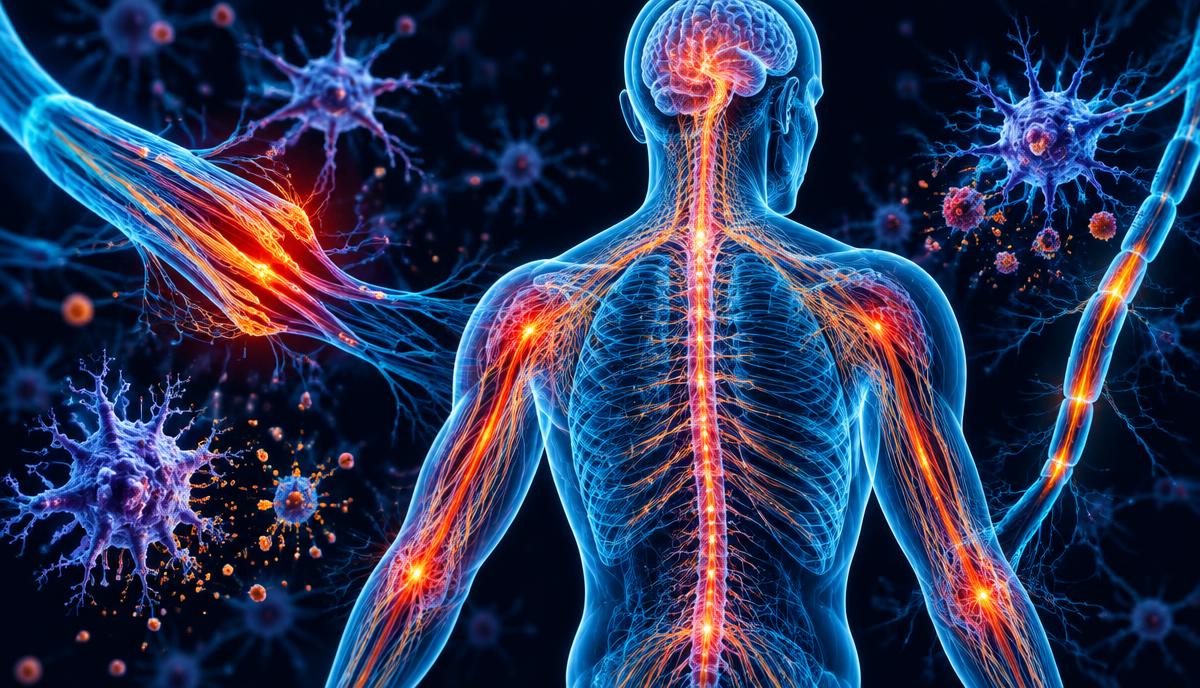
- Fibromyalgia's underlying biology is increasingly understood to involve central sensitization — an amplification of pain signaling within the brain and spinal cord — along with neuroinflammation and glial cell activation in response to excitatory signaling, according to a 2021 mechanistic review in the International Journal of Molecular Sciences. The same review notes that roughly half of fibromyalgia patients show evidence of small fiber neuropathy, meaning measurable damage to small nerve fibers that transmit pain and temperature signals.
- What the Evidence Shows
- Direct evidence in humans is extremely limited. gov (NCT02987855) is evaluating intravenous adipose-derived stem/stromal cells in patients with complex regional pain syndrome, reflex sympathetic dystrophy, and fibromyalgia, but as of this writing it has not published completed results, so no conclusions about safety or effectiveness in fibromyalgia can yet be drawn from it.
- Who Might Be a Candidate
- Because no stem cell therapy is FDA-approved or clinically validated for fibromyalgia, there is no evidence-based candidate profile to offer.
What This Article Covers
Fibromyalgia is a chronic widespread pain condition with no cure and limited treatment options, which has led some patients to ask whether stem cell therapy could help. This article reviews the biological rationale, the very early clinical and preclinical research that exists, and the significant evidence gaps and regulatory cautions that apply before anyone considers this unproven approach.
Overview
Fibromyalgia is a chronic disorder characterized by widespread musculoskeletal pain, fatigue, sleep disturbance, and cognitive difficulties often described as "fibro fog." It disproportionately affects women and has no single identifiable cause, which has historically made it difficult to treat and, at times, difficult to diagnose. Current FDA-approved treatments — a small handful of medications alongside exercise, cognitive behavioral therapy, and multidisciplinary pain management — help many patients but rarely resolve symptoms completely, and a meaningful subset of patients get inadequate relief. That treatment gap is part of why regenerative approaches, including stem cell therapy, have drawn interest from patients and some researchers, even though this remains an experimental and unproven application.
How It's Thought to Work
Fibromyalgia's underlying biology is increasingly understood to involve central sensitization — an amplification of pain signaling within the brain and spinal cord — along with neuroinflammation and glial cell activation in response to excitatory signaling, according to a 2021 mechanistic review in the International Journal of Molecular Sciences. The same review notes that roughly half of fibromyalgia patients show evidence of small fiber neuropathy, meaning measurable damage to small nerve fibers that transmit pain and temperature signals. The theoretical case for mesenchymal stem cells (MSCs) rests on their known anti-inflammatory and immunomodulatory secretions, which in principle could dampen the inflammatory signaling implicated in central sensitization. This remains a hypothesis extrapolated from general MSC biology and early animal data, not an established mechanism of benefit in fibromyalgia patients.
What the Evidence Shows
Direct evidence in humans is extremely limited. A Phase 1/2 trial registered on ClinicalTrials.gov (NCT02987855) is evaluating intravenous adipose-derived stem/stromal cells in patients with complex regional pain syndrome, reflex sympathetic dystrophy, and fibromyalgia, but as of this writing it has not published completed results, so no conclusions about safety or effectiveness in fibromyalgia can yet be drawn from it. Preclinical research offers a more encouraging, but still preliminary, signal: a 2022 study in the Journal of Birjand University of Medical Sciences found that conditioned medium from bone marrow-derived mesenchymal stem cells significantly reduced pain sensitivity and lowered elevated hippocampal TNF-α (an inflammatory marker) in a reserpine-induced rat model of fibromyalgia. That is a genuinely interesting finding worth watching — it offers biological plausibility for an anti-inflammatory pathway — but it was conducted in rodents using cell-derived secretions rather than cells themselves, and animal pain models frequently fail to translate into human clinical benefit. No peer-reviewed, placebo-controlled human trial of stem cell therapy for fibromyalgia has been published. Given this, any claim that stem cell therapy is a proven or reliable fibromyalgia treatment is not supported by current evidence.
Who Might Be a Candidate
Because no stem cell therapy is FDA-approved or clinically validated for fibromyalgia, there is no evidence-based candidate profile to offer. People considering this route, in the context of a registered clinical trial only, might reasonably discuss it with a rheumatologist or pain specialist if they:
- Have persistent, significantly disabling symptoms despite guideline-based medication, exercise, and behavioral therapy
- Are being evaluated for enrollment in a legitimate, registered clinical trial (such as one listed on ClinicalTrials.gov) with institutional oversight and informed consent
- Understand that any treatment obtained outside such a trial is unproven, unregulated, and not FDA-approved for this purpose
- Have discussed realistic expectations, costs, and risks with an independent physician who is not affiliated with the clinic offering the treatment
Bottom Line
The biological rationale for exploring stem cells in fibromyalgia — targeting neuroinflammation and central sensitization — is scientifically reasonable, and an early rodent study showing reduced pain and inflammatory markers is a genuinely promising early signal worth continued research. But that is where the evidence currently stops. There is no completed human clinical trial data, and the FDA has explicitly warned that unapproved regenerative medicine products are not shown to be safe or effective for chronic pain conditions, with the only FDA-approved stem cell products being certain cord blood-derived cells for blood disorders. Patients with fibromyalgia should treat stem cell therapy as an unproven, investigational concept at this stage — not an available treatment — and should be wary of any clinic marketing it as a cure.
Sources
- Siracusa R, Di Paola R, Cuzzocrea S, Impellizzeri D. "Fibromyalgia: Pathogenesis, Mechanisms, Diagnosis and Treatment Options Update." International Journal of Molecular Sciences, 2021. https://pmc.ncbi.nlm.nih.gov/articles/PMC8068842/
- Jasbinia F, Hassanpourezatti M. Study on mesenchymal stem cell-conditioned medium in a reserpine-induced rat model of fibromyalgia. Journal of Birjand University of Medical Sciences, 2022. https://journal.bums.ac.ir/article-1-3191-en.html
- "Adipose Stem/Stromal Cells in RSD, CRPS, Fibromyalgia" (NCT02987855), Phase 1/2 trial record. ClinicalTrials.gov, accessed 2026. https://clinicaltrials.gov/study/NCT02987855
- U.S. Food and Drug Administration. "Consumer Alert on Regenerative Medicine Products Including Stem Cells and Exosomes." FDA.gov, 2020 (updated 2024). https://www.fda.gov/vaccines-blood-biologics/consumers-biologics/consumer-alert-regenerative-medicine-products-including-stem-cells-and-exosomes
Related Articles
- Clinical Applications
FDA Clears First-of-Its-Kind Cell Therapy to Spare Transplant Patients From Chronic GVHD
FDA approval of Tregzi: what the PRECISION-T trial found for chronic GVHD prevention after matched-donor transplant, and key eligibility and access limits.
- Clinical Applications
Can Stem Cells Help With Stress Urinary Incontinence?
Cell therapy for stress urinary incontinence missed its Phase 3 primary endpoint, but a subgroup with prior failed surgery showed a durable signal.
- Clinical Applications
Can Stem Cells Help With Drug-Resistant Focal Epilepsy?
Stem-cell-derived interneurons show encouraging seizure reductions in early drug-resistant epilepsy trials, but NRTX-1001 remains investigational and unapproved.