CAR-T Therapy vs. Bone Marrow Transplant: What's the Difference?
What this article covers
- What Is a Bone Marrow/Stem Cell Transplant?
- A hematopoietic stem cell transplant (HSCT), commonly called a bone marrow transplant, replaces blood-forming stem cells that have been destroyed — intentionally — by very high doses of chemotherapy or radiation. According to the National Cancer Institute (NCI), the conditioning regimen typically lasts one to two weeks, after which stem cells are infused intravenously over one to five hours.
- What Is CAR-T Cell Therapy?
- Chimeric antigen receptor (CAR) T-cell therapy is a form of immunotherapy, not a transplant in the traditional sense. Doctors draw blood from the patient, isolate their T cells, and genetically engineer those cells in a lab to produce a receptor that recognizes a specific protein on the surface of cancer cells — most commonly CD19 on certain B-cell cancers.
- Key Differences in How They Work
- The mechanistic difference is the clearest way to keep these treatments straight. A transplant is fundamentally a "rescue" procedure: doctors deliberately destroy the bone marrow (and the cancer along with it, ideally) using chemo/radiation doses too toxic for the body to survive without a stem cell rescue, then restore blood production with new stem cells.
- Side Effects and Risks Compared
- Both treatments are demanding and carry real risk, but the specific dangers differ. Transplant-related short-term side effects include nausea, vomiting, fatigue, appetite loss, mouth sores, and hair loss; long-term effects can include infertility, cataracts, secondary cancers, and organ damage, per the NCI.
- When Are They Used Together?
- These treatments are increasingly used in sequence rather than as competitors. During the several weeks it takes to manufacture a patient's CAR-T cells, oncologists often give "bridging therapy" — chemotherapy or other treatment aimed at keeping the cancer under control until the engineered cells are ready to infuse.
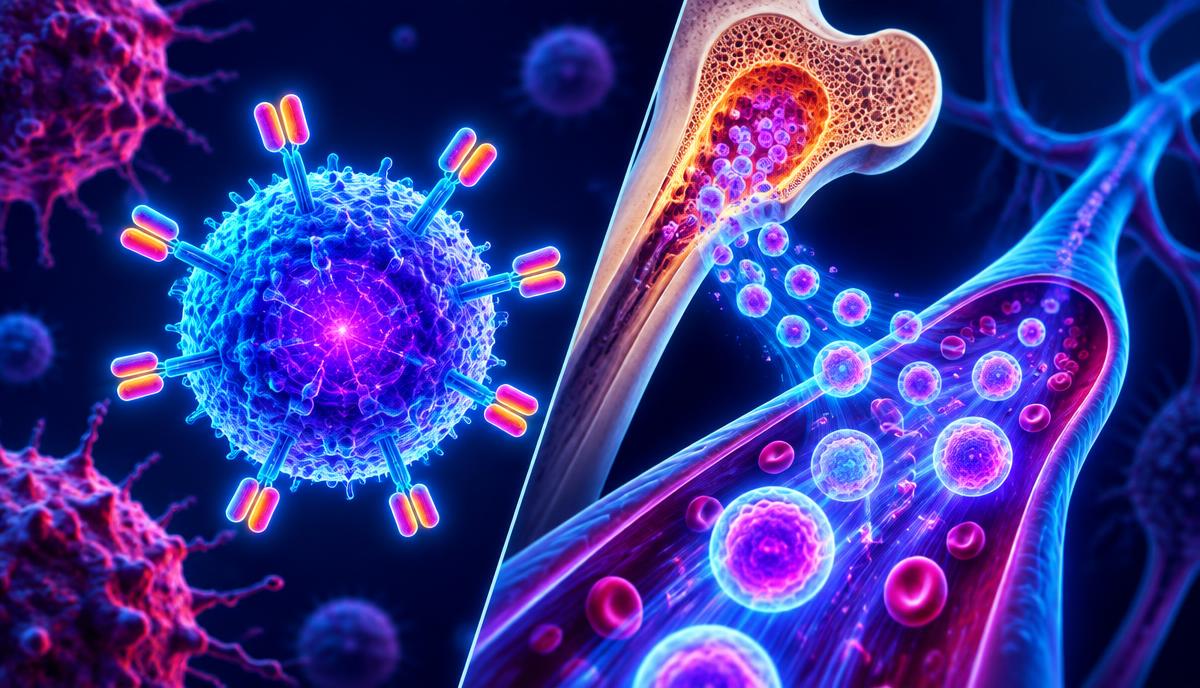
CAR-T cell therapy and bone marrow (hematopoietic stem cell) transplant are both serious, hospital-based treatments used against blood cancers, and both involve giving a patient back cells — which is where the confusion usually starts. But they work in almost opposite ways: a transplant rebuilds a patient's blood-forming system after it has been wiped out by high-dose chemotherapy or radiation, while CAR-T reprograms a patient's own immune cells to hunt down cancer directly. They carry different risks, suit different patients, and in a growing number of cases are used one after the other rather than as either/or choices. This article breaks down what each treatment actually is, how their risks differ, and when oncologists combine them.
What Is a Bone Marrow/Stem Cell Transplant?
A hematopoietic stem cell transplant (HSCT), commonly called a bone marrow transplant, replaces blood-forming stem cells that have been destroyed — intentionally — by very high doses of chemotherapy or radiation. According to the National Cancer Institute (NCI), the conditioning regimen typically lasts one to two weeks, after which stem cells are infused intravenously over one to five hours. There are two main types: in an autologous transplant, patients receive their own stem cells, collected and frozen beforehand, which avoids rejection but carries a small risk of reinfusing residual cancer cells; in an allogeneic transplant, cells come from a matched donor (a relative or unrelated donor), which brings a fresh, cancer-free immune system but requires close HLA matching. A rarer syngeneic transplant uses cells from an identical twin. Full immune recovery takes months after an autologous transplant and can take one to two years after an allogeneic one. Transplants are most commonly used for leukemia, lymphoma, multiple myeloma, and myelodysplastic syndromes, and sometimes for certain solid tumors like neuroblastoma or germ cell tumors.
What Is CAR-T Cell Therapy?
Chimeric antigen receptor (CAR) T-cell therapy is a form of immunotherapy, not a transplant in the traditional sense. Doctors draw blood from the patient, isolate their T cells, and genetically engineer those cells in a lab to produce a receptor that recognizes a specific protein on the surface of cancer cells — most commonly CD19 on certain B-cell cancers. The engineered cells are grown to hundreds of millions in number and infused back into the same patient, which is why the NCI describes CAR-T as "a living drug." The whole process, from blood collection to reinfusion, typically takes about three to five weeks. Seven CAR-T products are currently FDA-approved: one for B-cell acute lymphoblastic leukemia (ALL) in children and young adults (and, as of a newer approval, in adults), and others for adults with multiple myeloma, several types of non-Hodgkin lymphoma (follicular, large B-cell, and mantle cell), and chronic lymphocytic leukemia (CLL). In clinical trials for some advanced lymphomas, CAR-T produced responses in roughly 80% of patients, with a meaningful share remaining disease-free three or more years later — a genuinely notable result for a patient population that had already exhausted standard treatments.
Key Differences in How They Work
The mechanistic difference is the clearest way to keep these treatments straight. A transplant is fundamentally a "rescue" procedure: doctors deliberately destroy the bone marrow (and the cancer along with it, ideally) using chemo/radiation doses too toxic for the body to survive without a stem cell rescue, then restore blood production with new stem cells. CAR-T does not wipe out the bone marrow. Patients do receive a short course of lower-dose "lymphodepleting" chemotherapy before the CAR-T infusion to make room for the engineered cells to expand, but it is nowhere near the intensity of transplant conditioning. In effect, a transplant replaces a broken system; CAR-T arms the existing immune system with a new, targeted weapon.
Side Effects and Risks Compared
Both treatments are demanding and carry real risk, but the specific dangers differ. Transplant-related short-term side effects include nausea, vomiting, fatigue, appetite loss, mouth sores, and hair loss; long-term effects can include infertility, cataracts, secondary cancers, and organ damage, per the NCI. The signature risk unique to allogeneic transplant is graft-versus-host disease (GVHD), in which the donor's immune cells recognize the recipient's body as foreign and attack it — occurring as acute GVHD (within roughly the first three months) or chronic GVHD (later on), and treated with steroids or other immune-suppressing drugs. GVHD can range from mild to severe and is a leading cause of transplant-related illness and death. CAR-T's defining toxicities are different: cytokine release syndrome (CRS), in which activated T cells flood the body with inflammatory cytokines, causing high fevers and dangerous drops in blood pressure; and ICANS (immune effector cell-associated neurotoxicity syndrome), which can cause confusion, excessive sleepiness, or impaired speech. Both usually emerge within the first one to two weeks after infusion and are managed with drugs such as tocilizumab (for CRS) or steroids and anakinra (for more refractory CRS/ICANS). Because CAR-T does not require destroying the bone marrow, many patients describe its recovery as shorter and less grueling than a transplant's — though prolonged low blood counts, low antibody levels, and infection risk can still follow. Cost and access are also meaningful practical concerns for CAR-T, which ASCO has flagged as a significant financial burden for patients given the treatment's price and the specialized centers required to deliver it.
When Are They Used Together?
These treatments are increasingly used in sequence rather than as competitors. During the several weeks it takes to manufacture a patient's CAR-T cells, oncologists often give "bridging therapy" — chemotherapy or other treatment aimed at keeping the cancer under control until the engineered cells are ready to infuse. In the other direction, patients who relapse after an allogeneic stem cell transplant have been treated with CD19 or other CAR-T products, and researchers are studying donor-cell or transplant "consolidation" after CAR-T for certain high-risk leukemias to help maintain remission. Centers such as City of Hope note that while CAR-T alone is appropriate for many patients, combining the two approaches is an active area of research that may improve outcomes for some patients with high-risk or recurrent blood cancers — though specific sequencing protocols are still being worked out and are not yet one-size-fits-all.
Who Is a Candidate for Each?
Transplant eligibility has traditionally hinged on being in or near remission and having good enough overall health to tolerate intensive conditioning; a clinical practice guideline from the American Society for Blood and Marrow Transplantation emphasizes that chronological age alone should not disqualify a patient — instead, clinicians assess functional status and validated risk tools (such as the HCT Comorbidity Index) to judge whether a patient can safely undergo transplant with acceptably low non-relapse mortality risk. CAR-T, by contrast, is generally approved for patients whose cancer has relapsed or not responded to prior standard treatments, and it is often better tolerated by older adults or those with heart, kidney, or lung problems that would make transplant conditioning too risky. Ultimately, the choice — or sequence — depends on cancer type, prior treatment response, donor availability, overall fitness, and increasingly, enrollment in clinical trials studying how best to combine the two.
Bottom Line
CAR-T therapy and bone marrow transplant are not interchangeable and are not simply "newer vs. older" versions of the same idea — they work through fundamentally different mechanisms, carry different signature risks (GVHD for allogeneic transplant vs. CRS/ICANS for CAR-T), and are approved for overlapping but distinct situations. For many patients with resistant or relapsed blood cancers, CAR-T has become a genuinely transformative option with strong response rates in clinical trials. But it is not a replacement for transplant in every case, and a growing body of research shows the two can be used together — as a bridge, or in sequence — to give patients the best shot at durable remission. Anyone facing this choice should discuss both options, and the possibility of combining them, in detail with a hematology-oncology or transplant specialist.
Sources
- CAR T Cells: Engineering Immune Cells to Treat Cancer — National Cancer Institute (NCI), updated 2025 — https://www.cancer.gov/about-cancer/treatment/research/car-t-cells
- Stem Cell and Bone Marrow Transplants for Cancer — National Cancer Institute (NCI) — https://www.cancer.gov/about-cancer/treatment/types/stem-cell-transplant
- Indications for Autologous and Allogeneic Hematopoietic Cell Transplantation: Guidelines from the American Society for Blood and Marrow Transplantation — Biology of Blood and Marrow Transplantation, 2015 — https://pmc.ncbi.nlm.nih.gov/articles/PMC4830270/
- Assessment and Management of Cytokine Release Syndrome and Neurotoxicity Following CD19 CAR-T Cell Therapy — PMC (NIH) — https://pmc.ncbi.nlm.nih.gov/articles/PMC7393694/
- The Other Side of CAR T-Cell Therapy: Cytokine Release Syndrome, Neurologic Toxicity, and Financial Burden — ASCO Educational Book — https://ascopubs.org/doi/10.1200/EDBK_238691
- Stem Cell Transplant and CAR T-cell Therapy: When Are They Used for Lymphoma and Multiple Myeloma? — Dana-Farber Cancer Institute, Insight Blog, 2023 — https://blog.dana-farber.org/insight/2023/03/stem-cell-transplant-and-car-t-cell-therapy-when-are-they-used-for-lymphoma-and-multiple-myeloma/
- CAR T Cell Therapy and Bone Marrow Transplant — City of Hope — https://www.cityofhope.org/clinical-program/bone-marrow-and-blood-stem-cell-transplants/expertise/car-t-cell-and-bone-marrow-transplant
- Preventing GVHD after a Stem Cell Transplant — NCI, Cancer Currents Blog, 2023 — https://www.cancer.gov/news-events/cancer-currents-blog/2023/gvhd-prevention-stem-cell-transplant-cyclophosphamide
Related Articles
- Fundamentals
What Is the Tumor Microenvironment, and Why Does It Blunt Immunotherapy?
Tumors build a hostile neighborhood that excludes, exhausts, and disables immune cells. Here's what "hot" and "cold" tumors really mean — and how researchers are remodeling the terrain.
- Fundamentals
What Are Immune-Related Adverse Events (irAEs)? How Checkpoint Inhibitors Can Trigger Autoimmune-Like Side Effects
Checkpoint inhibitors release the immune system's brakes — and sometimes the immune system turns on healthy tissue. Here's how common irAEs really are, how oncologists grade and treat them, and what the survival association does and doesn't prove.
- Fundamentals
How Are CAR-T Cells Actually Engineered? Inside the Vector and Gene-Editing Process
What a chimeric antigen receptor really is, how viral vectors splice its gene into a T cell's DNA, and how CRISPR is being used to build off-the-shelf CAR-T.