How Do Scientists Know a Cell Is Really a Stem Cell? The Markers and Tests That Define an MSC
What this article covers
- The Problem: "Stem Cell" Alone Doesn't Mean Much
- In the early 2000s, MSC research was expanding rapidly, but labs around the world were isolating cells from bone marrow, fat, and other tissues using different methods and calling the results by different names — mesenchymal stem cells, marrow stromal cells, multipotent stromal cells — often without confirming the cells shared the same basic biological properties. That made it nearly impossible to compare results between studies, or to know whether a "positive" finding in one lab's cells would hold up in another's.
- The 2006 ISCT Position Statement
- That standard arrived in 2006, when Mauro Dominici and colleagues, writing on behalf of the ISCT, published "Minimal Criteria for Defining Multipotent Mesenchymal Stromal Cells" in the society's journal, Cytotherapy. The paper laid out three simple, testable criteria.
- Test One: Plastic Adherence
- " In practice, that means when researchers place the cells in an ordinary tissue-culture flask, they stick to the plastic surface and grow there, rather than floating free like blood cells. It's a low bar on its own, but it's a fast, cheap first filter that rules out several other cell types.
- The Surface Marker Checklist
- The second criterion is more specific, and it's the one you'll see cited most often: MSCs must test positive for three surface proteins — CD73, CD90, and CD105 — and must test negative for a defined panel of markers associated with blood and immune cells: CD34, CD45, CD14 or CD11b, CD79-alpha or CD19, and HLA-DR. Researchers check this using a technique called flow cytometry, which tags cells with fluorescent antibodies and measures, one cell at a time, which markers are present on its surface.
- Trilineage Differentiation: Proving the Cells Can Become Bone, Fat, and Cartilage
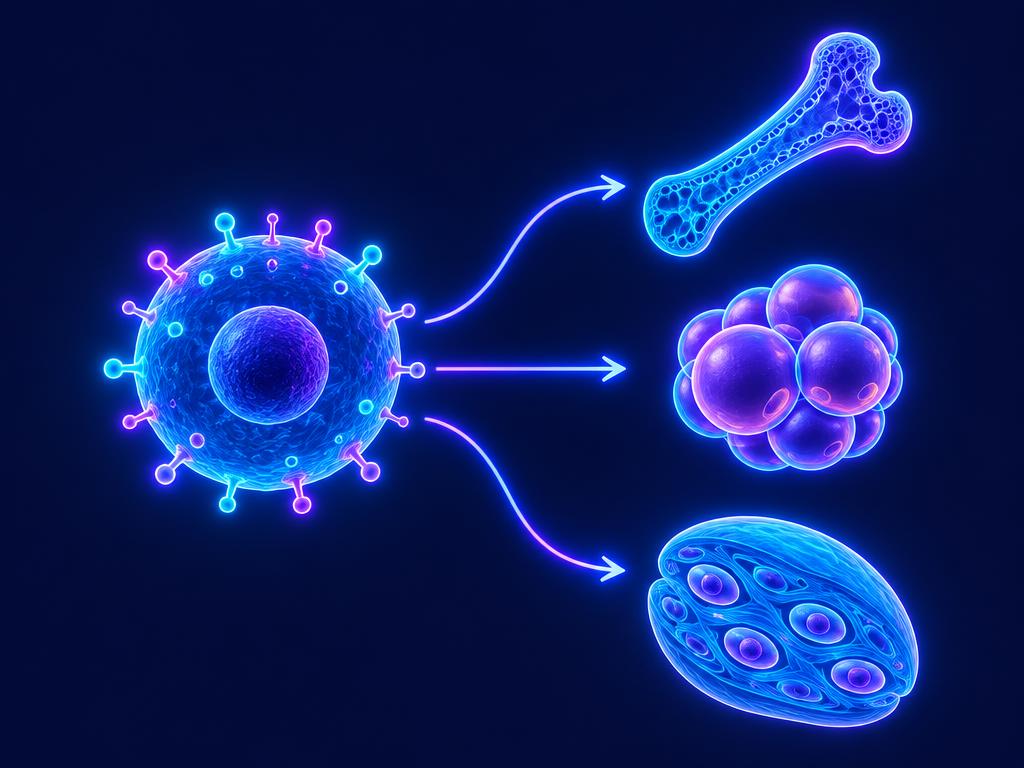
- The third criterion is functional, not just descriptive. MSCs must be able to differentiate, under specific culture conditions, into three cell types: osteoblasts (bone-forming cells), adipocytes (fat cells), and chondroblasts (cartilage-forming cells).
When a clinic advertises "stem cell therapy," it's easy to assume every vial of cells labeled that way is scientifically the same thing. It isn't. The most commonly used adult stem cells in regenerative medicine — mesenchymal stem/stromal cells, or MSCs — don't have a single, unmistakable fingerprint the way a fingerprint identifies a person. Instead, scientists confirm a cell population is really MSCs by running it through a specific, internationally agreed-upon checklist: a simple lab behavior, a set of surface markers, and a functional test of what the cells can turn into. This article walks through that checklist — the 2006 minimal criteria published by the International Society for Cellular Therapy (ISCT, now the International Society for Cell & Gene Therapy) — and explains why getting this identification right is central to whether a stem cell product is trustworthy at all.
The Problem: "Stem Cell" Alone Doesn't Mean Much
In the early 2000s, MSC research was expanding rapidly, but labs around the world were isolating cells from bone marrow, fat, and other tissues using different methods and calling the results by different names — mesenchymal stem cells, marrow stromal cells, multipotent stromal cells — often without confirming the cells shared the same basic biological properties. That made it nearly impossible to compare results between studies, or to know whether a "positive" finding in one lab's cells would hold up in another's. The field needed a shared, minimum standard: not a complete biological description, but a baseline every lab and manufacturer could test against.
The 2006 ISCT Position Statement
That standard arrived in 2006, when Mauro Dominici and colleagues, writing on behalf of the ISCT, published "Minimal Criteria for Defining Multipotent Mesenchymal Stromal Cells" in the society's journal, Cytotherapy. The paper laid out three simple, testable criteria. A cell population could only be called an MSC in the ISCT sense if it met all three. Nearly two decades later, this three-part test is still the reference point cited in most peer-reviewed MSC research and in regulatory submissions.
Test One: Plastic Adherence
The first criterion is almost deceptively simple: the cells must be "plastic-adherent when maintained in standard culture conditions." In practice, that means when researchers place the cells in an ordinary tissue-culture flask, they stick to the plastic surface and grow there, rather than floating free like blood cells. It's a low bar on its own, but it's a fast, cheap first filter that rules out several other cell types.
The Surface Marker Checklist
The second criterion is more specific, and it's the one you'll see cited most often: MSCs must test positive for three surface proteins — CD73, CD90, and CD105 — and must test negative for a defined panel of markers associated with blood and immune cells: CD34, CD45, CD14 or CD11b, CD79-alpha or CD19, and HLA-DR. Researchers check this using a technique called flow cytometry, which tags cells with fluorescent antibodies and measures, one cell at a time, which markers are present on its surface. Requiring at least 95% positivity for the "yes" markers and no more than 2% for the "no" markers, per the original paper, is what lets a lab say with confidence that it isn't looking at leftover blood stem cells, white blood cells, or other contaminating populations that can hide in a tissue sample.
Trilineage Differentiation: Proving the Cells Can Become Bone, Fat, and Cartilage
The third criterion is functional, not just descriptive. MSCs must be able to differentiate, under specific culture conditions, into three cell types: osteoblasts (bone-forming cells), adipocytes (fat cells), and chondroblasts (cartilage-forming cells). Researchers grow the cells in specialized media designed to push them down each path, then confirm the transformation with staining techniques that reveal mineral deposits, fat droplets, or cartilage matrix. This is the test that actually demonstrates "stemness" in the practical sense used here — multipotency, the capacity to become more than one specialized tissue type — rather than just resembling stem cells on the surface.
Why This Matters for Patients and Regulators
This three-part checklist isn't an academic formality. It's quality control. A manufacturer producing MSCs for a clinical trial or an approved product has to show, batch after batch, that what's in the vial actually meets this definition — otherwise a "stem cell" injection could be something else entirely, with different behavior and different risks. The FDA has said as much directly: its Center for Biologics Evaluation and Research runs ongoing research specifically on improving identity and potency testing for cell therapies, because, as the agency notes, cells manufactured in large quantities outside the body can lose their intended activity or become inconsistent between donors and production lots. The payoff for getting this right is real and already visible. In December 2024, the FDA approved Ryoncil (remestemcel-L), an allogeneic bone-marrow-derived MSC therapy for children with steroid-refractory acute graft-versus-host disease — the first MSC product ever approved in the United States, a milestone the ISCT called a "watershed moment" after more than a decade of MSC products reaching patients elsewhere. And manufacturing standards keep improving: in January 2026, the FDA acknowledged a Device Master File for a third-party MSC characterization assay measuring cell Property, Purity, and Potency together, a sign that the field is moving toward more rigorous, standardized release testing rather than relying on the 2006 criteria alone.
Has the Definition Changed Since 2006?
The core three-part test still stands, but the conversation around it has evolved. In 2017, MSC pioneer Arnold Caplan argued in STEM CELLS Translational Medicine that the cells work mainly by secreting signaling molecules that recruit and direct the body's own repair processes, rather than by physically becoming replacement tissue in most therapeutic contexts — and proposed renaming them "medicinal signaling cells" to reflect that. The ISCT's own MSC Committee weighed in formally in 2019, publishing a position statement in Cytotherapy that kept the familiar "MSC" acronym but urged the field to be more precise: name the tissue of origin (for example, bone-marrow MSC or umbilical-cord MSC), reserve the word "stem" for cases with rigorous proof of stem-cell-like behavior, and pair the 2006 minimal criteria with functional assays matched to how a specific product is meant to work therapeutically. In other words, the marker-and-differentiation checklist remains the floor, not the ceiling, for defining these cells.
Bottom Line
No single test proves a cell is an MSC — it takes all three: sticking to plastic, showing the right combination of surface markers, and actually differentiating into bone, fat, and cartilage. That standard, set by the ISCT in 2006, is still the backbone of MSC identification worldwide, and it's precisely the kind of rigor that separates a scientifically verified cell product from an unproven one. The field hasn't stood still since then — naming debates, functional-assay recommendations, and newer FDA-recognized potency tests are all pushing MSC manufacturing toward greater consistency, a trend that should give patients more confidence in what a "stem cell" product actually contains.
Sources
- Minimal criteria for defining multipotent mesenchymal stromal cells. The International Society for Cellular Therapy position statement — Dominici et al., Cytotherapy, 2006 — https://pubmed.ncbi.nlm.nih.gov/16923606/
- Mesenchymal stem versus stromal cells: International Society for Cell & Gene Therapy (ISCT) Mesenchymal Stromal Cell committee position statement on nomenclature — Cytotherapy, 2019 — https://pubmed.ncbi.nlm.nih.gov/31526643/
- Mesenchymal Stem Cells: Time to Change the Name! — Arnold I. Caplan, STEM CELLS Translational Medicine, 2017 — https://pubmed.ncbi.nlm.nih.gov/28452204/
- Development of strategies to improve cell therapy product characterization — U.S. Food and Drug Administration — https://www.fda.gov/vaccines-blood-biologics/biologics-research-projects/development-strategies-improve-cell-therapy-product-characterization
- ISCT Hails Landmark US FDA Approval of RYONCIL as Major Milestone for MSC Field — International Society for Cell & Gene Therapy, 2024/2025 — https://www.isctglobal.org/isct-in-the-news/us-fda-approval-of-ryoncil
- FDA accepts first quality control standard for mesenchymal stromal cells — Manufacturing Chemist, 2026 — https://manufacturingchemist.com/fda-quality-control-standard-mesenchymal-stromal-cells
- ISCT MSC committee offers position statement on nomenclature of mesenchymal stromal cells — ISCT Community, 2019 — https://community.isctglobal.org/blogs/isct-head-office1/2019/09/16/isct-msc-committee-offers-position-statement-on-no
Related Articles
- Fundamentals
What Is Stem Cell Cryopreservation? How Cells Are Frozen, Stored, and Thawed Without Being Destroyed
Freezing kills most cells — ice shreds them from the inside. Here's how cryoprotectants, controlled-rate freezing, and vitrification let stem cells survive nearly 30 years at -196°C and come back working.
- Fundamentals
What Is RMAT Designation, and How Does It Speed Up Stem Cell Therapy Approval?
RMAT designation fast-tracks promising regenerative medicine products through FDA development — but it is not approval, and it doesn't certify a therapy works. Here's what the designation actually means.
- Fundamentals
What Is HLA Matching, and Why Does It Matter for Stem Cell Transplants?
HLA matching decides who can receive a donor stem cell transplant and how risky it is. Here's what HLA is, how matches are graded, and why MSC therapies skip it.