New CAR-T Comparison Data Suggest Anito-cel May Match Carvykti's Efficacy With Far Fewer Neurological Side Effects
What this article covers
- What This Article Covers
- At the International Myeloma Society's 23rd Annual Meeting in Glasgow (September 23-26, 2026), researchers presented a new indirect comparison between an investigational CAR-T cell therapy, anitocabtagene autoleucel ("anito-cel," from Arcellx and Gilead Sciences), and the already-FDA-approved ciltacabtagene autoleucel (Carvykti, from Legend Biotech and Johnson & Johnson) in relapsed or refractory multiple myeloma. The analysis found roughly comparable response rates between the two therapies, but notably lower rates of cytokine release syndrome, neurotoxicity, and treatment-related infections with anito-cel.
- What Happened
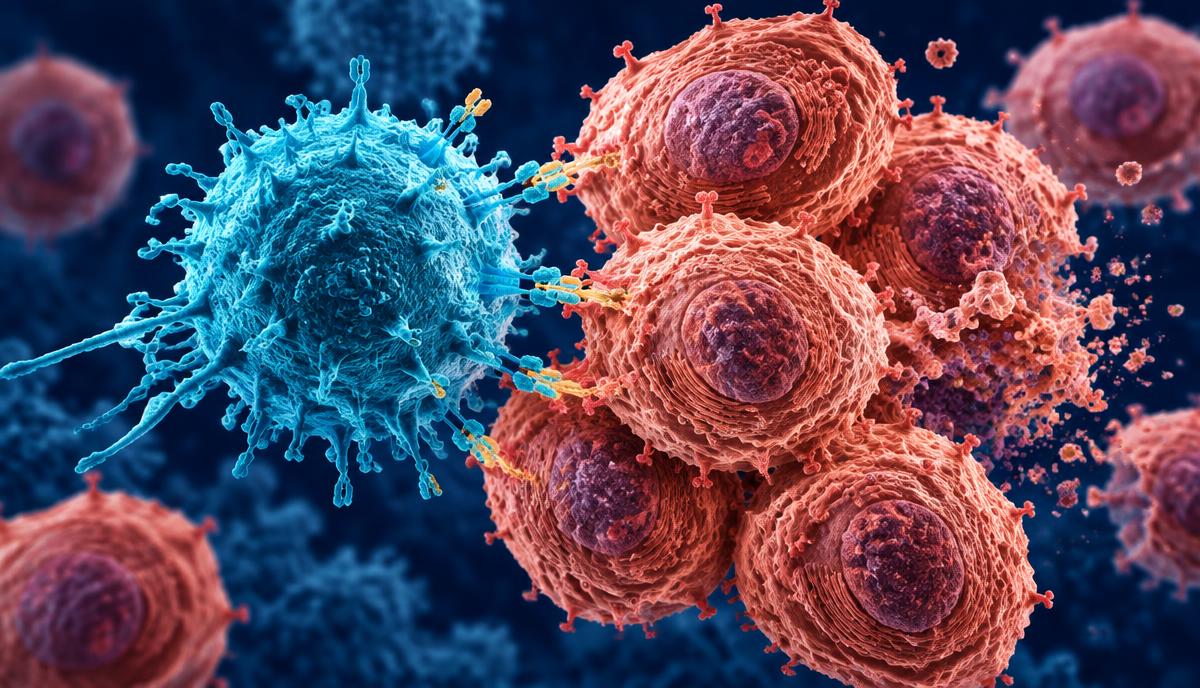
- Both anito-cel and Carvykti are "CAR-T" (chimeric antigen receptor T-cell) therapies: a patient's own T cells are collected, genetically engineered to recognize a protein called BCMA on myeloma cells, multiplied in the lab, and infused back into the patient to seek out and destroy the cancer. Carvykti has been FDA-approved since 2022 and is one of two BCMA-directed CAR-T products currently on the market for multiple myeloma (the other being Abecma).
- What the Data Actually Show
- On efficacy, the two therapies looked statistically similar after reweighting: - Overall response rate: 96% (112 of 117) with anito-cel vs. 98% with cilta-cel — not a statistically significant difference - Complete response or better: 74% vs.
- What It Means for Patients
- For patients with relapsed or refractory multiple myeloma — a blood cancer that, despite major treatment advances, is still not considered curable for most patients — a CAR-T option with similar cancer-fighting power but a meaningfully lighter side-effect burden would be a genuine quality-of-life and safety win, not just an incremental one. Lower rates of severe infections and non-relapse mortality in particular speak to patients being able to tolerate treatment with fewer life-threatening complications along the way.
- What's Still Unknown and What Comes Next
- Anito-cel remains an investigational therapy. S.
What This Article Covers
At the International Myeloma Society's 23rd Annual Meeting in Glasgow (September 23-26, 2026), researchers presented a new indirect comparison between an investigational CAR-T cell therapy, anitocabtagene autoleucel ("anito-cel," from Arcellx and Gilead Sciences), and the already-FDA-approved ciltacabtagene autoleucel (Carvykti, from Legend Biotech and Johnson & Johnson) in relapsed or refractory multiple myeloma. The analysis found roughly comparable response rates between the two therapies, but notably lower rates of cytokine release syndrome, neurotoxicity, and treatment-related infections with anito-cel. The therapy is not yet FDA-approved, and this type of analysis has real statistical limits, but the pattern — "similar efficacy, meaningfully better tolerability" in a CAR-T product in late-stage development — is the kind of signal patients and clinicians watch closely as cell therapy for blood cancers matures.
What Happened
Both anito-cel and Carvykti are "CAR-T" (chimeric antigen receptor T-cell) therapies: a patient's own T cells are collected, genetically engineered to recognize a protein called BCMA on myeloma cells, multiplied in the lab, and infused back into the patient to seek out and destroy the cancer. Carvykti has been FDA-approved since 2022 and is one of two BCMA-directed CAR-T products currently on the market for multiple myeloma (the other being Abecma). Anito-cel is still investigational — it has not been approved by the FDA — but Gilead's up to $7.8 billion acquisition of Arcellx, announced in February 2026, was built around advancing it toward a filing and potential launch.
Because no head-to-head randomized trial exists comparing the two therapies directly, researchers used a statistical technique called an unanchored matching-adjusted indirect comparison (MAIC). This method reweights patient data from anito-cel's ongoing Phase 2 iMMagine-1 trial (117 evaluable patients, 15.9-month median follow-up) to resemble the patient population enrolled in Carvykti's pivotal CARTITUDE-1 trial (97 patients, 18-month median follow-up), so the two groups can be compared more fairly on paper despite coming from separate studies.
What the Data Actually Show
On efficacy, the two therapies looked statistically similar after reweighting: - Overall response rate: 96% (112 of 117) with anito-cel vs. 98% with cilta-cel — not a statistically significant difference - Complete response or better: 74% vs. 78% — not significant - Very good partial response or better: 88% vs. 95% — not significant
On safety, anito-cel showed consistently lower rates of serious treatment-related complications: - Any-grade cytokine release syndrome: 85% vs. 95% - Any-grade ICANS (immune effector cell-associated neurotoxicity syndrome): 8% vs. 23% - Non-ICANS neurotoxicity (a category that includes rarer but more worrying complications such as cranial nerve palsies, Guillain-Barré-like syndromes, or Parkinsonian-type movement symptoms): zero cases with anito-cel versus 12 cases (12.4%) with cilta-cel - Grade 3/4 infections: 9% vs. 23% - Non-relapse mortality: 3% vs. 11%
The absence of any non-ICANS neurotoxicity cases in the anito-cel dataset is the detail drawing the most attention from myeloma specialists, since this rarer, delayed form of neurologic toxicity has been one of the more feared complications associated with BCMA-directed CAR-T therapy.
What It Means for Patients
For patients with relapsed or refractory multiple myeloma — a blood cancer that, despite major treatment advances, is still not considered curable for most patients — a CAR-T option with similar cancer-fighting power but a meaningfully lighter side-effect burden would be a genuine quality-of-life and safety win, not just an incremental one. Lower rates of severe infections and non-relapse mortality in particular speak to patients being able to tolerate treatment with fewer life-threatening complications along the way. If these differences hold up under more rigorous study, it could also influence how clinicians sequence or choose between BCMA-directed CAR-T products as more of them become available.
It's important to be precise about what this data does and does not establish. This is not a head-to-head randomized trial — it is an indirect statistical comparison of two separate single-arm trials, a method that can be influenced by differences the reweighting cannot fully correct for. The researchers themselves flagged that the two trials enrolled patients in different treatment eras, when supportive-care practices for managing CRS and neurotoxicity had evolved, which could make cilta-cel's safety numbers look relatively worse than they would with modern management. They also noted that at least one prognostic variable considered important by an expert panel, serum ferritin, was unavailable from the CARTITUDE-1 dataset and could not be adjusted for.
What's Still Unknown and What Comes Next
Anito-cel remains an investigational therapy. As of this presentation, no FDA approval, Biologics License Application (BLA) acceptance, or priority review designation had been publicly confirmed, though Gilead has signaled it is working toward a regulatory filing and potential U.S. launch. The iMMagine-1 trial is still ongoing, and longer follow-up will be needed to confirm whether early response rates translate into durable, long-term remission comparable to what has now been observed with several years of real-world Carvykti use. A true randomized comparison between the two therapies, were one ever conducted, would be the only way to settle the safety and efficacy questions with full confidence.
Patients and families should treat this as a promising early signal in a still-developing competitive landscape for myeloma cell therapy, not as a finalized clinical verdict, and should continue to rely on their treating hematologist-oncologist for decisions about which approved or trial-based option is appropriate for their individual case.
Bottom Line
New data presented at the International Myeloma Society's 2026 annual meeting suggest the investigational CAR-T therapy anito-cel may offer multiple myeloma patients efficacy similar to the approved therapy Carvykti, with substantially lower rates of cytokine release syndrome, neurotoxicity, and serious infections — including zero cases of a rare but serious delayed neurotoxicity seen in over 12% of Carvykti-treated patients in the comparison dataset. The comparison is indirect, not head-to-head, and anito-cel is not yet FDA-approved, but the pattern adds to a growing body of evidence that next-generation CAR-T designs may be able to preserve the dramatic efficacy of this cell therapy class while reducing some of its most serious risks.
Sources
- iMMagine-1 vs CARTITUDE-1 MAIC Shows Comparable Efficacy, Improved Safety With Anito-cel in Relapsed/Refractory Multiple Myeloma, OncLive, September 24, 2026, https://www.onclive.com/view/immagine-1-vs-cartitude-1-maic-shows-comparable-efficacy-improved-safety-with-anito-cel-in-relapsed-refractory-multiple-myeloma
- 23rd International Myeloma Society Annual Meeting & Exposition, International Myeloma Society, September 23-26, 2026, Glasgow, Scotland, https://www.myelomasociety.org/events/23rd-ims-annual-meeting
- Gilead Sciences to Acquire Arcellx to Maximize Long-Term Potential of Anito-cel, Gilead Sciences press release, February 23, 2026, https://www.gilead.com/news/news-details/2026/gilead-sciences-to-acquire-arcellx-to-maximize-long-term-potential-of-anito-cel
- ASH: Gilead Preps Filing for Anito-cel on iMMagine-1 Data, pharmaphorum, December 8, 2025, https://pharmaphorum.com/news/ash-gilead-preps-filing-anito-cel-immagine-1-data
- FDA Approves Ciltacabtagene Autoleucel for Relapsed or Refractory Multiple Myeloma, The ASCO Post, March 2022, https://ascopost.com/issues/march-25-2022/fda-approves-ciltacabtagene-autoleucel-for-relapsed-or-refractory-multiple-myeloma/
Related Articles
- Clinical Applications
Anito-Cel Shows Deep, Durable Responses in Hard-to-Treat Multiple Myeloma: What the Phase 1 Data Actually Show
All 38 patients in a Phase 1 trial of the BCMA CAR-T anito-cel responded, with nearly 80% in complete response and no delayed neurotoxicity — encouraging, but still early, single-arm evidence.
- Clinical Applications
What Does the FDA's CAR-T Boxed Warning on Secondary Cancers Actually Show?
The FDA's 2024 class-wide boxed warning on secondary T-cell cancers after CAR-T flagged a real signal — but the largest datasets since show the absolute risk is low and CAR-T's benefits still outweigh it.
- Clinical Applications
Why Doesn't Immunotherapy Work Well for Pancreatic Cancer? What the Evidence Shows
Most pancreatic tumors are genetically quiet and walled off by dense stroma, so checkpoint inhibitors rarely work — except in the small MSI-H/dMMR subset. Personalized mRNA vaccines are the most promising lead.