Protecting Oral and Dental Health As You Age: What the Evidence Actually Shows
What this article covers
- Why Oral Health Matters Beyond the Mouth
- Periodontal disease — the chronic bacterial inflammation of the gums and the bone that anchors teeth — is remarkably common. S.
- What the Evidence Shows
- The cardiovascular link is well documented as an association, though not established as direct causation. A 2018 review in Heart, Lung and Circulation found that periodontal disease has been consistently linked to ischemic heart disease, cerebrovascular disease, heart failure, and peripheral artery disease, with systemic inflammation proposed as the primary connecting mechanism.
- Age-Related Changes to Watch For
- Oral tissue changes measurably with age, independent of periodontal disease status:
- Bottom Line
- The evidence that periodontal health connects to broader systemic health is genuinely strong at the level of association — not a stretch, and not fringe science. What it does not yet show is that treating gum disease reliably prevents heart attacks or reverses diabetes; the research agencies tracking this are explicit that rigorous causal trials are still needed.
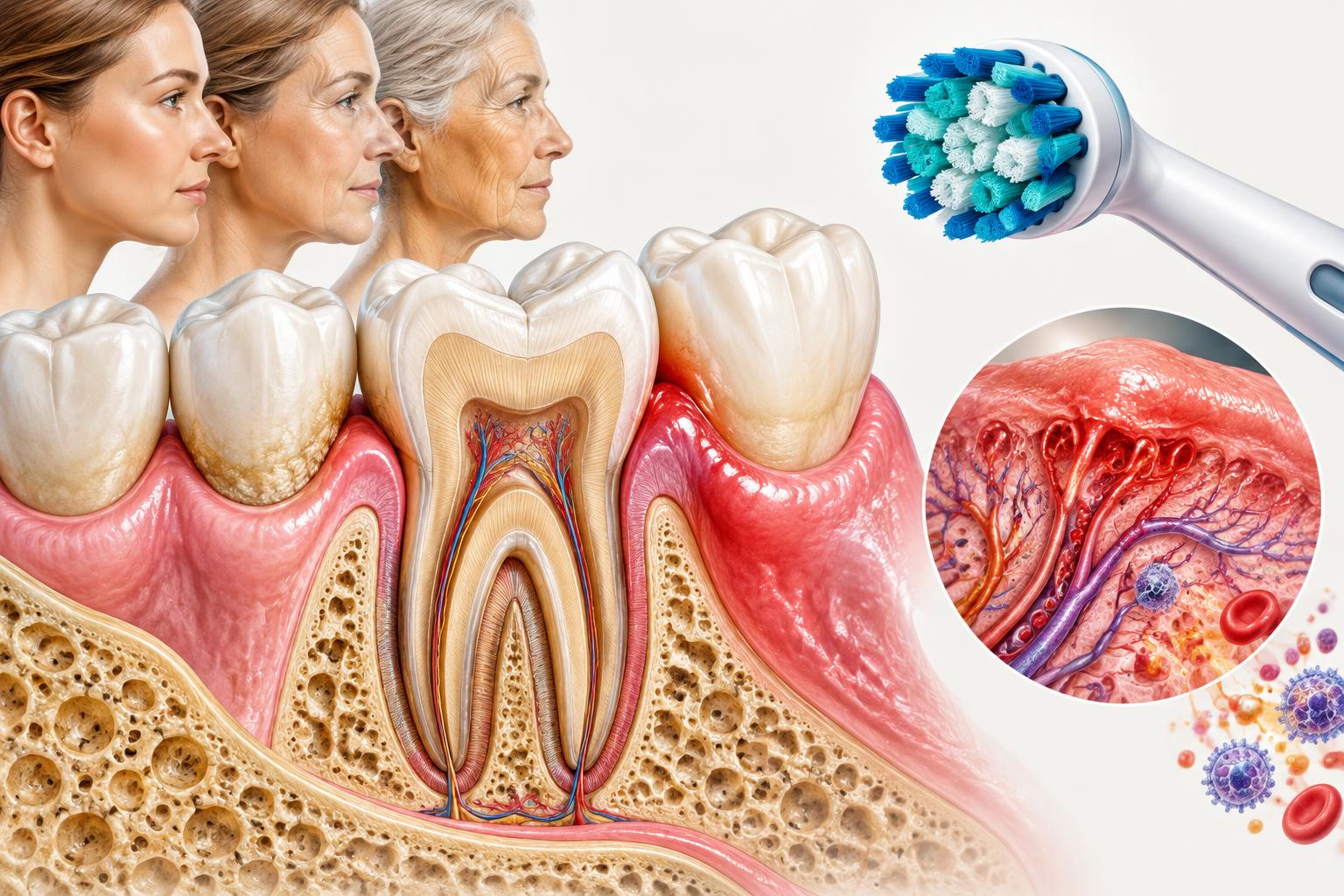
The mouth is not a closed system. Gum tissue sits directly against a dense network of blood vessels, and when it becomes chronically inflamed, that inflammation doesn't necessarily stay local. This article lays out what research actually supports about the connections between periodontal (gum) disease and systemic conditions like cardiovascular disease and diabetes, what changes in oral tissue as people age, and which prevention steps have real evidence behind them — while being clear about where the data is genuinely associative rather than proven causal.
Why Oral Health Matters Beyond the Mouth
Periodontal disease — the chronic bacterial inflammation of the gums and the bone that anchors teeth — is remarkably common. Using National Health and Nutrition Examination Survey (NHANES) data from 2009–2014, researchers estimated that 42.2% of U.S. adults 30 and older have some form of periodontitis, rising to roughly 59.8% of adults 65 and older, with severe disease affecting about 7.8% of adults overall. It remains the leading cause of adult tooth loss in the U.S.
What makes periodontal disease relevant to whole-body health is the inflammatory burden it can generate. Chronically infected gum tissue is believed to allow oral bacteria periodic access to the bloodstream through small injuries, and the resulting low-grade systemic inflammation is the leading mechanistic theory connecting gum disease to several systemic conditions.
What the Evidence Shows
The cardiovascular link is well documented as an association, though not established as direct causation. A 2018 review in Heart, Lung and Circulation found that periodontal disease has been consistently linked to ischemic heart disease, cerebrovascular disease, heart failure, and peripheral artery disease, with systemic inflammation proposed as the primary connecting mechanism. Separately, NIDCR has highlighted a 2023 study in the journal Stroke following more than 6,300 people for 21 years, which found cavities (a related but distinct form of oral disease) associated with a 40% higher stroke risk and a 13% higher risk of death from any cause — notably, cavities were not linked to heart attack risk, while periodontal disease specifically has been.
The diabetes relationship appears to run in both directions. NIDCR notes that uncontrolled high blood sugar may promote the bacteria that cause gum disease, and separately, treating periodontal disease appears to help with blood sugar management in people at high risk — though the agency is candid that treatment trials have had inconclusive results and that more rigorous randomized controlled trials are needed before causation can be claimed either way.
Importantly, gum disease, heart disease, stroke, and diabetes share several risk factors outright — smoking, obesity, poor diet, high blood pressure, and high LDL cholesterol — which complicates untangling cause from shared risk. As NIDCR puts it, these associations are well established, but their exact causal mechanisms are not.
Age-Related Changes to Watch For
Oral tissue changes measurably with age, independent of periodontal disease status:
- Dry mouth (xerostomia) affects about 30% of adults over 65 and up to 40% of those over 80, driven mainly by medication side effects (worsening with each additional daily prescription) rather than aging itself.
- Root caries (decay on exposed tooth roots) affects roughly half of adults over 75, a consequence of gum recession combined with reduced saliva.
- About 5% of adults over 65 have lost all their natural teeth — a declining rate compared to prior generations, as more people retain their teeth into older age.
Practical, Evidence-Aligned Steps
- Brush at least twice daily; an electric or oscillating toothbrush can help those with reduced dexterity.
- Use fluoride consistently — toothpaste, and for higher-risk patients, prescription-strength fluoride or varnish.
- Stay hydrated and limit alcohol, caffeine, and sugary drinks if dry mouth is a factor.
- Review medications periodically with a clinician or pharmacist, since polypharmacy is a major driver of dry mouth.
- Keep up routine dental cleanings and exams — frequency may need to increase with age, not decrease.
- Manage shared risk factors (smoking cessation, blood pressure, blood sugar, diet) as part of both oral and systemic health, since the two overlap substantially.
Bottom Line
The evidence that periodontal health connects to broader systemic health is genuinely strong at the level of association — not a stretch, and not fringe science. What it does not yet show is that treating gum disease reliably prevents heart attacks or reverses diabetes; the research agencies tracking this are explicit that rigorous causal trials are still needed. What is unambiguous and encouraging is that routine, evidence-based oral care — brushing, fluoride, hydration, and regular professional cleanings — measurably reduces oral disease itself, and age-related risks like dry mouth and root decay are manageable, not inevitable declines to accept passively.
Key Questions Answered
- Does treating gum disease prevent heart attacks or reverse diabetes?
- The associations with systemic conditions are well established, but direct causation is not. Trials have been inconclusive and more rigorous randomized studies are needed; treating gum disease is not proven to reliably prevent heart attacks or reverse diabetes.
- Is dry mouth simply an inevitable part of aging?
- No. Dry mouth affects about 30% of adults over 65 and up to 40% over 80, but medication side effects and polypharmacy are major drivers rather than aging itself.
- Which oral-health prevention steps have evidence behind them?
- Twice-daily brushing, consistent fluoride, hydration, medication reviews and routine dental cleanings reduce oral disease. Shared risks such as smoking, high blood sugar and blood pressure also deserve attention.
Sources
- Healthy Mouth, Healthy Body — National Institute of Dental and Craniofacial Research (NIDCR), 2024 — https://www.nidcr.nih.gov/news-events/nidcr-news/2024/healthy-mouth-healthy-body
- Periodontal Disease, Systemic Inflammation and the Risk of Cardiovascular Disease — Heart, Lung and Circulation, 2018 — https://pubmed.ncbi.nlm.nih.gov/29903685/
- Periodontal Disease Statistics in Adults — National Institute of Dental and Craniofacial Research (NIDCR), data from NHANES 2009–2014 / Eke et al., J Am Dent Assoc 2018 — https://nidcr.nih.gov/research/data-statistics/periodontal-disease/adults
- Aging and Dental Health — American Dental Association (ADA), Oral Health Topics — https://www.ada.org/en/member-center/oral-health-topics/aging-and-dental-health
Related Articles
- Fundamentals
Types of Primary Immunodeficiency: Which Are Treated With Stem Cell Transplant?
Stem cell transplant can cure selected inherited immune disorders, while gene therapies expand options and many primary immunodeficiencies need different care.
- Fundamentals
What Is Ulcerative Colitis?
Ulcerative colitis causes chronic inflammation in the colon; medications and surgery remain proven care while MSC and exosome therapies stay investigational.
- Fundamentals
Types of Inherited Blood Disorders: Which Are Treated With Stem Cell Transplant?
Donor transplants and approved gene therapies offer real progress for inherited blood disorders, but conditioning risks, cost and access barriers remain substantial.