What Is Scleroderma?
What this article covers
- What Causes Scleroderma and Who It Affects
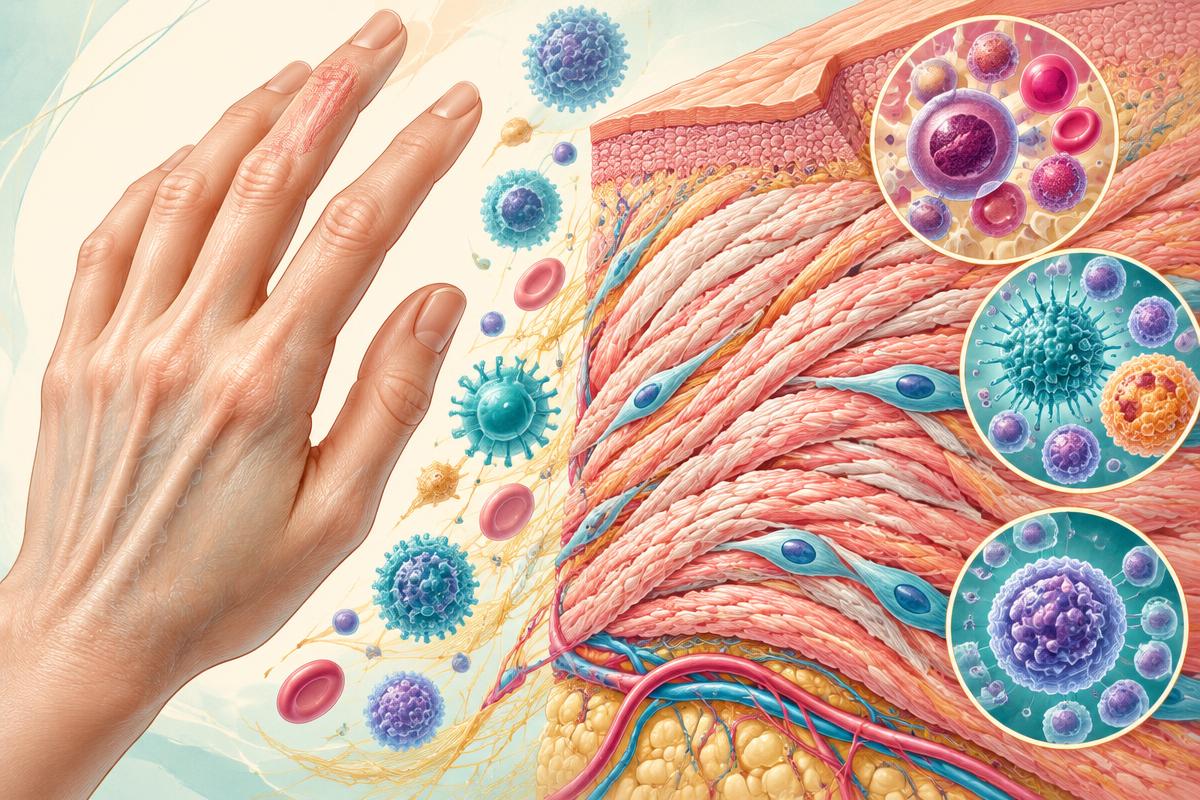
- Scleroderma is an autoimmune condition: the immune system mistakenly attacks the body's own connective tissue, triggering fibroblasts (the cells that produce collagen) to overproduce it. The exact trigger isn't fully understood, but it involves a combination of genetic susceptibility, immune system dysregulation, and likely environmental factors.
- Symptoms and Standard Care
- Common symptoms include skin thickening and tightening (often starting in the fingers), Raynaud's phenomenon (fingers turning white or blue in the cold), joint pain, and, in systemic disease, shortness of breath from lung involvement or digestive symptoms from gut involvement. Standard treatment is organized around managing whichever organ systems are affected rather than a single cure: immunosuppressive medications, drugs targeting specific complications like pulmonary hypertension or kidney crisis, physical therapy to preserve joint mobility, and careful monitoring for lung and heart involvement, which drive most of the disease's serious complications.
- Where Stem Cell Research Currently Stands
- For patients with severe, rapidly progressing systemic sclerosis involving the lungs or kidneys, autologous hematopoietic stem cell transplant (HSCT) — using a patient's own blood-forming stem cells after an immune-resetting conditioning regimen — has been studied in two major randomized trials, and the results are genuinely significant, with real caveats that matter.
- Bottom Line
- Scleroderma remains a serious, incurable autoimmune disease managed primarily through organ-specific treatment and immunosuppression. But it's also one of the clearer examples in this field of rigorously tested, randomized trial evidence showing a real survival benefit from a stem-cell-based approach — specifically autologous HSCT for a carefully selected group of patients with severe, progressive disease.
Scleroderma, also called systemic sclerosis, is a rare autoimmune disease in which the body produces too much collagen, causing the skin and, in more severe cases, internal organs to thicken and scar. It's a disease most people only learn about after a diagnosis, and one where stem cell research has produced a genuinely notable result: for a specific group of severe, high-risk patients, stem cell transplant has outperformed standard chemotherapy in large randomized trials. This article covers what scleroderma is, how it's currently treated, and honestly what the stem cell transplant evidence does and doesn't support.
What Causes Scleroderma and Who It Affects
Scleroderma is an autoimmune condition: the immune system mistakenly attacks the body's own connective tissue, triggering fibroblasts (the cells that produce collagen) to overproduce it. The exact trigger isn't fully understood, but it involves a combination of genetic susceptibility, immune system dysregulation, and likely environmental factors. It is more common in women than men and typically appears in mid-adulthood. There are two broad forms: localized scleroderma, which affects only the skin, and systemic sclerosis, which can also involve the lungs, heart, kidneys, and digestive tract — the form associated with the most serious health risks.
Symptoms and Standard Care
Common symptoms include skin thickening and tightening (often starting in the fingers), Raynaud's phenomenon (fingers turning white or blue in the cold), joint pain, and, in systemic disease, shortness of breath from lung involvement or digestive symptoms from gut involvement. Standard treatment is organized around managing whichever organ systems are affected rather than a single cure: immunosuppressive medications, drugs targeting specific complications like pulmonary hypertension or kidney crisis, physical therapy to preserve joint mobility, and careful monitoring for lung and heart involvement, which drive most of the disease's serious complications.
Where Stem Cell Research Currently Stands
For patients with severe, rapidly progressing systemic sclerosis involving the lungs or kidneys, autologous hematopoietic stem cell transplant (HSCT) — using a patient's own blood-forming stem cells after an immune-resetting conditioning regimen — has been studied in two major randomized trials, and the results are genuinely significant, with real caveats that matter.
The ASTIS trial, involving 156 patients across 27 European centers, found that over an average follow-up of seven years, transplant patients had meaningfully better long-term event-free survival (survival without persistent major organ failure) than those on standard monthly cyclophosphamide. The benefit built over time: transplant patients actually had about 2.5 times the mortality risk of the comparison group in the first four months after treatment, but by one year their risk had fallen to 61% lower, and by eight years to roughly 78% lower. That early risk was substantial: approximately 10% of transplant patients died from treatment-related causes within the first 100 days, underscoring that this is an intensive procedure reserved for carefully selected, severe cases rather than a low-risk option. Notably, the survival benefit appeared strongest in patients who had never smoked; among smokers, the long-term advantage over standard therapy largely disappeared. The separate, NIH-sponsored SCOT trial, which randomized 75 patients with diffuse disease and progressive lung or kidney involvement, similarly found better long-term outcomes with transplant than with cyclophosphamide, using a different, lower-intensity conditioning approach.
Taken together, these are among the more rigorous positive trial results in regenerative medicine for a serious autoimmune disease — genuinely good news for a subset of patients who previously had few strong options. The honest caveat is that this isn't a treatment for scleroderma broadly: it's reserved for patients with severe, progressive internal organ involvement who can tolerate an intensive procedure, it carries real upfront mortality risk, and specialists caution against overselling it to patients with milder or more stable disease.
Bottom Line
Scleroderma remains a serious, incurable autoimmune disease managed primarily through organ-specific treatment and immunosuppression. But it's also one of the clearer examples in this field of rigorously tested, randomized trial evidence showing a real survival benefit from a stem-cell-based approach — specifically autologous HSCT for a carefully selected group of patients with severe, progressive disease. That's a genuinely meaningful result. It comes bundled with real early risk, and it is not an option for most people with milder forms of the disease, which is exactly why it is handled through specialized transplant centers rather than offered broadly.
Key Questions Answered
- What is scleroderma?
- It is an autoimmune disease involving excessive collagen production and scarring. Localized disease affects skin, while systemic sclerosis can also involve the lungs, heart, kidneys and digestive tract.
- What did the ASTIS and SCOT transplant trials show?
- Both randomized trials reported better long-term outcomes with autologous HSCT than cyclophosphamide in selected severe systemic sclerosis patients. ASTIS enrolled 156 patients and SCOT enrolled 75.
- Why is transplant not offered broadly for scleroderma?
- It is intensive and carries substantial early risk: ASTIS reported approximately 10% treatment-related mortality within the first 100 days. It is reserved for carefully selected patients with severe, progressive organ involvement, not most people with mild or stable disease.
Sources
- Autologous Stem Cell Transplantation International Scleroderma (ASTIS) Trial — ISRCTN registry - https://isrctn.com/ISRCTN54371254
- ASCT Betters Cyclophosphamide for Severe Scleroderma: Long-Term Data From ASTIS and SCOT Trials, The Rheumatologist / coverage of ACR/ARHP Annual Meeting findings, 2016 - https://the-rheumatologist.org/?p=19555
- Conference coverage of ASTIS trial long-term follow-up results, MDedge/The Hospitalist - https://www.mdedge.com/node/54896
Related Articles
- Fundamentals
Types of Inherited Blood Disorders: Which Are Treated With Stem Cell Transplant?
Donor transplants and approved gene therapies offer real progress for inherited blood disorders, but conditioning risks, cost and access barriers remain substantial.
- Fundamentals
Protecting Muscle Health As You Age: What the Evidence Actually Shows
Resistance exercise has strong evidence for preserving muscle with age; protein and vitamin D show more modest, variable benefits when added to training.
- Fundamentals
What Is a Stem Cell Donor Registry, and How Does Matching Work?
What a stem cell donor registry is, how HLA matching works, what joining involves, the real odds of ever being called, and how public cord blood banking fits in.