What Is Ulcerative Colitis?
What this article covers
- What Causes It
- Doctors don't know exactly what causes ulcerative colitis, but research points to an interplay of several factors rather than one single trigger. Genetics plays a role — UC sometimes runs in families, and certain gene variants appear to raise risk — but having those genes doesn't guarantee the disease will develop.
- Symptoms
- UC symptoms vary with how much of the colon is inflamed and how active the disease is. The hallmark signs are diarrhea, blood in the stool or rectal bleeding, abdominal cramping, mucus or pus in stool, a persistent urge to pass stool even when the bowel is empty (tenesmus), and sudden urgency.
- Possible Complications
- Over time, UC can lead to anemia, bone thinning (osteopenia or osteoporosis), and, in children, growth or puberty delays. When inflammation has affected a third or more of the colon for many years, colorectal cancer risk rises, which is why regular colonoscopy surveillance is recommended.
- Standard Treatment Today
- Treatment is tailored to disease severity and how much of the colon is involved, with the goal of inducing and then maintaining remission. First-line options for mild-to-moderate disease are aminosalicylates (like mesalamine).
- Where Stem Cell Research Currently Stands
- No stem cell or cell-based therapy is currently FDA-approved to treat ulcerative colitis. That said, researchers have genuine reason for cautious optimism: mesenchymal stem cells (MSCs), typically derived from bone marrow, umbilical cord tissue, or fat, are being studied for their ability to calm the overactive immune signaling behind UC.
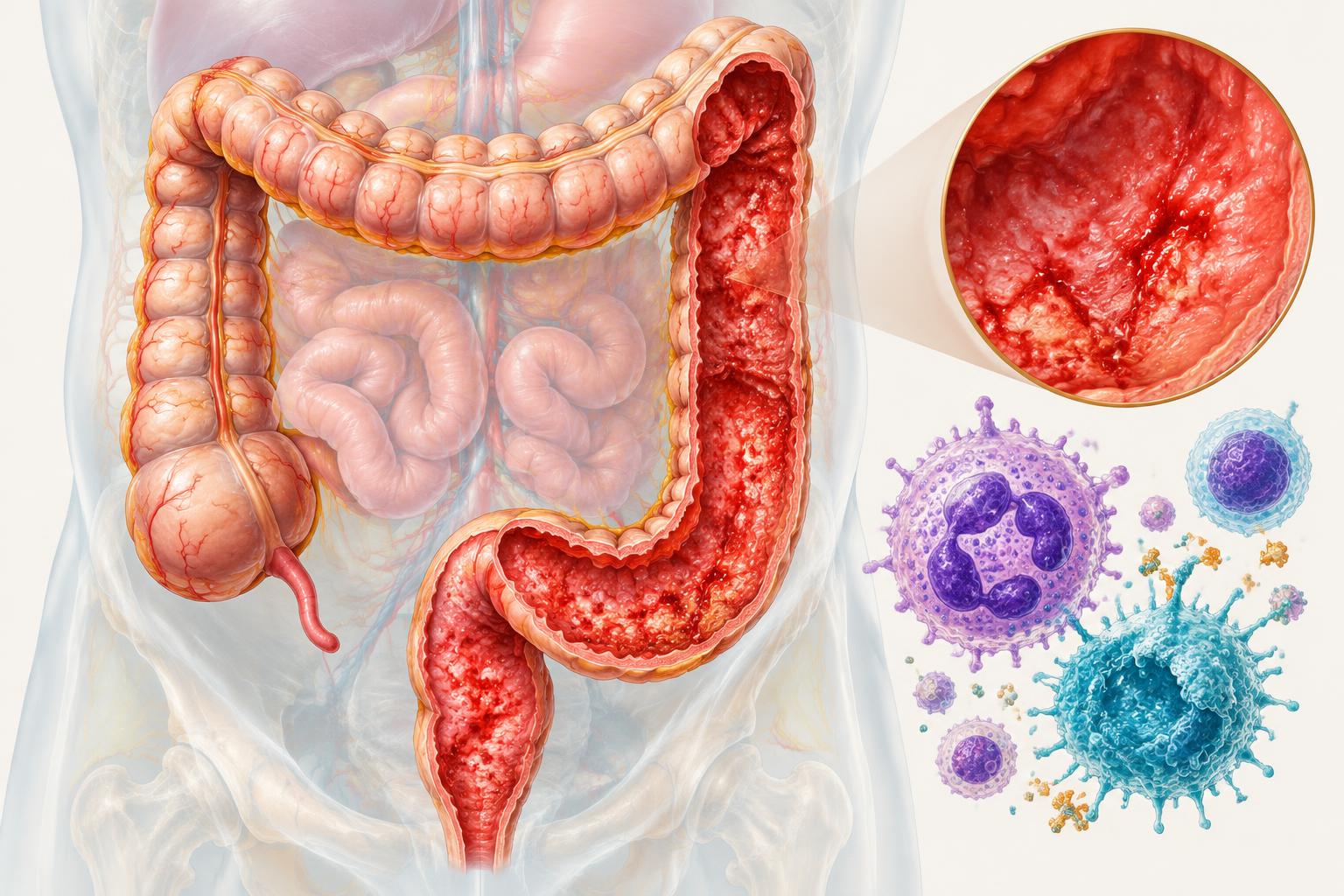
Ulcerative colitis (UC) is a chronic inflammatory bowel disease that causes ongoing inflammation and ulcers in the lining of the large intestine. It affects an estimated 600,000 to 900,000 people in the United States, with roughly 1.2% of U.S. adults (about 3.1 million) reporting a lifetime diagnosis of UC as of 2023–2024. This article explains what causes it, how it shows up day to day, how doctors manage it with medication and sometimes surgery, and gives an honest, concise snapshot of where stem cell and related cell-therapy research currently stands — a topic covered in far more depth in our companion article, "Stem Cell Therapy for Ulcerative Colitis."
What Causes It
Doctors don't know exactly what causes ulcerative colitis, but research points to an interplay of several factors rather than one single trigger. Genetics plays a role — UC sometimes runs in families, and certain gene variants appear to raise risk — but having those genes doesn't guarantee the disease will develop. Most researchers believe the core problem is an abnormal immune response: the immune system misreads the lining of the large intestine (or its resident bacteria) as a threat and mounts a sustained inflammatory attack against healthy tissue. Differences in the gut microbiome between people with and without inflammatory bowel disease have also been documented, though whether those differences are a cause or a consequence is still being studied. Environmental factors are suspected to interact with genetics, immunity, and the microbiome, but no specific exposure has been pinned down as a cause. UC most often first appears between ages 15 and 30, and risk is higher for people with a first-degree relative who has inflammatory bowel disease, and for people of Jewish descent.
Symptoms
UC symptoms vary with how much of the colon is inflamed and how active the disease is. The hallmark signs are diarrhea, blood in the stool or rectal bleeding, abdominal cramping, mucus or pus in stool, a persistent urge to pass stool even when the bowel is empty (tenesmus), and sudden urgency. Severity ranges widely: mild disease may mean fewer than four bowel movements a day, sometimes with blood, while severe disease means more than six a day, usually bloody, and can come with fatigue, fever, nausea, and weight loss. The disease typically follows a relapsing-remitting course — flares of active symptoms followed by remission that can last weeks, months, or years before symptoms return.
Possible Complications
Over time, UC can lead to anemia, bone thinning (osteopenia or osteoporosis), and, in children, growth or puberty delays. When inflammation has affected a third or more of the colon for many years, colorectal cancer risk rises, which is why regular colonoscopy surveillance is recommended. Rare but serious complications — severe bleeding, bowel perforation, and toxic megacolon — require emergency hospital care. UC can also trigger inflammation outside the gut, including in joints, skin, eyes, and the liver or bile ducts.
Standard Treatment Today
Treatment is tailored to disease severity and how much of the colon is involved, with the goal of inducing and then maintaining remission. First-line options for mild-to-moderate disease are aminosalicylates (like mesalamine). Corticosteroids control flares but aren't used long-term due to side effects. For moderate-to-severe or steroid-resistant disease, doctors turn to immunosuppressants, biologic drugs, or newer oral small-molecule medicines. Most people need some form of long-term medication to stay in remission. When medications fail, complications become life-threatening, or precancerous changes are found, surgical removal of the colon and rectum — with an ileoanal pouch or ileostomy to manage waste — can effectively cure UC, since the disease is confined to the colon.
Where Stem Cell Research Currently Stands
No stem cell or cell-based therapy is currently FDA-approved to treat ulcerative colitis. That said, researchers have genuine reason for cautious optimism: mesenchymal stem cells (MSCs), typically derived from bone marrow, umbilical cord tissue, or fat, are being studied for their ability to calm the overactive immune signaling behind UC. Early- and mid-stage trials — including a Phase IB/IIA study of an allogeneic bone-marrow-derived MSC product in people with medically refractory UC — have reported encouraging safety and some signals of clinical benefit, and newer approaches, such as MSC-derived exosomes, are now entering trials as of 2025. These results are real and worth watching, but they remain investigational: sample sizes are small, follow-up is short, and larger controlled trials are still needed before any cell therapy could be considered a standard option. Readers wanting the fuller research picture should see our companion article, "Stem Cell Therapy for Ulcerative Colitis."
Bottom Line
Ulcerative colitis is a lifelong but manageable autoimmune condition rooted in genetics, immune dysfunction, and gut biology that doctors don't yet fully understand. Standard care — anti-inflammatory and immune-modulating medications, with surgery as a potential cure in severe or refractory cases — remains the proven path to remission today. Stem cell-based approaches show early, genuinely promising signals in clinical research, but they are not an established or approved treatment, and anyone considering them should treat that research as a developing story rather than a current care option.
Key Questions Answered
- What symptoms and complications can ulcerative colitis cause?
- Common symptoms include bloody diarrhea, cramping, urgency and tenesmus, with flares and remission. Severe bleeding, perforation and toxic megacolon require emergency care, and longstanding extensive inflammation increases colorectal cancer risk.
- What treatments are established for ulcerative colitis?
- Aminosalicylates, short-term corticosteroids, immunosuppressants, biologics and oral small molecules are used according to severity. Removal of the colon and rectum can effectively cure UC in severe or refractory cases.
- Are stem cells or exosomes approved to treat UC?
- No stem cell or cell-based therapy is FDA-approved for UC. Early MSC trials report encouraging safety and some clinical benefit signals, and exosomes are entering trials, but small samples, short follow-up and the need for larger controlled studies limit conclusions.
Sources
- Definition & Facts of Ulcerative Colitis — National Institute of Diabetes and Digestive and Kidney Diseases (NIDDK), 2020 — https://www.niddk.nih.gov/health-information/digestive-diseases/ulcerative-colitis/definition-facts
- Symptoms & Causes of Ulcerative Colitis — NIDDK, 2020 — https://www.niddk.nih.gov/health-information/digestive-diseases/ulcerative-colitis/symptoms-causes
- Treatment for Ulcerative Colitis — NIDDK, 2020 — https://www.niddk.nih.gov/health-information/digestive-diseases/ulcerative-colitis/treatment
- Inflammatory Bowel Disease Among Adults Age 18 and Older: United States, 2023–2024 — National Center for Health Statistics, CDC, 2025 — https://www.cdc.gov/nchs/data/hestat/hestat122.htm
- Mesenchymal Stem Cells for the Treatment of Ulcerative Colitis: A Systematic Review and Meta-Analysis of Experimental and Clinical Studies — Stem Cell Research & Therapy, 2019 — https://stemcellres.biomedcentral.com/articles/10.1186/s13287-019-1336-4
- A Phase IB/IIA Study of Remestemcel-L, an Allogeneic Bone Marrow-Derived Mesenchymal Stem Cell Product, for the Treatment of Medically Refractory Ulcerative Colitis: An Interim Analysis — PMC, 2022 — https://pmc.ncbi.nlm.nih.gov/articles/PMC9795998/
- hucMSCs Exosomes for the Treatment of Active Ulcerative Colitis — ClinicalTrials.gov (NCT06853522), 2025 — https://clinicaltrials.gov/study/NCT06853522
Related Articles
- Fundamentals
Types of Primary Immunodeficiency: Which Are Treated With Stem Cell Transplant?
Stem cell transplant can cure selected inherited immune disorders, while gene therapies expand options and many primary immunodeficiencies need different care.
- Fundamentals
Protecting Oral and Dental Health As You Age: What the Evidence Actually Shows
Oral disease is strongly associated with systemic health, but causation remains uncertain; brushing, fluoride and dental care offer proven local benefits.
- Fundamentals
Types of Inherited Blood Disorders: Which Are Treated With Stem Cell Transplant?
Donor transplants and approved gene therapies offer real progress for inherited blood disorders, but conditioning risks, cost and access barriers remain substantial.