Stem Cell Therapy for Multiple Myeloma
What this article covers
- How the Procedure Works
- ASCT for myeloma uses the patient's own blood-forming (hematopoietic) stem cells, not the tumor-fighting cells themselves — the actual anti-myeloma effect comes from high-dose chemotherapy. The process generally follows a few steps.
- What the Evidence Shows
- The case for ASCT is strongest for progression-free survival. In the randomized DETERMINATION trial, patients who received a triplet regimen (RVd) plus early transplant had median progression-free survival of about 68 months, versus about 48 months without early transplant — roughly a year and a half of added remission time.
- Risks and Side Effects
- Because conditioning uses very high-dose chemotherapy, side effects are more intense than standard-dose chemo. The window before reinfused cells restore blood counts carries the highest infection and bleeding risk.
- Bottom Line
- " It isn't a cure or right for everyone, and its relative advantage is narrowing as newer drugs and immunotherapies (including CAR-T, covered separately on this site) improve outcomes for non-candidates or those who delay transplant. Anyone considering ASCT should discuss individualized risks, timing, and alternatives with a myeloma specialist.
For most people newly diagnosed with multiple myeloma who are healthy enough to tolerate it, autologous stem cell transplantation (ASCT) is not an experimental therapy — it's a well-established, decades-old part of standard care, typically used as "consolidation" after initial chemo-immunotherapy to deepen and extend remission. This article explains how ASCT actually works, what the clinical evidence shows about its benefits and limits, who is generally considered a candidate, and how its role is shifting as newer immunotherapies (including CAR-T cell therapy, covered elsewhere on this site) reshape myeloma care.
How the Procedure Works
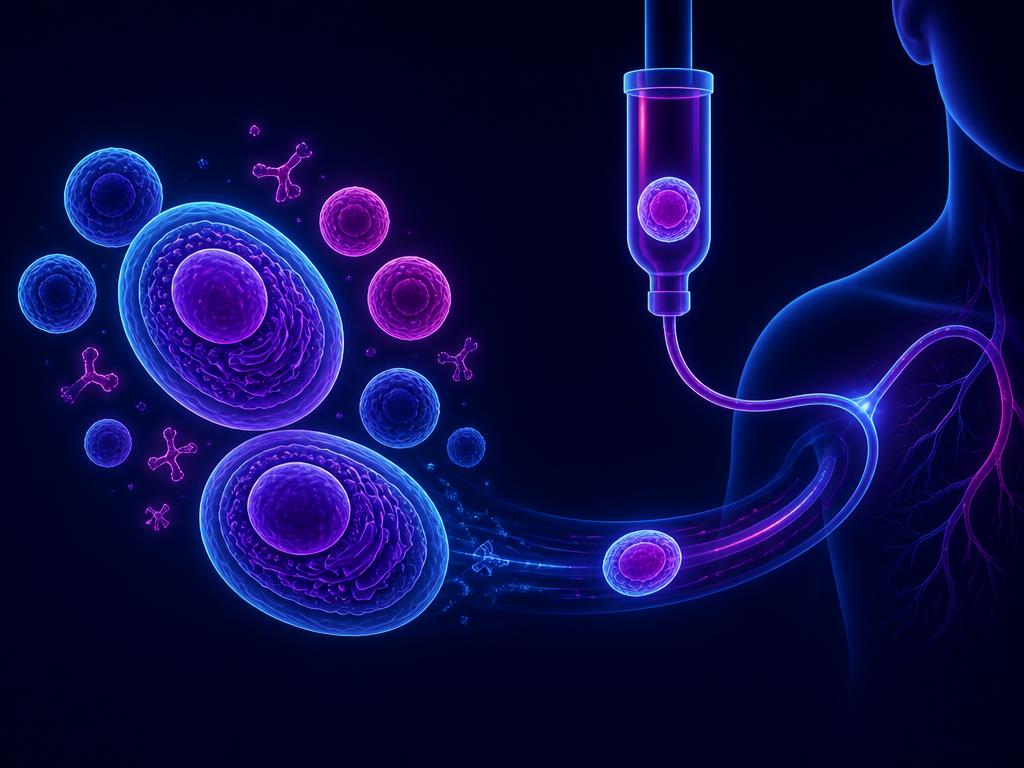
ASCT for myeloma uses the patient's own blood-forming (hematopoietic) stem cells, not the tumor-fighting cells themselves — the actual anti-myeloma effect comes from high-dose chemotherapy. The process generally follows a few steps. First, patients receive induction therapy to shrink the myeloma. Next, a mobilizing agent — usually filgrastim (G-CSF), sometimes with plerixafor — pushes stem cells out of the bone marrow into the bloodstream, where they're collected through apheresis and frozen. Patients then receive high-dose chemotherapy, almost always melphalan, which wipes out myeloma cells but also destroys normal bone marrow function. Finally, the patient's own thawed stem cells are reinfused through an IV; they travel back to the bone marrow and rebuild the blood system over the following two to three weeks, with fuller recovery taking several months. Because the cells reinfused are the patient's own, this differs fundamentally from allogeneic transplant, which uses donor cells and carries higher risks (including graft-versus-host disease); allogeneic transplant is rarely used in myeloma outside clinical trials, per the American Cancer Society.
What the Evidence Shows
The case for ASCT is strongest for progression-free survival. In the randomized DETERMINATION trial, patients who received a triplet regimen (RVd) plus early transplant had median progression-free survival of about 68 months, versus about 48 months without early transplant — roughly a year and a half of added remission time. Notably, overall survival was nearly identical between groups (around 85% at ~76 months median follow-up), largely because many who deferred transplant used it later or responded well to newer drugs at relapse. This pattern — clear PFS benefit, narrowing OS difference as newer agents enter the picture — echoes earlier trials like IFM 2009 and NCCN's evolving guidance. As of NCCN's most recent (2026) update, transplant remains part of preferred care for eligible patients, while guidelines also emphasize collecting stem cells early even if transplant is deferred. In short: ASCT can meaningfully delay relapse and is still standard of care for eligible patients, but it is not a cure, and its survival edge over "transplant now vs. later" strategies has narrowed as drug therapy improves.
Who Might Be a Candidate
- Overall physical fitness and performance status, not just chronological age
- Adequate heart, lung, kidney, and liver function
- Absence of serious uncontrolled infections or major comorbidities
- Response to induction therapy already received
- Willingness to tolerate an intensive, weeks-long process
Those who don't meet these criteria are "transplant-ineligible" and treated with drug combinations alone; many do well with modern regimens. Some eligible patients store cells and delay transplant, an approach current guidelines explicitly support.
Risks and Side Effects
Because conditioning uses very high-dose chemotherapy, side effects are more intense than standard-dose chemo. The window before reinfused cells restore blood counts carries the highest infection and bleeding risk. Mucositis, nausea, diarrhea, fatigue, and temporary hair loss are common. Most patients need a two-to-three-week hospital stay. Serious complications (life-threatening infection, rare secondary cancers) are possible but uncommon in well-selected patients, and transplant-related mortality at experienced centers is generally well under 5%.
Bottom Line
Autologous stem cell transplant is a real, evidence-backed part of multiple myeloma treatment — a decades-old, guideline-supported procedure that can meaningfully extend remission, not an unproven "stem cell therapy." It isn't a cure or right for everyone, and its relative advantage is narrowing as newer drugs and immunotherapies (including CAR-T, covered separately on this site) improve outcomes for non-candidates or those who delay transplant. Anyone considering ASCT should discuss individualized risks, timing, and alternatives with a myeloma specialist.
Sources
- Stem Cell Transplant for Multiple Myeloma — American Cancer Society, 2024 — https://www.cancer.org/cancer/types/multiple-myeloma/treating/stem-cell-transplant.html
- Autologous Stem Cell Transplant (ASCT) for Multiple Myeloma — International Myeloma Foundation — https://www.myeloma.org/autologous-stem-cell-transplant
- Improved Progression-Free Survival in Patients with Multiple Myeloma Following Three-Drug Therapy with Autologous Stem Cell Transplant (DETERMINATION Trial) — Dana-Farber Cancer Institute, 2022 — https://www.dana-farber.org/newsroom/news-releases/2022/improved-progression-free-survival-in-patients-with-multiple-myeloma-following-three-drug-therapy-with-autologous-stem-cell-transplant
- 2026 Guideline Updates in Multiple Myeloma Care — Medthority, 2026 — https://www.medthority.com/news/2026/5/2026-nccn-and-asco-multiple-myeloma-guidelines/
- NCCN Guidelines for Patients: Multiple Myeloma — National Comprehensive Cancer Network — https://www.nccn.org/patients/guidelines/content/PDF/myeloma-patient.pdf
Related Articles
- Clinical Applications
Stem Cell Therapy for Lymphoma
Autologous stem cell transplantation for lymphoma is a proven, guideline-supported treatment that lets doctors deliver high-dose chemotherapy. Here's how it works for Hodgkin and non-Hodgkin lymphoma, what the evidence shows, and where CAR-T now fits.
- Clinical Applications
Stem Cell Therapy for Bone Fracture Non-Union
Bone marrow cell therapy for fractures that won't heal: a 2025 meta-analysis of 866 patients shows 91% union rates at 12 months — but nothing is FDA-approved.
- Clinical Applications
Stem Cell Therapy for Asherman's Syndrome (Intrauterine Adhesions)
A 2025 phase 1/2 trial of CD133+ stem cells for Asherman's syndrome produced a 30% live birth rate in women who had exhausted surgical options — promising, but still investigational.