Types of Chronic Pain Conditions: Which Are Being Studied With Stem Cell Therapy?
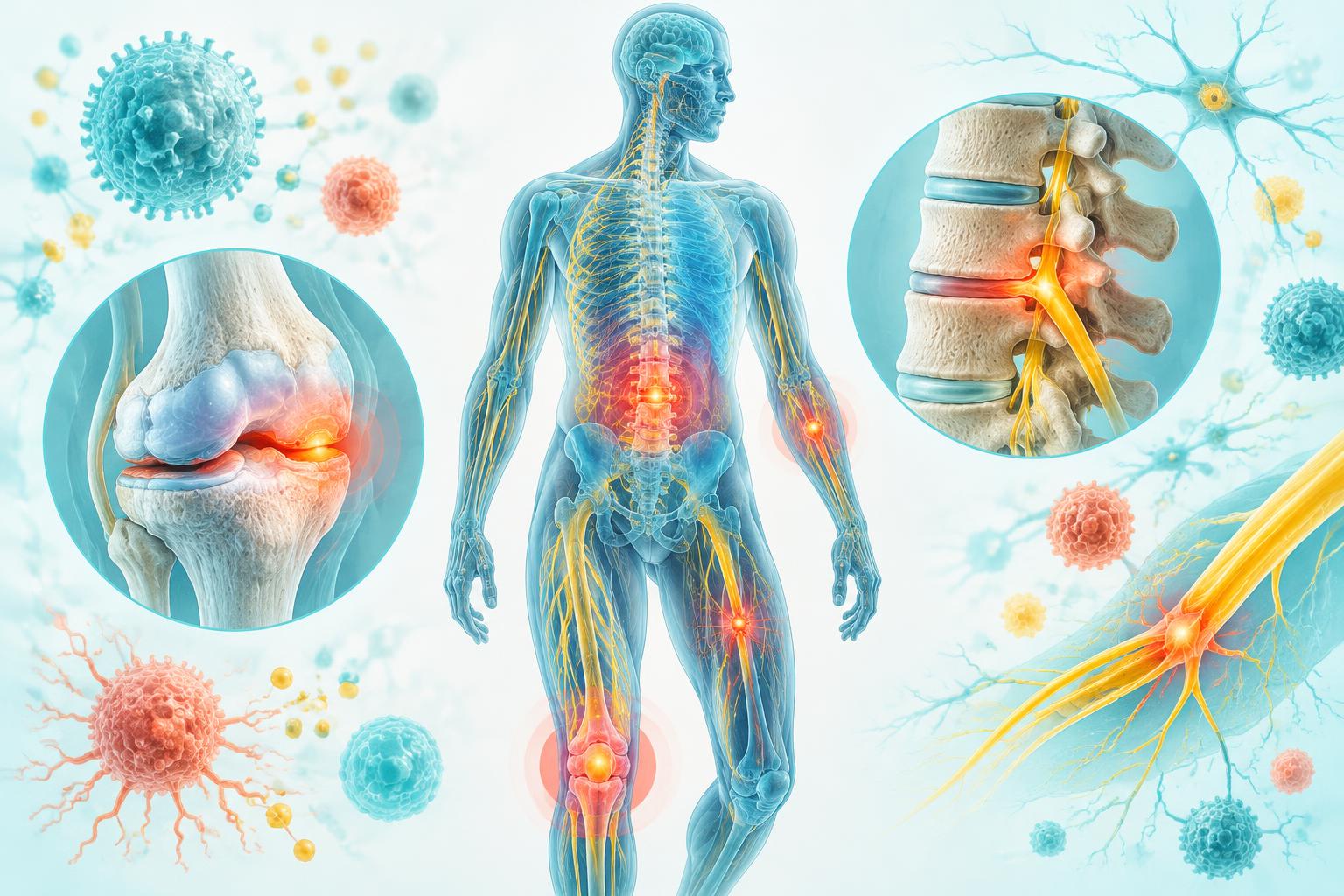
What this article covers
- Osteoarthritis and Joint Pain
- This is the category with the strongest human evidence. A 2025 dose-focused meta-analysis pooling six randomized controlled trials (roughly 300 patients across eight treatment arms) found that a single intra-articular injection of mesenchymal stem cells (MSCs) — sourced from fat, bone marrow, or umbilical cord tissue — produced a moderate-to-large improvement in WOMAC scores (which combine pain, stiffness, and function) at 12 months compared with controls.
- Degenerative Disc Disease and Chronic Low Back Pain
- This category illustrates why rigorous trials matter. The RESPINE study, a multicenter, randomized, placebo-controlled trial published in Annals of the Rheumatic Diseases (2024), tested a single intradiscal injection of allogeneic bone marrow-derived MSCs in 114 patients with chronic low back pain.
- Tendinopathy
- Early but genuinely encouraging. A phase IIa proof-of-concept study of autologous bone marrow-derived MSCs in 10 patients with chronic Achilles tendinopathy (published in Scientific Reports, 2024) reported no serious adverse events over 24 weeks and a notable pain improvement: mean MOXFQ pain scores dropped from 52 to 24, with 8 of 10 patients exceeding the threshold for a clinically meaningful change.
- Neuropathic Pain (Including Diabetic Peripheral Neuropathy)
- Mostly preclinical. Research into a specially engineered, anti-inflammatory MSC population (dubbed "MSC2") showed meaningful improvement in nerve-related symptoms in diabetic mice — around 40% improvement versus roughly 14% for conventional MSCs — a finding from Tulane University researchers that generated genuine scientific interest.
- Fibromyalgia
- The evidence here is thin. gov) has examined adipose-derived stem/stromal cells across a small group of conditions including reflex sympathetic dystrophy, complex regional pain syndrome, and fibromyalgia together — a design that itself reflects how exploratory this work still is.
"Chronic pain" is not one condition — it is a label covering mechanically distinct problems, from worn-down cartilage to misfiring nerves, and the stem cell research behind each one is at a very different stage. Some categories, particularly knee osteoarthritis, now have a real body of randomized, placebo-controlled human trial data showing a measurable signal. Others, like chronic low back pain from disc degeneration, have been tested rigorously and the results have been disappointing on the question that matters most — relieving pain better than a placebo. Still others, including fibromyalgia and most forms of neuropathic pain, remain largely preclinical or limited to single small pilot studies. This article walks through the major categories of chronic pain and summarizes, honestly, what the evidence does and does not show for each — including that no stem cell therapy is FDA-approved for any chronic pain condition today.
Osteoarthritis and Joint Pain
This is the category with the strongest human evidence. A 2025 dose-focused meta-analysis pooling six randomized controlled trials (roughly 300 patients across eight treatment arms) found that a single intra-articular injection of mesenchymal stem cells (MSCs) — sourced from fat, bone marrow, or umbilical cord tissue — produced a moderate-to-large improvement in WOMAC scores (which combine pain, stiffness, and function) at 12 months compared with controls. Seven of eight treatment arms showed statistically significant benefit, and doses of 25 million cells or fewer performed as well as or better than higher doses. The authors rated the overall certainty of evidence as low to moderate — real signal, but not yet definitive, and more and larger trials are needed before this becomes standard, FDA-sanctioned care.
Degenerative Disc Disease and Chronic Low Back Pain
This category illustrates why rigorous trials matter. The RESPINE study, a multicenter, randomized, placebo-controlled trial published in Annals of the Rheumatic Diseases (2024), tested a single intradiscal injection of allogeneic bone marrow-derived MSCs in 114 patients with chronic low back pain. The result: no meaningful difference from placebo. At 12 months, 74% of the MSC group met the responder criteria for pain and disability improvement versus 69% of the placebo group — not a statistically significant gap. The procedure was safe, with no related serious adverse events, but the trial did not demonstrate efficacy. This is an important, honest data point: a well-designed study of a real stem cell product for this specific condition came back negative on its primary endpoint.
Tendinopathy
Early but genuinely encouraging. A phase IIa proof-of-concept study of autologous bone marrow-derived MSCs in 10 patients with chronic Achilles tendinopathy (published in Scientific Reports, 2024) reported no serious adverse events over 24 weeks and a notable pain improvement: mean MOXFQ pain scores dropped from 52 to 24, with 8 of 10 patients exceeding the threshold for a clinically meaningful change. This is a real, promising signal — but the study was small, uncontrolled, and explicitly designed only to test safety, not to prove efficacy. The authors themselves called for a larger randomized trial before any conclusions about effectiveness can be drawn.
Neuropathic Pain (Including Diabetic Peripheral Neuropathy)
Mostly preclinical. Research into a specially engineered, anti-inflammatory MSC population (dubbed "MSC2") showed meaningful improvement in nerve-related symptoms in diabetic mice — around 40% improvement versus roughly 14% for conventional MSCs — a finding from Tulane University researchers that generated genuine scientific interest. But this work, and most of the broader neuropathic pain literature, remains in animal models. A handful of early human pilot studies are recruiting, but there is not yet meaningful published human efficacy data for neuropathic pain as a category.
Fibromyalgia
The evidence here is thin. A single early-phase pilot trial (registered on ClinicalTrials.gov) has examined adipose-derived stem/stromal cells across a small group of conditions including reflex sympathetic dystrophy, complex regional pain syndrome, and fibromyalgia together — a design that itself reflects how exploratory this work still is. Beyond that, fibromyalgia has essentially no dedicated, adequately powered clinical trial program behind stem cell therapy. Claims of stem cell "treatment" for fibromyalgia marketed outside research settings should be treated with significant skepticism.
Complex Regional Pain Syndrome (CRPS)
Also early-stage, but with a notable research investment behind it. In December 2022, a research institution announced a $5.5 million NIH grant — described as the first federally funded project of its kind — to develop a human mesenchymal stem cell therapy for CRPS, with collaborators at a university and another research institution. As of that announcement, the work was still preclinical: researchers were manufacturing clinical-grade cells and designing a delivery method in animal models, with human trials to follow only after that groundwork is complete. The rationale — that CRPS involves dysregulated neuroimmune signaling that immune-modulating MSCs might address — is scientifically reasonable, but no clinical trial results exist yet.
Bottom Line
The honest picture is uneven. Knee osteoarthritis has the most substantial human trial evidence, with a real (if still low-to-moderate certainty) signal for pain and function improvement. Tendinopathy has small but genuinely promising early safety and pain data. Chronic low back pain from disc degeneration has been tested rigorously and, so far, has not beaten placebo. Neuropathic pain, fibromyalgia, and CRPS remain largely preclinical or limited to pilot-scale research, with real scientific rationale but no robust human efficacy data yet. Across every one of these categories, no stem cell therapy is FDA-approved for any chronic pain indication — the FDA states plainly that no stem cell or exosome product has been approved for any orthopedic condition or for chronic pain generally, and warns that some products marketed for these uses may carry real safety risks. Anyone considering stem cell therapy for chronic pain should understand which category their condition falls into, what phase of research actually supports it, and that "promising early research" is not the same as "proven treatment."
Key Questions Answered
- Which chronic pain category has the strongest human MSC evidence?
- Knee osteoarthritis has the most substantial randomized-trial evidence, including improvements in WOMAC scores at 12 months. Certainty remains low to moderate and no stem cell therapy is FDA-approved for chronic pain.
- Did the RESPINE trial show MSC injections beat placebo for low back pain?
- No. In 114 patients, responder rates were 74% with MSCs versus 69% with placebo at 12 months, a difference that was not statistically significant.
- Are fibromyalgia, neuropathic pain and CRPS proven cell-therapy indications?
- No. These remain largely preclinical or pilot-scale areas without robust human efficacy data. The small Achilles tendinopathy study was encouraging but uncontrolled and designed for safety, not proof of effectiveness.
Sources
- Allogenic bone marrow-derived mesenchymal stromal cell-based therapy for patients with chronic low back pain: a prospective, multicentre, randomised placebo-controlled trial (RESPINE study) — Annals of the Rheumatic Diseases, 2024 — https://ard.bmj.com/content/83/11/1572
- Efficacy of a single intra-articular injection of mesenchymal stem cells for knee osteoarthritis: a dose-focused meta-analysis of randomized controlled trials — PMC, 2025 — https://pmc.ncbi.nlm.nih.gov/articles/PMC12398016/
- Autologous bone marrow derived mesenchymal stem cells are safe for the treatment of Achilles tendinopathy — Scientific Reports, 2024 — https://pmc.ncbi.nlm.nih.gov/articles/PMC11102920/
- A Step Forward for Stem Cell Therapy (MSC2 preclinical research on diabetic neuropathic pain) — Tulane University News — https://news.tulane.edu/news/step-forward-stem-cell-therapy
- Cleveland Clinic Studying Stem Cell Treatment for Complex Regional Pain Syndrome — Cleveland Clinic Newsroom, 2022 — https://newsroom.clevelandclinic.org/2022/12/14/cleveland-clinic-studying-stem-cell-treatment-for-complex-regional-pain-syndrome
- Adipose Stem/Stromal Cells in RSD, CRPS, Fibromyalgia (trial registration NCT02987855) — ClinicalTrials.gov — https://clinicaltrials.gov/study/NCT02987855
- Consumer Alert on Regenerative Medicine Products Including Stem Cells and Exosomes — U.S. Food and Drug Administration — https://www.fda.gov/vaccines-blood-biologics/consumers-biologics/consumer-alert-regenerative-medicine-products-including-stem-cells-and-exosomes
Related Articles
- Fundamentals
Protecting Liver Health As You Age: What the Evidence Actually Shows
How the liver ages, which habits genuinely protect it, and when fibrosis or hepatitis screening is actually recommended — evidence-based prevention, not lifestyle hype.
- Fundamentals
What Is Peripheral Artery Disease?
A plain-language guide to peripheral artery disease — causes, claudication and critical limb ischemia symptoms, diagnosis, standard care, and where stem cell research honestly stands today.
- Fundamentals
What Is Chimerism, and Why Do Doctors Test for It After a Stem Cell Transplant?
Chimerism testing after donor stem cell transplant: STR methods, full versus mixed donor cells, relapse warning signals and why MRD testing matters.