Autologous vs. Allogeneic CAR-T: What's the Difference?
What this article covers
- How Autologous CAR-T Works
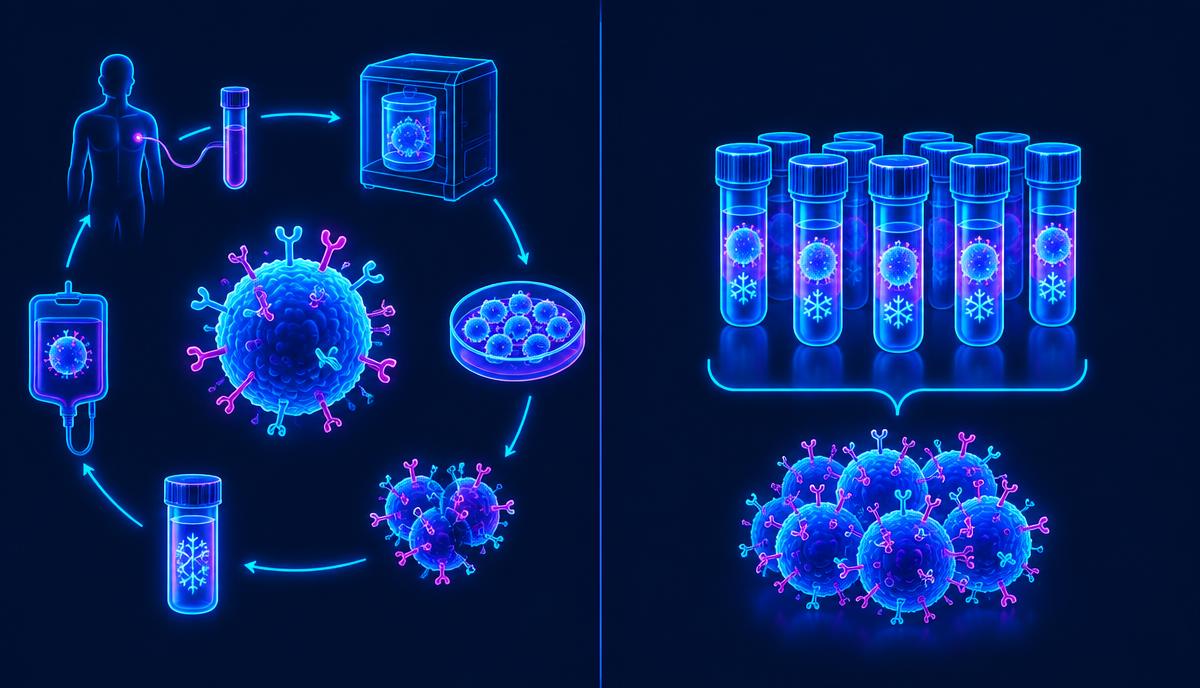
- In autologous CAR-T therapy, the process starts with leukapheresis: a patient's blood is drawn and passed through a machine that collects white blood cells, including T-cells, before returning the rest of the blood to the body. Those T-cells are shipped to a specialized manufacturing facility, where scientists use a viral vector to insert a gene for a chimeric antigen receptor (CAR) — a synthetic receptor that lets the T-cell recognize a specific protein on cancer cells, such as CD19 on certain leukemias and lymphomas.
- How Allogeneic (Off-the-Shelf) CAR-T Works
- Allogeneic CAR-T starts with T-cells from a healthy donor rather than the patient. Because donor T-cells could otherwise attack the recipient's body (graft-versus-host disease, or GVHD) or be rejected by the recipient's immune system, manufacturers use gene-editing tools — most commonly CRISPR/Cas9, along with older platforms like TALENs and newer ones like Cas-CLOVER and ARCUS — to disable the T-cell receptor gene that would otherwise drive GVHD, and often additional genes to blunt immune rejection.
- Why the Distinction Matters for Patients
- The manufacturing choice has direct clinical consequences. Autologous CAR-T's multi-week wait can be a real problem for patients whose cancer is progressing quickly, or whose own T-cells are too depleted or dysfunctional (often after multiple prior chemotherapies) to expand well in the lab.
- Where the Field Stands Today
- Early allogeneic trial data are encouraging, but the picture is still developing. In Allogene's Phase 1 ALPHA/ALPHA2 trials of cemacabtagene ansegedleucel in relapsed or refractory large B-cell lymphoma, the overall response rate was 58% across the full study (67% at the regimen selected for further development), with complete responses in 42% of patients overall — and, importantly, no cases of GVHD, severe neurotoxicity, or high-grade cytokine release syndrome.
- Bottom Line
- Autologous and allogeneic CAR-T represent two different bets on how to deliver the same core idea — a genetically engineered T-cell that hunts cancer. Autologous CAR-T is the proven, FDA-approved path today, built individually for each patient over several weeks.
CAR-T cell therapy has transformed treatment for certain blood cancers by engineering T-cells to hunt down and kill tumor cells. But not all CAR-T is built the same way. Every CAR-T product approved by the FDA today is “autologous,” made from a patient's own T-cells in a custom, weeks-long process. A newer approach, called “allogeneic” or “off-the-shelf” CAR-T, uses donor T-cells instead, with the goal of a faster, more standardized, and potentially less expensive product. This article explains how each approach works, walks through real examples in development, and lays out the genuine trade-offs — including where allogeneic CAR-T still has real, unresolved questions — so newcomers can understand why this manufacturing choice matters for patients.
How Autologous CAR-T Works
In autologous CAR-T therapy, the process starts with leukapheresis: a patient's blood is drawn and passed through a machine that collects white blood cells, including T-cells, before returning the rest of the blood to the body. Those T-cells are shipped to a specialized manufacturing facility, where scientists use a viral vector to insert a gene for a chimeric antigen receptor (CAR) — a synthetic receptor that lets the T-cell recognize a specific protein on cancer cells, such as CD19 on certain leukemias and lymphomas. The engineered cells are then expanded in culture until there are hundreds of millions of them, frozen, shipped back to the treatment center, and infused into the same patient after a short course of chemotherapy to make room for them. According to the National Cancer Institute, this entire process — from blood draw to infusion — typically takes about three to five weeks. All six CAR-T products currently approved by the FDA are autologous: Kymriah (tisagenlecleucel), Yescarta (axicabtagene ciloleucel), Tecartus (brexucabtagene autoleucel), Breyanzi (lisocabtagene maraleucel), Abecma (idecabtagene vicleucel), and Carvykti (ciltacabtagene autoleucel).
How Allogeneic (Off-the-Shelf) CAR-T Works
Allogeneic CAR-T starts with T-cells from a healthy donor rather than the patient. Because donor T-cells could otherwise attack the recipient's body (graft-versus-host disease, or GVHD) or be rejected by the recipient's immune system, manufacturers use gene-editing tools — most commonly CRISPR/Cas9, along with older platforms like TALENs and newer ones like Cas-CLOVER and ARCUS — to disable the T-cell receptor gene that would otherwise drive GVHD, and often additional genes to blunt immune rejection. Because the donor cells aren't tied to a single patient, they can be manufactured in large standardized batches, frozen, and stored ready to ship — in principle allowing treatment within days of a decision to treat, rather than weeks. Real examples currently in clinical trials include Allogene Therapeutics' cemacabtagene ansegedleucel (ALLO-501) and Caribou Biosciences' vispacabtagene regedleucel (CB-010, also known as vispa-cel). As of today, no allogeneic CAR-T product has been approved by the FDA; all remain investigational.
Why the Distinction Matters for Patients
The manufacturing choice has direct clinical consequences. Autologous CAR-T's multi-week wait can be a real problem for patients whose cancer is progressing quickly, or whose own T-cells are too depleted or dysfunctional (often after multiple prior chemotherapies) to expand well in the lab. A notable illustration comes from a Phase 1 trial of an allogeneic BCMA-targeted CAR-T for multiple myeloma, summarized by Memorial Sloan Kettering Cancer Center: nearly 90% of patients received their allogeneic cells within five days of enrolling — more than six weeks earlier than would typically be possible with autologous therapy — eliminating the need for “bridging” chemotherapy to hold the disease at bay during manufacturing. Cost is another factor: currently approved autologous CAR-T products carry list prices roughly in the $373,000–$475,000 range per infusion, driven largely by the individualized, one-patient-at-a-time manufacturing process. Allogeneic developers hope that standardized batch production could eventually lower costs and expand access, though no allogeneic product has reached the market to test that promise in practice.
Where the Field Stands Today
Early allogeneic trial data are encouraging, but the picture is still developing. In Allogene's Phase 1 ALPHA/ALPHA2 trials of cemacabtagene ansegedleucel in relapsed or refractory large B-cell lymphoma, the overall response rate was 58% across the full study (67% at the regimen selected for further development), with complete responses in 42% of patients overall — and, importantly, no cases of GVHD, severe neurotoxicity, or high-grade cytokine release syndrome. Among patients who achieved a complete response, the median duration of response was over 23 months. That program has since advanced into an ALPHA3 pivotal trial. Caribou Biosciences' vispa-cel, tested in the Phase 1 ANTLER trial for large B-cell lymphoma, reported overall response rates of 82–86% and complete response rates around 63–64% across its cohorts. Both programs carry FDA Regenerative Medicine Advanced Therapy (RMAT) designation, a status meant to expedite development of promising cell and gene therapies — but neither is approved, and larger, randomized trials are still needed to confirm safety and durability at scale. A key open question researchers are still studying is persistence: because the immune system can eventually clear donor-derived allogeneic cells, some data suggest these cells may survive in the body for a shorter window compared with autologous cells, which could affect how long protection against relapse lasts.
Bottom Line
Autologous and allogeneic CAR-T represent two different bets on how to deliver the same core idea — a genetically engineered T-cell that hunts cancer. Autologous CAR-T is the proven, FDA-approved path today, built individually for each patient over several weeks. Allogeneic, off-the-shelf CAR-T is a promising and fast-moving area of investigation, with early trial data showing strong response rates, encouraging durability in at least one program, and a much faster path to treatment for patients who can't wait. But it remains investigational: no allogeneic CAR-T product is FDA-approved anywhere as of this writing, and questions about long-term cell persistence and rejection are still being actively studied in ongoing trials. Patients and caregivers evaluating CAR-T options today will, for now, be considering one of the six approved autologous products — with allogeneic therapies to watch as trial data continue to mature.
Sources
- Approved Cellular and Gene Therapy Products — U.S. Food and Drug Administration — https://www.fda.gov/vaccines-blood-biologics/cellular-gene-therapy-products/approved-cellular-and-gene-therapy-products
- CAR T Cells: Engineering Immune Cells to Treat Cancer — National Cancer Institute, 2025 — https://www.cancer.gov/about-cancer/treatment/research/car-t-cells
- The paths and challenges of “off-the-shelf” CAR-T cell therapy: An overview of clinical trials — Biomedicine & Pharmacotherapy, 2023 — https://www.sciencedirect.com/science/article/pii/S0753332223016864
- Allogeneic CAR T Cell Therapy for Multiple Myeloma Shows Promise — Memorial Sloan Kettering Cancer Center — https://www.mskcc.org/clinical-updates/allogeneic-car-cell-therapy-multiple-myeloma-shows-promise
- Allogene Therapeutics Announces Publication of Durable Response Data from Phase 1 ALPHA/ALPHA2 Trials of Cemacabtagene Ansegedleucel (ALLO-501) in the Journal of Clinical Oncology — Allogene Therapeutics, 2025 — https://ir.allogene.com/news-releases/news-release-details/allogene-therapeutics-announces-publication-durable-response/
- Caribou Biosciences Announces Positive Data from ANTLER Phase 1 Trial Demonstrating Efficacy and Durability of Vispa-cel (CB-010) — Caribou Biosciences, 2026 — https://investor.cariboubio.com/news-releases/news-release-details/caribou-biosciences-announces-positive-data-antler-phase-1-trial
- Allogeneic vs Autologous CAR T-Cell Therapy Explained — AJMC — https://www.ajmc.com/view/allogeneic-vs-autologous-car-t-cell-therapy-explained
Related Articles
- Fundamentals
What Is a Cancer Vaccine? Preventive vs. Therapeutic Vaccines Explained
Preventive HPV and hepatitis B vaccines are proven cancer-prevention tools. Therapeutic cancer vaccines are a harder, mostly still-investigational problem.
- Fundamentals
CAR-T Therapy vs. Bone Marrow Transplant: What's the Difference?
Both give patients cells back, but a transplant rebuilds a destroyed blood system while CAR-T arms the existing immune system — different risks, different candidates, and increasingly used in sequence.
- Fundamentals
What Is the Tumor Microenvironment, and Why Does It Blunt Immunotherapy?
Tumors build a hostile neighborhood that excludes, exhausts, and disables immune cells. Here's what "hot" and "cold" tumors really mean — and how researchers are remodeling the terrain.