Bispecific Antibody Etentamig Nearly Doubles Response Rates in Hard-to-Treat Multiple Myeloma, Phase 3 Trial Shows
What this article covers
- What This Article Covers
- On September 3, 2026, AbbVie announced topline results from CERVINO, a global Phase 3 trial testing etentamig — an investigational BCMA x CD3 bispecific antibody — against standard therapy in patients with triple-class exposed relapsed/refractory multiple myeloma, a population that has already failed the three major drug classes used to treat the disease. The trial met both of its primary endpoints, nearly doubling response rates and cutting the risk of progression or death by 60%.
- What CERVINO Tested
- CERVINO enrolled 393 patients with triple-class exposed relapsed/refractory multiple myeloma, meaning they had already been treated with a proteasome inhibitor, an immunomodulatory drug, and an anti-CD38 monoclonal antibody — the three pillars of modern myeloma treatment. Patients had received a median of three prior lines of therapy.
- The Headline Results
- The numbers here are strong by any standard for this patient population. 0001) — a near-doubling of the share of patients whose disease measurably shrank.
- A Promising Survival Signal — With a Real Caveat
- 0012). That is an encouraging trend in the right direction, and worth taking seriously.
- The Safety Picture
- No effective therapy in this drug class comes free of toxicity, and CERVINO's safety data should be read plainly rather than minimized. 3% rate and no grade 3 or higher events in the subgroup receiving the single step-up dosing regimen), and the vast majority of cases were low-grade (grade 1-2), consistent with the drug's engineered low-affinity CD3 design.
What This Article Covers
On September 3, 2026, AbbVie announced topline results from CERVINO, a global Phase 3 trial testing etentamig — an investigational BCMA x CD3 bispecific antibody — against standard therapy in patients with triple-class exposed relapsed/refractory multiple myeloma, a population that has already failed the three major drug classes used to treat the disease. The trial met both of its primary endpoints, nearly doubling response rates and cutting the risk of progression or death by 60%. Full data were presented later that month. The results are genuinely encouraging for a hard-to-treat population, but etentamig remains an investigational drug with no regulatory approval anywhere, and an important secondary measure — overall survival — has not yet crossed the statistical threshold needed to call it a confirmed benefit.
What CERVINO Tested
CERVINO enrolled 393 patients with triple-class exposed relapsed/refractory multiple myeloma, meaning they had already been treated with a proteasome inhibitor, an immunomodulatory drug, and an anti-CD38 monoclonal antibody — the three pillars of modern myeloma treatment. Patients had received a median of three prior lines of therapy. They were randomized 1:1 to either etentamig or investigator's choice of one of three standard regimens: carfilzomib plus dexamethasone, elotuzumab plus pomalidomide and dexamethasone, or selinexor plus bortezomib and dexamethasone.
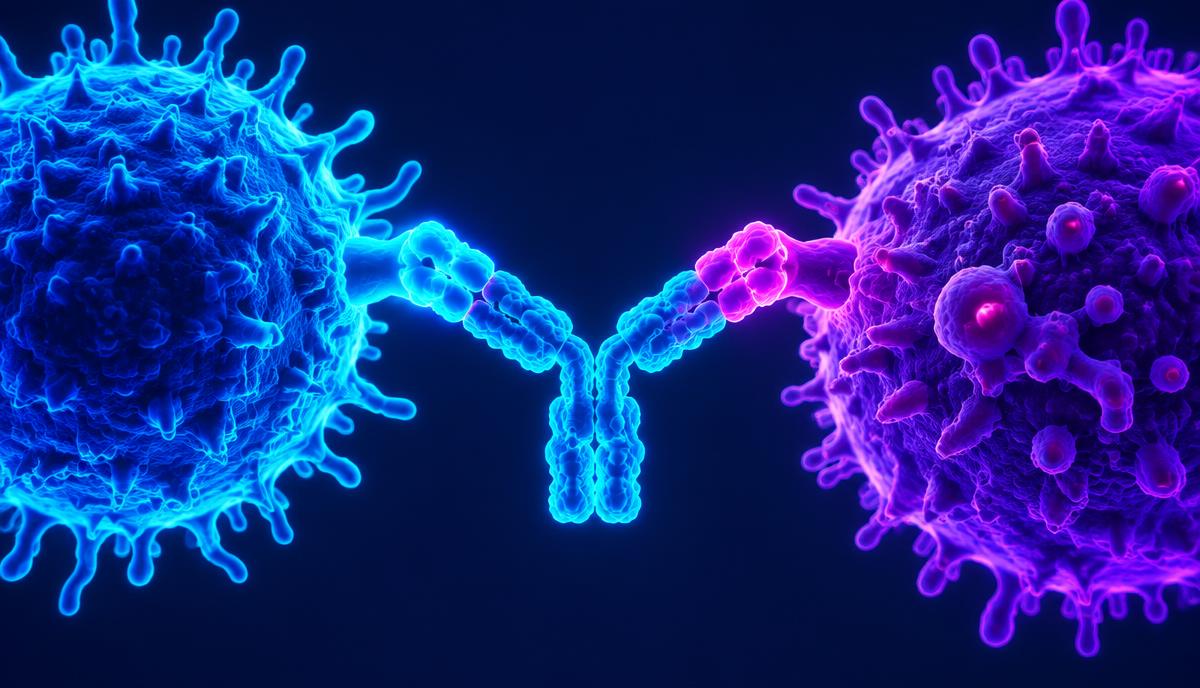
Etentamig is a second-generation bispecific antibody T-cell engager, designed to physically link a patient's own T cells to myeloma cells expressing the BCMA protein. Its design pairs a deliberately low-affinity CD3-binding arm — intended to reduce the intensity of T-cell activation and lower the risk of cytokine release syndrome — with a high-avidity, two-pronged BCMA-binding arm meant to grip tumor cells tightly. It also retains FcRn binding, which extends the antibody's half-life and allows dosing just once every four weeks after an initial step-up dose, a notably convenient schedule for a T-cell engaging therapy.
The Headline Results
The numbers here are strong by any standard for this patient population. Etentamig produced an objective response rate of 74.0%, compared with 45.7% for standard therapy (P<0.0001) — a near-doubling of the share of patients whose disease measurably shrank. Deeper responses told a similar story: roughly 40% of etentamig patients achieved a complete response or better, versus about 7% on standard therapy.
On progression-free survival, the co-primary endpoint, median PFS had not yet been reached in the etentamig arm at the time of analysis, versus 6.2 months with standard therapy — a hazard ratio of 0.40 (95% CI, 0.29-0.54; P<0.0001), representing a 60% reduction in the risk of disease progression or death. At 12 months, 62.1% of etentamig patients remained progression-free, compared with 28.4% on standard therapy. Lead investigator Peter Voorhees, MD, of Atrium Health Levine Cancer Institute, noted that CERVINO enrolled a more heavily pretreated population than has been reflected in prior published bispecific antibody trials in myeloma — a meaningful detail, since outcomes typically worsen with each additional prior line of therapy.
A Promising Survival Signal — With a Real Caveat
Overall survival data also favored etentamig: 87.9% of patients were alive at 12 months, versus 72.0% on standard therapy, a hazard ratio of 0.48 (95% CI, 0.29-0.77; nominal P=0.0012). That is an encouraging trend in the right direction, and worth taking seriously.
It is not, however, a statistically confirmed survival benefit. Overall survival was a secondary endpoint with its own prespecified statistical efficacy boundary, and that boundary was not crossed at this interim analysis — the data remain immature, and the trial will need longer follow-up before survival can be reported as a definitively established benefit rather than a favorable early trend.
The Safety Picture
No effective therapy in this drug class comes free of toxicity, and CERVINO's safety data should be read plainly rather than minimized. Cytokine release syndrome occurred in about 39.5% of etentamig-treated patients overall (with a lower 28.3% rate and no grade 3 or higher events in the subgroup receiving the single step-up dosing regimen), and the vast majority of cases were low-grade (grade 1-2), consistent with the drug's engineered low-affinity CD3 design. Immune effector cell-associated neurotoxicity syndrome (ICANS) occurred in roughly 3.6% of patients overall. Grade 3/4 infections were more common with etentamig than with standard therapy — 27.7% versus 19.2% — a known class effect of BCMA-targeted T-cell engagers that clinicians will need to monitor closely, particularly given this is intended as chronic, ongoing therapy rather than a short course.
What Happens Next
These are topline and conference-presented results from a single company-sponsored trial — strong signals, but not yet a full peer-reviewed publication, and not yet a regulatory decision. AbbVie has said it plans to discuss the CERVINO data with global regulatory authorities to determine next steps. Etentamig is investigational and has not been approved by the FDA, the EMA, or any other regulator. Patients and clinicians should not expect near-term availability; any path to approval will still require regulatory review, and the current survival data will mature with more follow-up time.
Bottom Line
For patients who have already exhausted the three major classes of myeloma therapy and are running out of good options, CERVINO's results are a legitimately exciting data point: a convenient, monthly bispecific antibody that nearly doubled response rates and cut the risk of progression by 60% relative to standard salvage regimens. That said, the overall survival advantage — while directionally favorable — has not yet met its statistical bar, and real toxicities (CRS, infections, and a smaller rate of neurotoxicity) occurred and will need careful long-term management. Etentamig is not an approved treatment, and this is one trial's early results, not a settled verdict. The responsible read is cautious optimism: a promising step for a genuinely underserved patient population, with regulatory review and longer-term data still ahead.
Sources
- Etentamig Meets Dual Primary End Points in Triple-Class Exposed R/R Myeloma — OncLive (September 3, 2026) — https://www.onclive.com/view/etentamig-meets-dual-primary-end-points-in-triple-class-exposed-r-r-myeloma
- Etentamig Improves Responses and Progression-Free Survival in Relapsed Multiple Myeloma — CURE Today (September 3, 2026) — https://www.curetoday.com/view/etentamig-improves-responses-and-progression-free-survival-in-relapsed-multiple-myeloma
- Etentamig Improves Response and PFS vs Standard Therapies in Triple-Class Exposed Relapsed/Refractory Myeloma — OncLive (September 25, 2026) — https://www.onclive.com/view/etentamig-improves-response-and-pfs-vs-standard-therapies-in-triple-class-exposed-relapsed-refractory-myeloma
- Etentamig Shows Superior Efficacy vs SOC in Relapsed/Refractory Myeloma — Cancer Network (2026) — https://www.cancernetwork.com/view/etentamig-shows-superior-efficacy-vs-soc-in-relapsed-refractory-myeloma
- AbbVie Announces Positive Topline Results from the Phase 3 CERVINO Trial — AbbVie Newsroom (September 3, 2026) — https://news.abbvie.com/2026-09-03-AbbVie-Announces-Positive-Topline-Results-from-the-Phase-3-CERVINO-Trial-Showing-Etentamig-Significantly-Improved-Response-Rate-and-Progression-Free-Survival-in-Patients-with-Relapsed-Refractory-Multiple-Myeloma
Related Articles
- Clinical Applications
New CAR-T Comparison Data Suggest Anito-cel May Match Carvykti's Efficacy With Far Fewer Neurological Side Effects
An indirect 2026 myeloma comparison finds similar responses for investigational anito-cel and approved Carvykti, with fewer safety events; not a head-to-head trial.
- Clinical Applications
Anito-Cel Shows Deep, Durable Responses in Hard-to-Treat Multiple Myeloma: What the Phase 1 Data Actually Show
All 38 patients in a Phase 1 trial of the BCMA CAR-T anito-cel responded, with nearly 80% in complete response and no delayed neurotoxicity — encouraging, but still early, single-arm evidence.
- Clinical Applications
What Does the FDA's CAR-T Boxed Warning on Secondary Cancers Actually Show?
The FDA's 2024 class-wide boxed warning on secondary T-cell cancers after CAR-T flagged a real signal — but the largest datasets since show the absolute risk is low and CAR-T's benefits still outweigh it.