Can Stem Cells Help With Achilles Tendinopathy?
What this article covers
- WHAT THIS ARTICLE COVERS
- Achilles tendinopathy is a common, often stubborn cause of heel and calf pain that can resist months of standard care. A small first-in-human trial has tested whether injecting a patient's own bone-marrow stem cells into the damaged tendon is safe and might speed healing.
- What Is Achilles Tendinopathy?
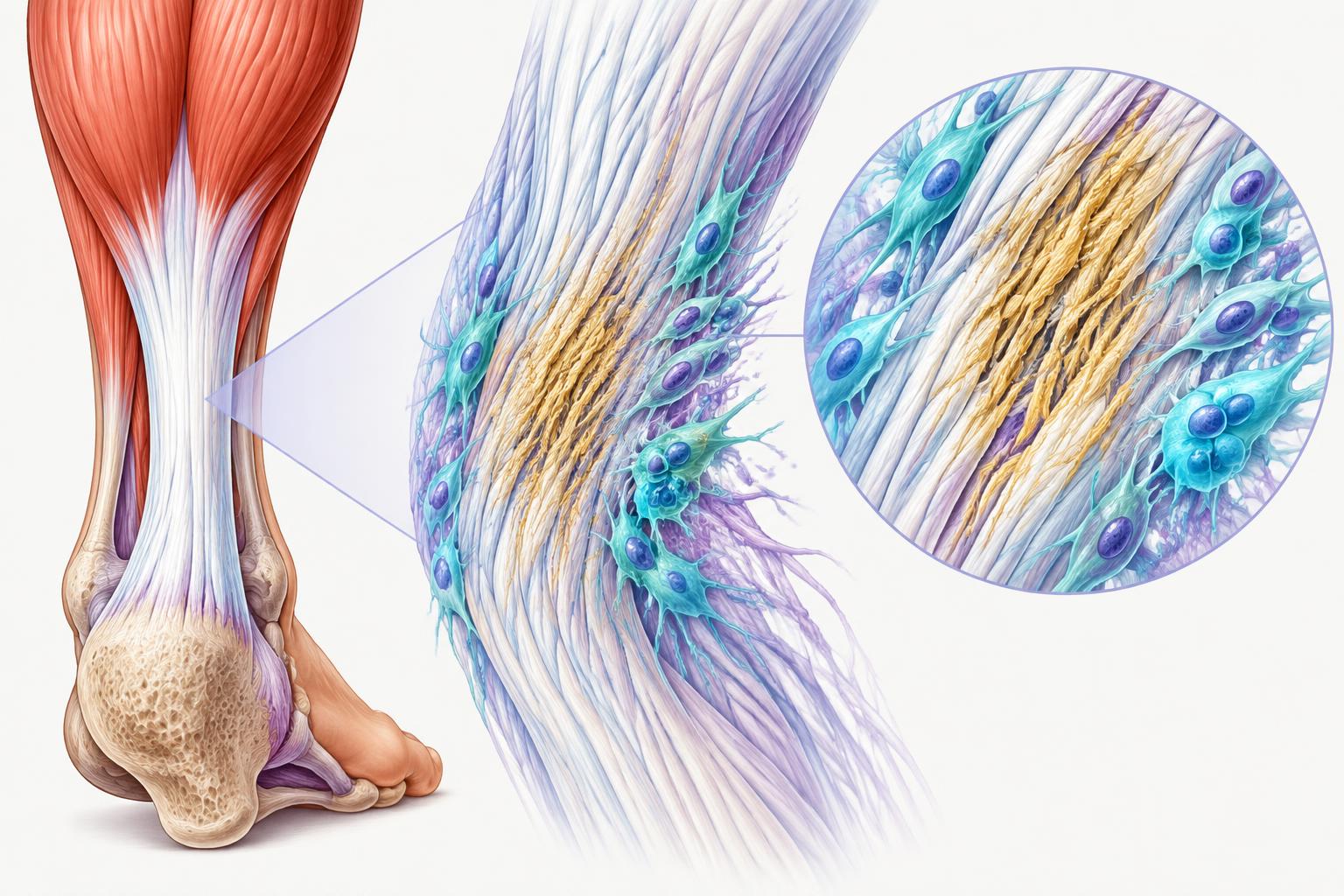
- Achilles tendinopathy is a degenerative, overuse-related condition of the tendon connecting the calf muscles to the heel bone, marked by pain, stiffness, and swelling that worsens with activity. It most often affects the mid-portion of the tendon, though it can also occur at the insertion.
- How It's Thought to Work
- The theory centers less on cells becoming new tendon tissue and more on what they secrete. Mesenchymal stem cells (MSCs) are thought to act mainly through paracrine signaling — releasing growth factors, cytokines, and extracellular vesicles that may shift the local environment away from disorganized scar-type repair and toward more organized healing, while also modulating inflammation.
- What the Evidence Shows
- gov. Ten adults with chronic mid-portion Achilles tendinopathy who had failed conservative treatment received a single ultrasound-guided injection of their own culture-expanded bone-marrow MSCs, plus a 12-week eccentric-loading physiotherapy program.
- Bottom Line
- Stem cell injections for Achilles tendinopathy are an area of real, if early, promise: a small first-in-human trial found the approach safe and reported meaningful pain and function improvements in most participants — an encouraging signal worth taking seriously. But it comes from one uncontrolled study of ten people, and the researchers who ran it were explicit that a controlled trial is needed before anyone can say the cells themselves, rather than the injection process or physical therapy, are driving the benefit.
WHAT THIS ARTICLE COVERS
Achilles tendinopathy is a common, often stubborn cause of heel and calf pain that can resist months of standard care. A small first-in-human trial has tested whether injecting a patient's own bone-marrow stem cells into the damaged tendon is safe and might speed healing. This article covers what that trial and the surrounding research show, how the approach is thought to work, and why — despite a promising early signal — it remains investigational rather than approved or proven.
What Is Achilles Tendinopathy?
Achilles tendinopathy is a degenerative, overuse-related condition of the tendon connecting the calf muscles to the heel bone, marked by pain, stiffness, and swelling that worsens with activity. It most often affects the mid-portion of the tendon, though it can also occur at the insertion. It's especially common among runners, but also affects non-athletic middle-aged and older adults. Unlike an acute tear, tendinopathy involves microscopic collagen disorganization and failed healing rather than simple inflammation — part of why it can drag on for months or years. First-line treatment is conservative: eccentric calf-loading exercise, activity modification, and sometimes shockwave therapy; a meaningful subset of patients still have persistent pain after exhausting these options.
How It's Thought to Work
The theory centers less on cells becoming new tendon tissue and more on what they secrete. Mesenchymal stem cells (MSCs) are thought to act mainly through paracrine signaling — releasing growth factors, cytokines, and extracellular vesicles that may shift the local environment away from disorganized scar-type repair and toward more organized healing, while also modulating inflammation. Researchers are careful to call this a working hypothesis: reviews of the tendon-regeneration literature suggest direct differentiation into tendon cells may matter less than these signaling effects, and results across cell types and delivery methods have been inconsistent.
What the Evidence Shows
The most relevant human data comes from a 2024 Phase IIa, open-label, uncontrolled trial published in Scientific Reports (Goldberg et al.), registered on ClinicalTrials.gov. Ten adults with chronic mid-portion Achilles tendinopathy who had failed conservative treatment received a single ultrasound-guided injection of their own culture-expanded bone-marrow MSCs, plus a 12-week eccentric-loading physiotherapy program. The primary goal was safety, and results were reassuring: no serious adverse events occurred (0%, 95% CI 0–31%, reflecting the small sample), with no complications from the harvest or injection.
The secondary, efficacy-related findings give real reason for cautious optimism. By 24 weeks, average VISA-A function scores rose from 41 to 61 (of 100), and pain scores roughly halved; 8 of 10 patients (80%) met the threshold for a clinically meaningful improvement — genuinely good numbers for people who'd already failed other treatments. But the authors flagged the trial's core limitation: with no control group and physiotherapy given to everyone, the study cannot separate a true cell effect from the needling, the exercise, or natural symptom fluctuation, and they called for a larger, randomized Phase IIb trial before drawing firmer conclusions.
A broader 2023 systematic review in Medicina, covering 32 studies on adipose-derived stem cells and stromal vascular fraction for tendinopathy (10 in humans), reached a similarly measured verdict: these approaches are a "promising alternative," but the field lacks standardized protocols and needs more randomized trials. Other reviews of the tendon-regeneration literature note inconsistent results between studies — some comparisons failed to reach statistical significance, and in one study a scaffold alone performed as well as a stem cell–seeded one.
Who Might Be a Candidate
This research has generally centered on people who:
- Have chronic (typically 6+ months), imaging-confirmed mid-portion Achilles tendinopathy
- Have already tried and failed a supervised eccentric-loading exercise program and other standard conservative care
- Are not dealing with an acute, complete tendon rupture (a different problem requiring different management)
- Are being evaluated through a registered clinical trial rather than a direct-to-consumer clinic selling the injection as a stand-alone procedure
- Have realistic expectations that this is investigational and unapproved, not a guaranteed fix
Bottom Line
Stem cell injections for Achilles tendinopathy are an area of real, if early, promise: a small first-in-human trial found the approach safe and reported meaningful pain and function improvements in most participants — an encouraging signal worth taking seriously. But it comes from one uncontrolled study of ten people, and the researchers who ran it were explicit that a controlled trial is needed before anyone can say the cells themselves, rather than the injection process or physical therapy, are driving the benefit. No stem cell product is FDA-approved for Achilles tendinopathy or any orthopedic condition; the FDA's only approved stem cell products are cord-blood-derived cells for certain blood disorders, and the agency has warned that unapproved regenerative medicine products are being marketed for orthopedic conditions outside legitimate trials. Anyone considering this approach should treat it as experimental, favor a registered trial over a paid clinic offering, and view marketing claims with skepticism until larger, controlled studies appear.
Key Questions Answered
- What did the small Achilles tendinopathy trial find?
- Ten adults received their own bone-marrow MSCs plus physiotherapy. No serious adverse events occurred, and eight met the threshold for clinically meaningful improvement by 24 weeks, but there was no control group.
- Can the study show that stem cells caused the improvement?
- No. The uncontrolled study cannot separate effects of the cells from needling, physiotherapy or natural symptom fluctuation. A larger randomized trial is needed.
- Is stem cell treatment approved for Achilles tendinopathy?
- The article describes this as investigational and unapproved. Anyone considering it should favor a registered clinical trial rather than a paid clinic offering a guaranteed fix.
Sources
- Goldberg AJ, Masci L, O'Donnell P, et al. "Autologous bone marrow derived mesenchymal stem cells are safe for the treatment of Achilles tendinopathy." — Scientific Reports, 2024 — https://pmc.ncbi.nlm.nih.gov/articles/PMC11102920/
- ClinicalTrials.gov. "Autologous Stem Cells in Achilles Tendinopathy" (NCT02064062) — U.S. National Library of Medicine — https://clinicaltrials.gov/study/NCT02064062
- "Efficacy of Adipose-Derived Mesenchymal Stem Cells and Stromal Vascular Fraction Alone and Combined to Biomaterials in Tendinopathy or Tendon Injury: Systematic Review of Current Concepts." — Medicina, 59(2):273, 2023 — https://www.ncbi.nlm.nih.gov/pmc/articles/PMC9963687/
- "Tendon healing in the era of regenerative medicine: literature review." — Annals of Translational Medicine — https://atm.amegroups.org/article/view/149990/html
- U.S. Food and Drug Administration. "Important Patient and Consumer Information About Regenerative Medicine Therapies." — FDA.gov — https://www.fda.gov/vaccines-blood-biologics/consumers-biologics/important-patient-and-consumer-information-about-regenerative-medicine-therapies
Related Articles
- Clinical Applications
Can Stem Cells Help With Cystic Fibrosis?
Cystic fibrosis MSC safety-trial findings, preclinical anti-inflammatory research and lung organoids for drug testing — without established treatment efficacy.
- Clinical Applications
Exosome Therapy for Hair Loss in Turkey: What's Actually Happening
Turkey's exosome hair-treatment add-ons, new tissue and cell rules, limited human evidence and product-traceability questions for patients.
- Clinical Applications
Does a Higher Price Tag Mean a Better, Safer Stem Cell Treatment?
Why cash-pay stem cell pricing does not establish efficacy or safety, and how trial-backed approved cell therapies differ from unproven injections.