Can Stem Cells Help With Cystic Fibrosis?
What this article covers
- What This Article Covers
- Cystic fibrosis (CF) is a genetic disease in which a faulty CFTR protein causes thick mucus to build up in the lungs and digestive tract, driving chronic infection, inflammation, and progressive lung damage. While CFTR modulator drugs have transformed outcomes for many patients with eligible mutations, they don't help everyone, and they don't reverse existing lung scarring.
- Overview
- Cystic fibrosis affects roughly 40,000 people in the United States and remains a lifelong, progressive condition even with modern therapy. Because CFTR modulators work only for patients with specific, responsive mutations, researchers have been exploring "mutation-agnostic" strategies — treatments that might help regardless of which CFTR variant a person carries.
- How It's Thought to Work
- MSCs are not intended to fix the underlying CFTR gene defect. Instead, the working hypothesis is that infused MSCs travel to inflamed, damaged areas of the lung, where they release signaling molecules that dial down excessive immune activity, help clear bacterial colonization, and potentially support repair of injured airway tissue — all while leaving enough inflammatory response intact to keep infections in check.
- What the Evidence Shows
- gov NCT02866721). Reporting on the completed trial noted no dose-limiting toxicities, deaths, or life-threatening adverse events among the roughly dozen adults treated, with vital signs, spirometry, and safety labs showing no meaningful change from baseline.
- Who Might Be a Candidate
- Stem cell therapy for CF is not an approved treatment, and there is currently no clinic or program offering it outside of regulated clinical trials.
What This Article Covers
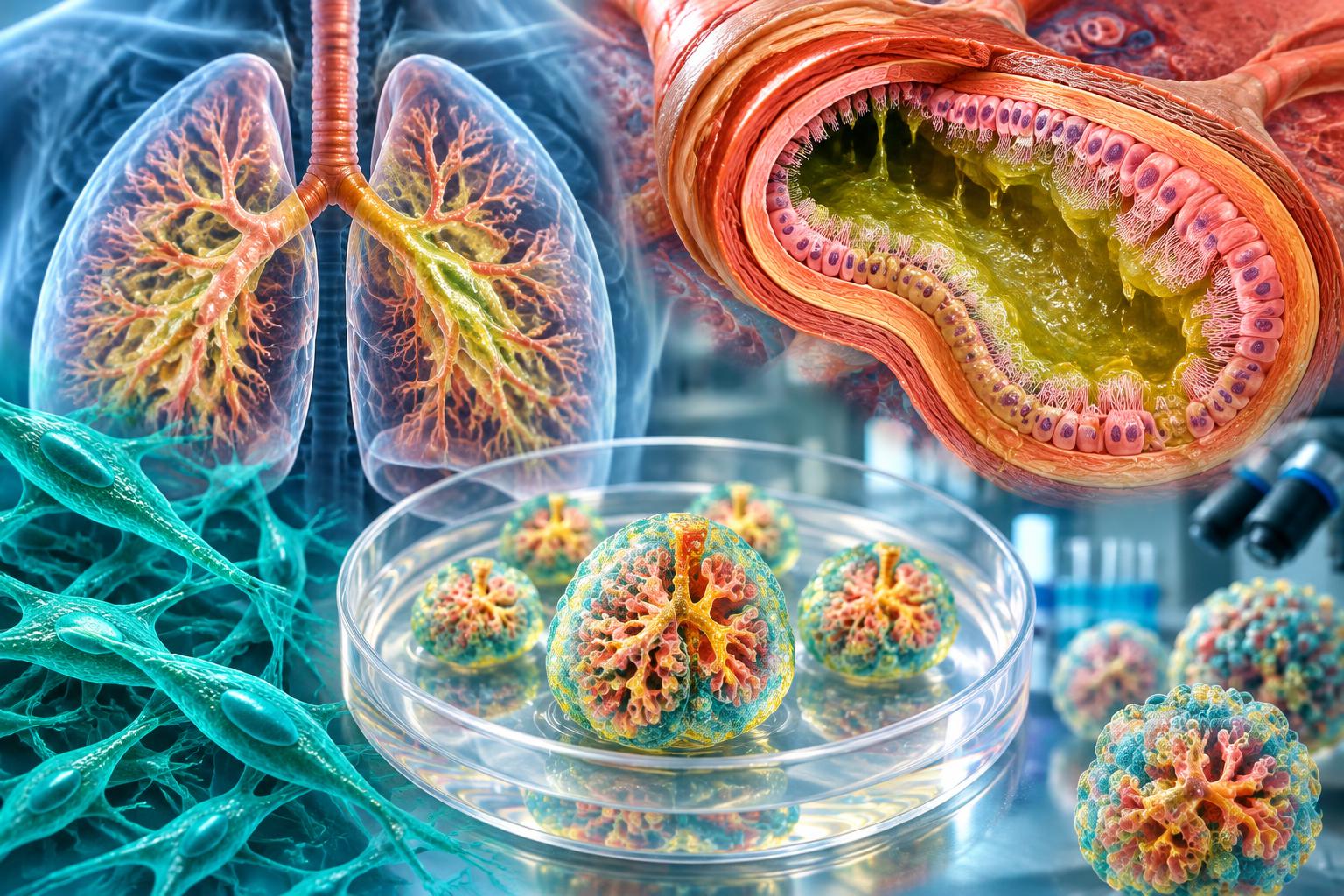
Cystic fibrosis (CF) is a genetic disease in which a faulty CFTR protein causes thick mucus to build up in the lungs and digestive tract, driving chronic infection, inflammation, and progressive lung damage. While CFTR modulator drugs have transformed outcomes for many patients with eligible mutations, they don't help everyone, and they don't reverse existing lung scarring. This has prompted early-stage research into whether stem cell–based approaches — particularly mesenchymal stem cells (MSCs) and lab-grown lung organoids — could calm inflammation, support tissue repair, or improve drug testing, independent of a patient's specific mutation. This article covers what that research actually shows today, and what it doesn't yet show.
Overview
Cystic fibrosis affects roughly 40,000 people in the United States and remains a lifelong, progressive condition even with modern therapy. Because CFTR modulators work only for patients with specific, responsive mutations, researchers have been exploring "mutation-agnostic" strategies — treatments that might help regardless of which CFTR variant a person carries. Mesenchymal stem cells, known for their immune-modulating and tissue-repair signaling properties in other inflammatory lung conditions, have become the most clinically advanced stem cell approach studied in CF so far. Separately, scientists are using induced pluripotent stem cells (iPSCs) to grow miniature lung and airway "organoids" in the lab, not as a treatment delivered to patients, but as a tool to study CF and predict which drugs might work for an individual.
How It's Thought to Work
MSCs are not intended to fix the underlying CFTR gene defect. Instead, the working hypothesis is that infused MSCs travel to inflamed, damaged areas of the lung, where they release signaling molecules that dial down excessive immune activity, help clear bacterial colonization, and potentially support repair of injured airway tissue — all while leaving enough inflammatory response intact to keep infections in check. In animal models, this has included effects on specific immune cells and inflammatory mediators in the lungs. The organoid approach works differently: iPSCs are coaxed into lung progenitor or airway basal cells, then grown into 3D structures that mimic airway tissue bearing a patient's own CFTR mutation. These organoids can be exposed to CFTR modulator combinations in the lab to see whether the tissue "swells" in response — a readout of restored channel function that may help predict real-world drug response before a patient ever takes the medication.
What the Evidence Shows
The clearest clinical data point comes from CEASE-CF, a Phase 1, dose-escalation trial of a single intravenous infusion of allogeneic human MSCs in adults with CF, supported by the Cystic Fibrosis Foundation (ClinicalTrials.gov NCT02866721). Reporting on the completed trial noted no dose-limiting toxicities, deaths, or life-threatening adverse events among the roughly dozen adults treated, with vital signs, spirometry, and safety labs showing no meaningful change from baseline. Importantly, the trial was a small, open-label safety study — it was not designed or powered to prove whether MSCs actually reduce inflammation or improve lung function, and those efficacy questions remain open. On the preclinical side, a 2024 study in Scientific Reports (Doherty et al.) found that intravenously delivered MSCs reduced inflammatory cells and pro-inflammatory mediators in the lungs of a mouse model with CF-like lung disease, while also reducing emphysema-like damage and improving measured lung function — encouraging mechanistic support, though mouse models don't guarantee the same effect in humans. Meanwhile, a 2025 study in the International Journal of Molecular Sciences demonstrated that iPSC-derived lung organoids carrying the common F508del mutation responded to CFTR modulator combinations in patterns that tracked with patients' real clinical responses, suggesting these lab-grown tissues could become a genuine tool for personalizing modulator therapy — a promising, if still early, application of stem cell science to CF care.
Who Might Be a Candidate
Stem cell therapy for CF is not an approved treatment, and there is currently no clinic or program offering it outside of regulated clinical trials. People who may want to watch this space, or ask their CF care team about trial enrollment where available, include:
- Adults with CF who have mutations not addressed by current CFTR modulators
- Patients who cannot tolerate or do not adequately respond to modulator therapy
- Anyone interested in understanding emerging, investigational research directions in CF
- Patients curious about organoid-based drug-response testing as it moves toward clinical use
Bottom Line
Early research gives genuine reason for cautious optimism: a completed Phase 1 trial found a single MSC infusion appeared safe and well tolerated in adults with CF, and preclinical and lab-model studies show plausible, measurable anti-inflammatory and drug-testing benefits. But none of this amounts to a proven therapy. No stem cell treatment for cystic fibrosis is FDA-approved, efficacy in humans has not been established, and the available trial was too small and too short to answer whether MSCs meaningfully change the course of the disease. Anyone considering stem cell-related care for CF should pursue it only through legitimate, registered clinical trials and discuss options directly with their CF specialty care team.
Key Questions Answered
- Is stem cell therapy approved for cystic fibrosis?
- No. Human efficacy has not been established; the completed CEASE-CF trial was a small Phase 1 safety study, not a trial designed to prove benefit.
- Are MSCs intended to correct the CFTR mutation?
- No. The hypothesis concerns immune-modulating signals and possible airway repair, rather than correction of the underlying gene defect.
- Are lung organoids a treatment infused into patients?
- No. They are laboratory models used to study CF and test potential drug responses, an early application distinct from cell treatment.
Sources
- Safety and Tolerability Study of Allogeneic Mesenchymal Stem Cell Infusion in Adults With Cystic Fibrosis (CEASE-CF) — ClinicalTrials.gov, NCT02866721, 2024 — https://clinicaltrials.gov/study/NCT02866721
- Report on the First-Ever Stem Cell Trial in Cystic Fibrosis — 2023 — https://uhhospitals.org/for-clinicians/articles-and-news/articles/2023/02/uh-rainbow-babies-childrens-hospital-conducts-first-ever-stem-cell-trial-in-cystic-fibrosis
- Doherty DF, et al., "Mesenchymal stromal cells reduce inflammation and improve lung function in a mouse model of cystic fibrosis lung disease" — Scientific Reports, 2024 — https://doi.org/10.1038/s41598-024-81276-3
- "Human Induced Lung Organoids: A Promising Tool for Cystic Fibrosis Drug Screening" — International Journal of Molecular Sciences, 2025 — https://pmc.ncbi.nlm.nih.gov/articles/PMC11764749/
Related Articles
- Clinical Applications
Exosome Therapy for Hair Loss in Turkey: What's Actually Happening
Turkey's exosome hair-treatment add-ons, new tissue and cell rules, limited human evidence and product-traceability questions for patients.
- Clinical Applications
Does a Higher Price Tag Mean a Better, Safer Stem Cell Treatment?
Why cash-pay stem cell pricing does not establish efficacy or safety, and how trial-backed approved cell therapies differ from unproven injections.
- Clinical Applications
Can Stem Cells Help With Pressure Ulcers (Bedsores)?
Early cell-therapy studies show promising pressure-ulcer healing signals, but evidence remains small and mixed, with no FDA-approved product for bedsores.