Can Stem Cells Help With Pressure Ulcers (Bedsores)?
What this article covers
- What This Article Covers
- Pressure ulcers (bedsores) that reach stage III or IV often stall despite meticulous standard wound care, prompting researchers to test whether mesenchymal stem cells (MSCs) and related cell-based therapies can restart healing. This article reviews what the early clinical and preclinical evidence actually shows, how these therapies are thought to work, and why — despite some genuinely encouraging small-study results — this remains an investigational approach with no FDA-approved cell therapy for this specific indication.
- Overview
- Pressure ulcers (also called pressure injuries, decubitus ulcers, or bedsores) develop when sustained pressure, shear, or friction cuts off blood flow to skin and underlying tissue, most often over bony areas like the heels, sacrum, and hips in people with limited mobility. Advanced ulcers (stage III and IV) involve full-thickness tissue loss and can take months to heal, raise infection and sepsis risk, and significantly extend hospital stays.
- How It's Thought to Work
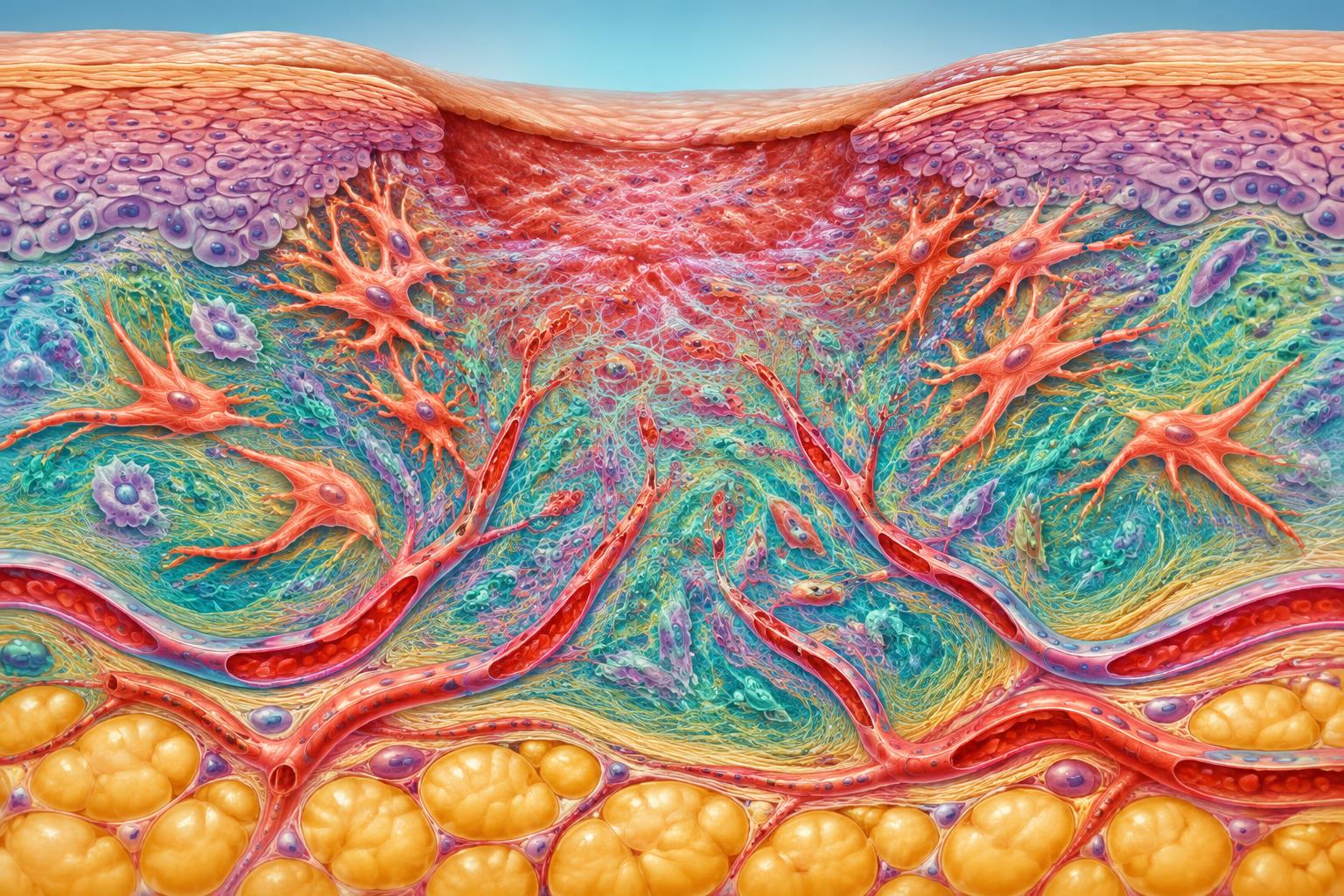
- MSCs are not generally believed to heal pressure ulcers by directly rebuilding tissue themselves. Instead, the leading hypothesis is that they act largely through paracrine signaling — secreting growth factors, cytokines, and exosomes that calm the chronic, unproductive inflammation often seen in stalled wounds, stimulate new blood vessel formation (angiogenesis), and recruit the body's own cells to rebuild granulation tissue and re-epithelialize the wound bed.
- What the Evidence Shows
- The evidence base is real but still early-stage and small. A 2023 systematic review in the Journal of Clinical Medicine identified 11 studies on MSCs for pressure ulcers — eight preclinical (mouse, rat, and rabbit models) and only three in humans — and found genuinely promising signals: in one small human study, 18 of 20 patients achieved complete wound closure after bone-marrow-derived MSC treatment, and in another, 19 of 22 patients with spinal-cord-injury-related stage IV ulcers (86%) healed fully, with average hospital stay dropping from roughly 85 to 43 days and no recurrence at 19-month follow-up.
- Bottom Line
- Mesenchymal stem cell therapy for pressure ulcers has produced some genuinely heartening results in small human studies and case reports, including high complete-healing rates and shortened hospital stays in patients who had stalled on conventional treatment. That is real signal worth taking seriously.
What This Article Covers
Pressure ulcers (bedsores) that reach stage III or IV often stall despite meticulous standard wound care, prompting researchers to test whether mesenchymal stem cells (MSCs) and related cell-based therapies can restart healing. This article reviews what the early clinical and preclinical evidence actually shows, how these therapies are thought to work, and why — despite some genuinely encouraging small-study results — this remains an investigational approach with no FDA-approved cell therapy for this specific indication.
Overview
Pressure ulcers (also called pressure injuries, decubitus ulcers, or bedsores) develop when sustained pressure, shear, or friction cuts off blood flow to skin and underlying tissue, most often over bony areas like the heels, sacrum, and hips in people with limited mobility. Advanced ulcers (stage III and IV) involve full-thickness tissue loss and can take months to heal, raise infection and sepsis risk, and significantly extend hospital stays. Standard treatment — debridement, specialized dressings, pressure-relieving surfaces, nutritional support, and sometimes surgical closure — remains the foundation of care, and it works for many patients. But a meaningful subset of wounds fail to progress even with optimal conventional management, and it's this unmet need that has driven interest in regenerative, cell-based approaches, including MSCs derived from bone marrow, adipose tissue, and umbilical cord (Wharton's jelly) tissue.
How It's Thought to Work
MSCs are not generally believed to heal pressure ulcers by directly rebuilding tissue themselves. Instead, the leading hypothesis is that they act largely through paracrine signaling — secreting growth factors, cytokines, and exosomes that calm the chronic, unproductive inflammation often seen in stalled wounds, stimulate new blood vessel formation (angiogenesis), and recruit the body's own cells to rebuild granulation tissue and re-epithelialize the wound bed. Some protocols pair MSCs with platelet-rich plasma (PRP), reasoning that platelet-derived growth factors may further support this signaling environment. Delivery is typically by injection around the wound margins or application to the wound bed after debridement, rather than systemic infusion.
What the Evidence Shows
The evidence base is real but still early-stage and small. A 2023 systematic review in the Journal of Clinical Medicine identified 11 studies on MSCs for pressure ulcers — eight preclinical (mouse, rat, and rabbit models) and only three in humans — and found genuinely promising signals: in one small human study, 18 of 20 patients achieved complete wound closure after bone-marrow-derived MSC treatment, and in another, 19 of 22 patients with spinal-cord-injury-related stage IV ulcers (86%) healed fully, with average hospital stay dropping from roughly 85 to 43 days and no recurrence at 19-month follow-up. A separate 2023 systematic review in the Journal of Tissue Engineering pooled 6 interventional studies and 481 patients across several cell types (bone marrow mononuclear cells, hematopoietic stem cells, macrophage suspensions, and placental membrane products), reporting faster healing or complete closure in several cohorts — though one bone-marrow-cell study actually showed slower healing than standard care, underscoring how mixed the picture still is. A 2024 case report described a single patient whose stage IV heel ulcer, unresponsive to standard care for over four months, nearly fully healed within 47 days of a single injection of umbilical-cord MSCs combined with PRP, with no adverse events at 12-month follow-up — an encouraging result, but from one uncontrolled case. Several early-phase trials are registered on ClinicalTrials.gov, including a completed safety study of adipose-derived stromal cells and an ongoing trial combining PRP with umbilical-cord MSCs for stage III/IV injuries, but no large randomized controlled trial has yet confirmed benefit, and reviewers consistently flag small sample sizes, inconsistent methodology, and incomplete safety reporting as key limitations.
Who Might Be a Candidate
- People with stage III or IV pressure ulcers that have not responded to several months of optimized standard wound care
- Patients being evaluated for enrollment in a registered clinical trial (the appropriate current setting for this therapy)
- People without active wound infection, uncontrolled systemic illness, or other contraindications their care team would assess
- Individuals who understand this is investigational, not a guaranteed or standard therapy
Bottom Line
Mesenchymal stem cell therapy for pressure ulcers has produced some genuinely heartening results in small human studies and case reports, including high complete-healing rates and shortened hospital stays in patients who had stalled on conventional treatment. That is real signal worth taking seriously. But it remains early: no cell-based product is FDA-approved for pressure ulcers, the human evidence comes from a handful of small, heterogeneous studies rather than large randomized trials, and at least one study found cell therapy performed worse than standard care. For now, this approach belongs in the context of registered clinical trials and a conversation with a wound-care specialist — not as a replacement for proven pressure ulcer prevention and treatment protocols.
Key Questions Answered
- Is stem cell therapy FDA-approved for pressure ulcers?
- No cell-based product is FDA-approved for pressure ulcers. The approach remains investigational and belongs in registered clinical trials, not as a replacement for standard wound care.
- What do small human studies show?
- Small studies reported complete healing in 18 of 20 and 19 of 22 patients, but studies are heterogeneous and at least one found slower healing than standard care. No large randomized trial has confirmed benefit.
- Who might be evaluated for a trial?
- People with stage III or IV ulcers unresponsive to months of optimized standard care may be evaluated, subject to infection screening, systemic health and other eligibility criteria. Participation does not guarantee healing.
Sources
- Mesenchymal Stromal Cell Healing Outcomes in Clinical and Pre-Clinical Models to Treat Pressure Ulcers: A Systematic Review — Journal of Clinical Medicine — 2023 — https://www.mdpi.com/2077-0383/12/24/7545
- Advancements in Cell-Based Therapies for the Treatment of Pressure Injuries: A Systematic Review of Interventional Studies — Journal of Tissue Engineering — 2023 — https://pmc.ncbi.nlm.nih.gov/articles/PMC10658773
- Combined Treatment of Umbilical Cord Wharton's Jelly-Derived Mesenchymal Stem Cells and Platelet-Rich Plasma for a Surgical Patient With Hospital-Acquired Pressure Ulcer: A Case Report and Literature Review — PMC (case report) — 2024 — https://pmc.ncbi.nlm.nih.gov/articles/PMC11263083
- Platelet Rich Plasma Combined With Human Umbilical Cord Mesenchymal Stem Cells for Stage 3 and 4 Stress Injury — ClinicalTrials.gov — 2024 — https://clinicaltrials.gov/study/NCT06302582
- Adipose-Derived Stromal Cells (ASC's) for Pressure Ulcers — ClinicalTrials.gov — 2015 — https://clinicaltrials.gov/study/NCT02375802
- Hematopoietic Stem Cell Therapy in Chronic Wounds Using a Pressure Sore Model — ClinicalTrials.gov — https://clinicaltrials.gov/study/NCT00535548
Related Articles
- Clinical Applications
Can Stem Cells Help With Alopecia Areata?
Small human studies show real hair regrowth signals for stem cell approaches in alopecia areata, but no cell or exosome product is FDA-approved or placebo-tested.
- Clinical Applications
Can Stem Cells Help With Beta-Thalassemia?
Beta-thalassemia is one of the few conditions stem cells already cure: matched-sibling HSCT and the FDA-approved gene therapies Zynteglo and Casgevy, with real caveats.
- Clinical Applications
Can Stem Cells Help With Dry Eye Disease?
Early MSC and exosome studies for dry eye report improved symptoms and tear function, but the evidence remains small and no product is FDA-approved.