FDA Expands Bladder Cancer Immunotherapy to Cover More Patients Who've Run Out of BCG Options
What this article covers
- WHAT THIS ARTICLE COVERS
- On October 14, 2026, the FDA expanded the approval of nogapendekin alfa inbakicept-pmln (Anktiva), an IL-15 receptor agonist immunotherapy given with BCG directly into the bladder, to cover adults with BCG-unresponsive, high-grade papillary-only non-muscle-invasive bladder cancer (NMIBC) — a group of patients who, until now, had no FDA-approved option once standard BCG therapy stopped working for their specific tumor type. This article explains what changed, the clinical trial data behind it, and what it means for patients facing a disease with historically limited choices once first-line treatment fails.
- What Happened
- The FDA's Oncology Center of Excellence approved a label expansion for nogapendekin alfa inbakicept-pmln, marketed as Anktiva by ImmunityBio, broadening its use beyond the carcinoma-in-situ (CIS) population it was approved for in April 2024. The new approval covers patients whose BCG-unresponsive disease is limited to high-grade papillary tumors, without CIS.
- The Data Behind the Decision
- 032 trial (NCT03022825), a single-arm, multicenter phase 2/3 study of 77 patients with BCG-unresponsive, high-risk NMIBC. Patients received induction treatment with nogapendekin alfa inbakicept plus BCG, followed by maintenance for up to 37 months.
- How the Treatment Works
- Nogapendekin alfa inbakicept is not a conventional chemotherapy. It's an engineered IL-15 receptor agonist — a modified interleukin-15 molecule fused to a receptor fragment that extends its activity in the body — designed to stimulate the immune system's own cancer-killing machinery.
- What It Means for Patients
- For the roughly 84,530 Americans projected to be diagnosed with bladder cancer in 2026, most of whom will initially present with non-muscle-invasive disease, this expansion closes a real gap. Patients whose papillary tumors stopped responding to BCG previously had few paths besides radical cystectomy or enrollment in a clinical trial.
WHAT THIS ARTICLE COVERS
On October 14, 2026, the FDA expanded the approval of nogapendekin alfa inbakicept-pmln (Anktiva), an IL-15 receptor agonist immunotherapy given with BCG directly into the bladder, to cover adults with BCG-unresponsive, high-grade papillary-only non-muscle-invasive bladder cancer (NMIBC) — a group of patients who, until now, had no FDA-approved option once standard BCG therapy stopped working for their specific tumor type. This article explains what changed, the clinical trial data behind it, and what it means for patients facing a disease with historically limited choices once first-line treatment fails.
What Happened
The FDA's Oncology Center of Excellence approved a label expansion for nogapendekin alfa inbakicept-pmln, marketed as Anktiva by ImmunityBio, broadening its use beyond the carcinoma-in-situ (CIS) population it was approved for in April 2024. The new approval covers patients whose BCG-unresponsive disease is limited to high-grade papillary tumors, without CIS.
That distinction matters more than it might sound. NMIBC — bladder cancer that hasn't invaded the muscle wall — comes in two main forms: CIS, which appears as flat, always-high-grade patches along the bladder lining, and papillary tumors, small finger-like growths that can be low- or high-grade. The 2024 approval covered CIS patients (with or without accompanying papillary tumors), but patients whose disease was papillary-only had been left out, even though their cancers behave aggressively and carry a high risk of recurrence or progression once BCG fails. According to R. Angelo De Claro, M.D., director of the FDA's Oncology Center of Excellence, the agency "listen[ed] to patients, clinicians, and researchers, and act[ed] when the science supports a new approach," extrapolating the established CIS efficacy data to papillary-only disease based on the clinical and biological overlap between the two tumor types.
The Data Behind the Decision
The original efficacy data for CIS came from Cohort A of the QUILT-3.032 trial (NCT03022825), a single-arm, multicenter phase 2/3 study of 77 patients with BCG-unresponsive, high-risk NMIBC. Patients received induction treatment with nogapendekin alfa inbakicept plus BCG, followed by maintenance for up to 37 months. The complete response rate was 62% (95% CI, 51%–73%), and among responders, 58% maintained that response for at least 12 months and 40% for at least 24 months — a meaningfully durable result in a population that typically faces cystectomy, the surgical removal of the bladder, as the next step after BCG fails.
For papillary-only disease specifically, ImmunityBio drew on Cohort B of the same trial, which enrolled 72 evaluable patients and followed them for a median of nearly 21 months. Median disease-free survival reached 19.3 months, with disease-free survival rates of roughly 55% at 12 months and 48% at 24 months. Progression-free survival stayed high throughout — 97% at 12 months and 89% at 24 months — and disease-specific survival was 100% at 12 months and nearly 98% at 24 months. Only 7% of patients in this cohort ultimately needed a cystectomy, the outcome bladder-sparing therapies are specifically trying to prevent.
It's worth being candid about how this regulatory pathway actually unfolded, because it reflects real scientific scrutiny rather than a rubber stamp. ImmunityBio first submitted the papillary-only data as a supplemental application in April 2025, and the FDA issued a refusal-to-file letter the following month — a sign the agency wanted more. Only after a formal end-of-phase meeting and resubmission with longer-term follow-up data did the approval come through, well ahead of its January 2027 target decision date. That back-and-forth is a useful reminder that even a drug already proven safe and effective in one bladder cancer subtype still has to clear a real evidentiary bar before its use is extended to another.
How the Treatment Works
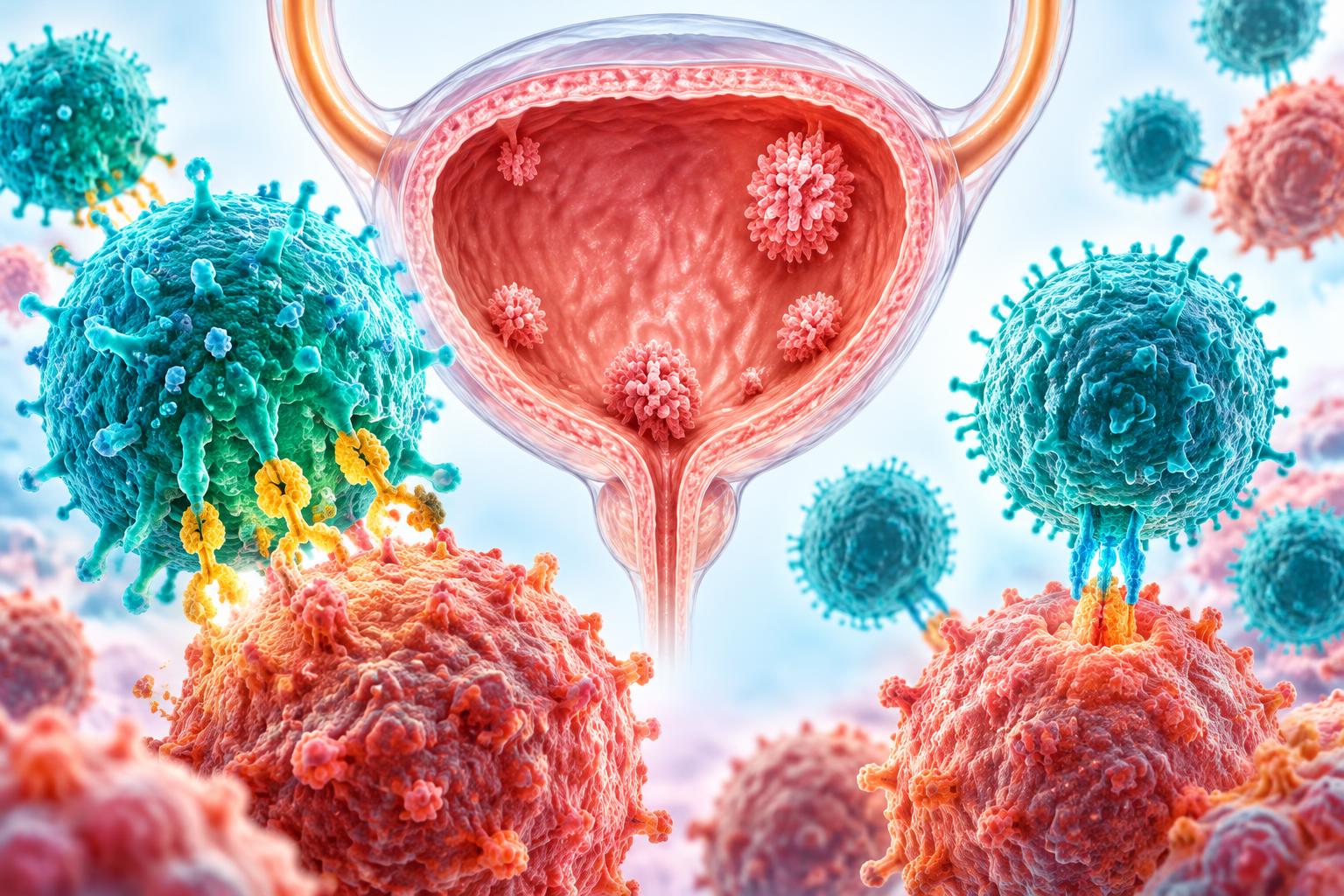
Nogapendekin alfa inbakicept is not a conventional chemotherapy. It's an engineered IL-15 receptor agonist — a modified interleukin-15 molecule fused to a receptor fragment that extends its activity in the body — designed to stimulate the immune system's own cancer-killing machinery. After it's instilled into the bladder alongside BCG, it binds receptors on natural killer (NK) cells and CD8+ and CD4+ T cells, boosting their numbers and activating them to attack tumor cells more effectively, while also encouraging the formation of longer-lived memory T cells that can sustain that anti-tumor response over time.
What It Means for Patients
For the roughly 84,530 Americans projected to be diagnosed with bladder cancer in 2026, most of whom will initially present with non-muscle-invasive disease, this expansion closes a real gap. Patients whose papillary tumors stopped responding to BCG previously had few paths besides radical cystectomy or enrollment in a clinical trial. Now there is an FDA-approved, bladder-sparing immunotherapy option specifically validated for their tumor type. Treatment is given intravesically (by catheter) alongside BCG — an induction course of once-weekly dosing for six weeks, followed by scheduled maintenance dosing for up to 37 months depending on response.
What's Still Unknown or Worth Watching
This remains a single-arm trial without a randomized comparator, which is a genuine limitation when interpreting response and survival figures, even though the FDA found the data persuasive enough for approval. The most common side effects reported — increased creatinine, dysuria, blood in the urine, urinary frequency and urgency, urinary tract infections, elevated potassium, musculoskeletal pain, chills, and fever — are generally manageable but real, and the prescribing information specifically warns that delaying a needed cystectomy in a non-responding patient can allow the cancer to become metastatic and potentially fatal. The FDA has also indicated it is working on broader guidance for drug development in BCG-unresponsive NMIBC, suggesting more approvals in this space may follow as other agents complete similar trials.
Bottom Line
This is a genuine, incremental win for a specific group of bladder cancer patients who previously had no dedicated FDA-approved option after BCG failure: a bladder-sparing immunotherapy with a durable complete response rate above 60% in the related CIS population and encouraging disease-free and progression-free survival data in the papillary-only group newly covered by this approval. It is not a cure-all, it comes from a single-arm trial, and real side effects and a cystectomy-delay risk remain part of the picture — but for patients trying to avoid losing their bladder, having another evidence-backed, FDA-sanctioned option is meaningful progress.
Key Questions Answered
- Which patients does the October 2026 expansion cover?
- Adults with BCG-unresponsive, high-grade papillary-only non-muscle-invasive bladder cancer without carcinoma in situ. Anktiva is given directly into the bladder alongside BCG.
- Were the trial results compared with a randomized control group?
- No. QUILT-3.032 was a single-arm trial. The CIS cohort had a 62% complete response rate; the papillary-only cohort had median disease-free survival of 19.3 months.
- What important risk remains if treatment does not work?
- Delaying a needed cystectomy in a non-responding patient can allow cancer to become metastatic and potentially fatal. Side effects and response monitoring remain important.
Sources
- FDA Approves Expanded Indication for Nogapendekin Alfa Inbakicept in BCG-Unresponsive NMIBC, The ASCO Post, 2026 — https://ascopost.com/news/october-2026/fda-approves-expanded-indication-for-nogapendekin-alfa-inbakicept-in-bcg-unresponsive-nmibc/
- FDA Approves Nogapendekin Alfa Inbakicept Plus BCG for High-Grade Papillary-Only BCG-Unresponsive NMIBC, OncLive, 2026 — https://www.onclive.com/view/fda-approves-nogapendekin-alfa-inbakicept-plus-bcg-for-high-grade-papillary-only-bcg-unresponsive-nmibc
- FDA Approves First Treatment for BCG-Unresponsive Bladder Cancer, AJMC, 2026 — https://www.ajmc.com/view/fda-approves-first-treatment-for-bcg-unresponsive-bladder-cancer
- FDA Expands Anktiva Immunotherapy Approval for BCG-Unresponsive Bladder Cancer, Healio, 2026 — https://www.healio.com/news/hematology-oncology/20261014/fda-expands-anktiva-immunotherapy-approval-for-bcgunresponsive-bladder-cancer
- FDA Expands Anktiva Approval in BCG-Unresponsive Bladder Cancer, CURE Today, 2026 — https://curetoday.com/view/fda-expands-anktiva-approval-in-bcg-unresponsive-bladder-cancer
- Bladder Cancer: Key Statistics, American Cancer Society, 2026 — https://www.cancer.org/cancer/types/bladder-cancer/about/key-statistics.html
- Oncology (Cancer)/Hematologic Malignancies Approval Notifications, U.S. Food and Drug Administration — https://www.fda.gov/drugs/resources-information-approved-drugs/oncology-cancer-hematologic-malignancies-approval-notifications
Related Articles
- Clinical Applications
CAR-T Therapy for Autoimmune Disease in China: What's Actually Happening
China leads CAR-T research for severe autoimmune disease. Early lupus nephritis results are encouraging, but trials remain small and no autoimmune indication is approved.
- Clinical Applications
FDA Approves First Adjuvant Immunotherapy for a Common Form of Stage III Colon Cancer: What the NCI-Funded ATOMIC Trial Found
The FDA approved Tecentriq plus chemotherapy for dMMR stage III colon cancer after the NCI-funded ATOMIC trial cut recurrence risk by roughly half. Here's what it means.
- Clinical Applications
Bispecific Antibody Etentamig Nearly Doubles Response Rates in Hard-to-Treat Multiple Myeloma, Phase 3 Trial Shows
Etentamig nearly doubled response rates and cut progression risk 60% in the Phase 3 CERVINO myeloma trial, but overall survival hasn't met its statistical bar.