NIH-Led Trial Finds Experimental T-Cell Drug Controls Tumors That Stopped Responding to Immunotherapy
What this article covers
- What This Article Covers
- Researchers at the National Institutes of Health, working with Mass General Brigham and Memorial Sloan Kettering Cancer Center, have published early results from a first-in-human trial of a new kind of immune-activating drug designed for patients whose cancers have already stopped responding to standard checkpoint inhibitors like pembrolizumab or nivolumab. In the optimal-dose group of the Phase 1/2 START-001 trial, more than half of patients had no further tumor growth, and a smaller subset saw meaningful tumor shrinkage — a genuinely encouraging signal in a population that, by definition, had already exhausted one of oncology's most powerful tool classes.
- What Happened
- gov identifier NCT05592626), the first human trial of an experimental drug called invikafusp alfa — nicknamed "invika" in the NIH's own release — developed by Marengo Therapeutics. The study enrolled patients with a range of solid tumors who had largely stopped responding to immune checkpoint blockade, a group with historically few good options.
- What the Data Actually Showed
- Among 27 patients treated at the trial's optimal biological doses (0.08 or 0.12 mg/kg):
- What It Doesn't Mean Yet
- This is genuinely promising early data, but it is not evidence of an approved or established treatment, and several important caveats apply:
- Context and Caveats
- Checkpoint inhibitors transformed cancer treatment over the past decade, but a substantial share of patients either never respond or eventually relapse — and once that happens, options narrow considerably. That unmet need is exactly the population START-001 targets, which is part of why the trial has drawn attention beyond typical early-phase data.
What This Article Covers
Researchers at the National Institutes of Health, working with Mass General Brigham and Memorial Sloan Kettering Cancer Center, have published early results from a first-in-human trial of a new kind of immune-activating drug designed for patients whose cancers have already stopped responding to standard checkpoint inhibitors like pembrolizumab or nivolumab. In the optimal-dose group of the Phase 1/2 START-001 trial, more than half of patients had no further tumor growth, and a smaller subset saw meaningful tumor shrinkage — a genuinely encouraging signal in a population that, by definition, had already exhausted one of oncology's most powerful tool classes. The results, published in Nature Medicine and announced via NIH news release in late October 2026, are early and preliminary, but they point to a selective approach that may sidestep some of the toxicity problems that have limited broader T-cell-activating drugs.
What Happened
The NIH, in collaboration with Mass General Brigham and Memorial Sloan Kettering, reported findings from START-001 (ClinicalTrials.gov identifier NCT05592626), the first human trial of an experimental drug called invikafusp alfa — nicknamed "invika" in the NIH's own release — developed by Marengo Therapeutics. The study enrolled patients with a range of solid tumors who had largely stopped responding to immune checkpoint blockade, a group with historically few good options. James Gulley, M.D., Ph.D., of the NCI's Center for Cancer Research, is a co-corresponding author on the paper, alongside collaborators at Mass General Brigham and Memorial Sloan Kettering.
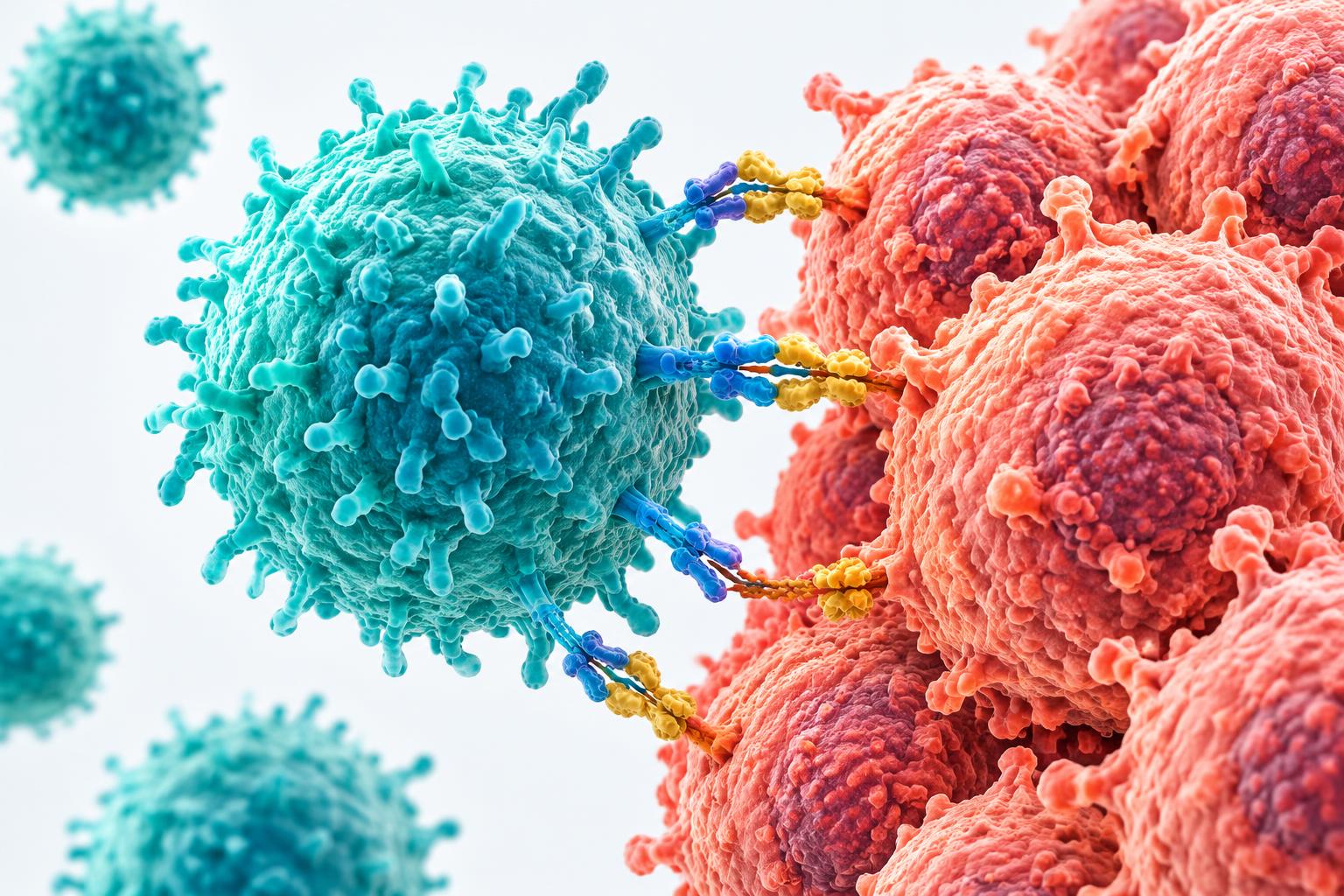
What makes invikafusp alfa different from earlier T-cell-activating drugs is its selectivity. Rather than broadly stimulating the immune system's T cells — an approach that can produce powerful but dangerously nonspecific inflammation — the drug is a bispecific molecule that targets only T cells carrying a specific receptor signature, known as Vβ6 or Vβ10, and simultaneously delivers an activating (IL-2-based) signal directly to those same cells. The intent is to concentrate immune activation on a tumor-relevant T-cell population while sparing the broader immune system.
What the Data Actually Showed
Among 27 patients treated at the trial's optimal biological doses (0.08 or 0.12 mg/kg):
- 16 patients (59.3%) showed no disease progression during the assessment period
- 4 patients (14.8%) had tumor reductions of more than 30% in target lesions
- Responses included two patients with heavily pretreated metastatic colorectal cancer and one with stage 4 non-small cell lung cancer
- The drug selectively expanded the targeted Vβ6/Vβ10 T-cell populations without broadly expanding other T-cell populations, and the researchers found that the degree of this targeted expansion tracked with which patients had tumor responses
- Patients treated at doses outside this optimal range did not show a comparable benefit
- The recommended Phase 2 dose was set at 0.08 mg/kg administered intravenously every two weeks
Side effects were generally flu-like and described as manageable with supportive care — notably milder than the severe, systemic immune-related toxicities that have constrained some other T-cell-engaging therapies. The FDA has already granted invikafusp alfa Fast Track designation for certain advanced colorectal cancers and other solid tumors that progressed after prior treatment, including checkpoint inhibitors.
What It Doesn't Mean Yet
This is genuinely promising early data, but it is not evidence of an approved or established treatment, and several important caveats apply:
- This is a Phase 1/2 dose-finding study. Its primary purpose was to establish safety and identify an optimal dose — not to prove the drug works.
- "No disease progression" is not the same as tumor shrinkage. The 59.3% figure includes patients whose tumors simply stopped growing, not just the smaller group with measurable shrinkage.
- The efficacy signal rests on small numbers — 27 patients at the optimal dose, with only 4 showing substantial tumor reduction.
- Immune activation did not always translate into a clinical response; the researchers noted that some patients showed the targeted T-cell expansion without a corresponding tumor response.
- The published data do not report progression-free survival, overall survival, or durability of response, and there is no control arm — standard limitations at this stage of drug development.
- The researchers themselves emphasized that larger studies are needed before conclusions can be drawn about real-world effectiveness and safety.
Context and Caveats
Checkpoint inhibitors transformed cancer treatment over the past decade, but a substantial share of patients either never respond or eventually relapse — and once that happens, options narrow considerably. That unmet need is exactly the population START-001 targets, which is part of why the trial has drawn attention beyond typical early-phase data. Earlier presentations of the same drug program, at conferences including AACR and ESMO Gastrointestinal Cancers Congress in 2025, had already reported encouraging disease-control signals in overlapping patient cohorts, and this Nature Medicine publication represents the peer-reviewed, more mature dataset from the dose-optimization portion of the trial. The drug is still being studied; it is not an FDA-approved therapy, and patients should not interpret Fast Track designation as equivalent to approval — Fast Track simply expedites FDA review and interaction during development.
Bottom Line
A selective, NIH-co-led T-cell therapy showed real, biologically coherent signals of activity — including tumor shrinkage in a handful of patients — in a difficult-to-treat population that had already failed standard immunotherapy, with a side-effect profile that appears milder than broader T-cell-activating approaches. That is a meaningful and encouraging result worth taking seriously. But it comes from a small, early-phase, uncontrolled trial, and the researchers themselves are clear that confirmation in larger studies is the necessary next step before invikafusp alfa could become an actual treatment option. For now, this is a promising research lead, not a new standard of care.
Key Questions Answered
- What did START-001 show at the optimal doses?
- Among 27 patients, 16 (59.3%) had no disease progression and 4 (14.8%) had target-lesion reductions greater than 30%. Disease control is not the same as tumor shrinkage.
- How does invikafusp alfa activate T cells selectively?
- The bispecific drug targets T cells carrying Vβ6 or Vβ10 and delivers an IL-2-based activating signal to those cells, rather than broadly stimulating all T-cell populations.
- Does Fast Track designation mean the drug is approved?
- No. Fast Track expedites FDA review and interaction during development. Invikafusp alfa remains experimental, and this small uncontrolled Phase 1/2 trial needs confirmation in larger studies.
Sources
- A precision T-cell therapy stalls treatment-resistant cancers in clinical trial, National Institutes of Health, 2026, https://www.nih.gov/news-events/news-releases/precision-t-cell-therapy-stalls-treatment-resistant-cancers-clinical-trial
- Selective T-Cell Therapy Shows Activity in Treatment-Resistant Cancers, AABB, 2026, https://www.aabb.org/news-resources/news/article/2026/10/28/selective-t-cell-therapy-shows-activity-in-treatment-resistant-cancers
- Invikafusp Alfa Hits 50% DCR in Solid Tumors, Targeted Oncology, 2026, https://www.targetedonc.com/view/invikafusp-alfa-hits-50-dcr-in-solid-tumors
- ClinicalTrials.gov record for START-001 (NCT05592626), https://clinicaltrials.gov/study/NCT05592626
Related Articles
- Clinical Applications
FDA Converts Pembrolizumab's Tumor-Agnostic Approval to Full Status, Confirming Durable Responses in High-Mutation-Burden Cancers
The FDA converted pembrolizumab's tumor-agnostic TMB-H approval to full status with durable response data — while narrowing eligibility from 10 to 13 mutations per megabase.
- Clinical Applications
Real-World Data Show Strong Early Responses to CAR-T Therapy in Hard-to-Treat Chronic Lymphocytic Leukemia
A 41-patient real-world liso-cel analysis reports encouraging early CLL responses and survival, with short follow-up, observational limits and a fatal HLH-like complication.
- Clinical Applications
FDA Expands Bladder Cancer Immunotherapy to Cover More Patients Who've Run Out of BCG Options
Anktiva’s October 2026 bladder cancer label expansion explained, with QUILT-3.032 outcomes, single-arm evidence limits and risks of delaying needed cystectomy.