Stem Cell Therapy for Intraventricular Hemorrhage (IVH) in Premature Infants
What this article covers
- How It's Thought to Work
- The leading candidate is an allogeneic mesenchymal stromal cell product derived from donated umbilical cord blood, delivered directly into the brain's ventricles through the infant's soft fontanelle under ultrasound guidance — not intravenously. Researchers believe MSCs don't replace damaged brain tissue directly; instead, they appear to act mainly through paracrine signaling, releasing factors that dial down inflammation, protect surrounding brain cells, and may reduce the scarring and fluid buildup that lead to hydrocephalus.
- What the Evidence Shows
- The most developed evidence comes from a South Korean research group (led by Won Soon Park and colleagues) using an umbilical cord blood-derived MSC product called Pneumostem. A 2018 Phase I dose-escalation trial enrolled just nine extremely premature infants with severe (grade IV) IVH, testing two dose levels delivered intraventricularly.
- Bottom Line
- Stem cell therapy for severe IVH is a genuinely active and scientifically credible area of neonatal research, with real human safety data and some encouraging long-term signals from a dedicated South Korean trial program. But the pivotal randomized trial did not meet its primary efficacy endpoint, sample sizes remain very small, and no product is FDA-approved for this use.
Severe bleeding into the brain's ventricles is one of the most serious complications of extreme prematurity, and there is currently no approved drug or cell therapy that reverses the damage it causes. This article explains why researchers are testing umbilical cord blood-derived mesenchymal stem cells (MSCs) as a potential treatment, summarizes what small early-phase human trials have actually found, and is honest about how far this therapy still is from routine clinical use.
Intraventricular hemorrhage (IVH) occurs when the fragile blood vessels in a premature infant's brain rupture, most often within the first days of life. Mild bleeds (grade I-II) frequently resolve without lasting harm, but severe IVH (grade III-IV, sometimes called periventricular hemorrhagic infarction, or PVHI) can trigger inflammation, hydrocephalus, and permanent brain injury, raising the risk of cerebral palsy, cognitive delay, and epilepsy. No medication currently prevents or repairs this damage, which is why stem cell approaches have drawn research interest.
How It's Thought to Work
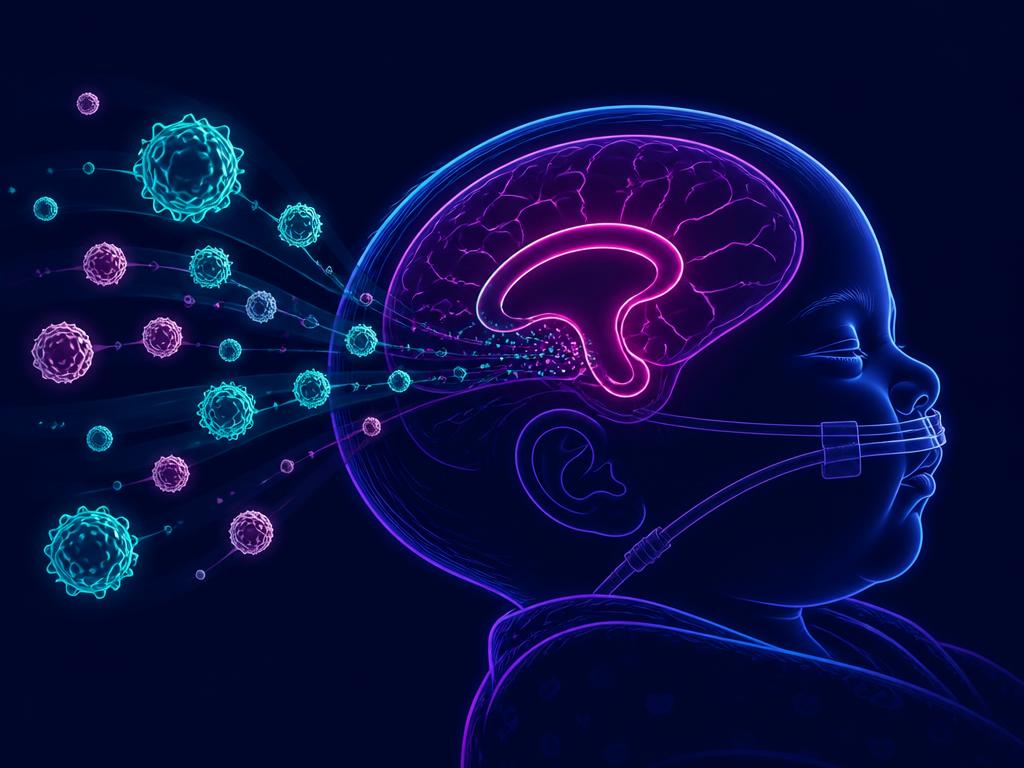
The leading candidate is an allogeneic mesenchymal stromal cell product derived from donated umbilical cord blood, delivered directly into the brain's ventricles through the infant's soft fontanelle under ultrasound guidance — not intravenously. Researchers believe MSCs don't replace damaged brain tissue directly; instead, they appear to act mainly through paracrine signaling, releasing factors that dial down inflammation, protect surrounding brain cells, and may reduce the scarring and fluid buildup that lead to hydrocephalus. In the main human trial program, cerebrospinal fluid levels of the inflammatory marker IL-6 dropped after treatment, consistent with this proposed anti-inflammatory mechanism, though this is a biological signal, not proof of improved brain outcomes.
What the Evidence Shows
The most developed evidence comes from a South Korean research group (led by Won Soon Park and colleagues) using an umbilical cord blood-derived MSC product called Pneumostem. A 2018 Phase I dose-escalation trial enrolled just nine extremely premature infants with severe (grade IV) IVH, testing two dose levels delivered intraventricularly. No dose-limiting toxicities or serious treatment-related adverse events occurred, and all nine infants survived to discharge — an encouraging safety signal, though with no control group for comparison. A five-year follow-up of that same small cohort found no evidence of long-term adverse events, including no tumors — reassuring for feasibility — but also found that the severity of the original brain injury, not the cell treatment, remained the strongest predictor of a child's neurodevelopmental outcome.
The more rigorous test came next: a double-blinded, randomized, controlled Phase IIa trial in 22 extremely preterm infants with PVHI, comparing MSC therapy to placebo. On the trial's primary endpoint — combined rate of death or need for a ventriculo-peritoneal shunt by 36 weeks — there was no statistically significant difference between groups. That is an important, sobering result. At the same time, secondary two-year outcomes leaned favorably for the treated group, with lower observed rates of cerebral palsy, epilepsy, and microcephaly — genuinely promising signals worth watching — though the authors caution the confidence intervals were wide and these findings are exploratory, requiring confirmation in larger trials. No serious treatment-related adverse events were reported. A 2023 Cochrane systematic review of stem cell interventions for IVH in preterm infants likewise concluded that trial evidence to date remains too limited in size and duration to determine whether these therapies meaningfully improve outcomes.
No stem cell therapy is FDA-approved for IVH. Additional Phase 1 and Phase 2a trials are registered on ClinicalTrials.gov (e.g., NCT02274428, NCT02673788, NCT02890953), reflecting real, ongoing investigation — but this remains investigational, early-stage research, not an available clinical treatment.
Who Might Be a Candidate
- Extremely premature infants (roughly 23-31 weeks gestation) diagnosed with severe (grade III-IV) intraventricular hemorrhage or periventricular hemorrhagic infarction
- Infants enrolled through academic neonatal intensive care research programs actively running or following up on registered clinical trials
- Families working with neonatologists to understand experimental options where no approved treatment currently exists
- This is not an outpatient or elective therapy, and it is not offered as standard NICU care outside of formal trial protocols
Bottom Line
Stem cell therapy for severe IVH is a genuinely active and scientifically credible area of neonatal research, with real human safety data and some encouraging long-term signals from a dedicated South Korean trial program. But the pivotal randomized trial did not meet its primary efficacy endpoint, sample sizes remain very small, and no product is FDA-approved for this use. Parents should treat this as promising investigational science to watch, not an available treatment — and should be very cautious of any clinic marketing stem cell injections for IVH outside a registered, monitored trial.
Key Questions Answered
- Is stem cell therapy approved for intraventricular hemorrhage in premature infants?
- No. No stem cell therapy is FDA-approved for IVH. The work to date consists of small early-phase trials, and additional Phase 1 and Phase 2a studies are registered on ClinicalTrials.gov, so this remains investigational research rather than an available clinical treatment.
- How are the stem cells delivered to the infant's brain?
- The allogeneic mesenchymal stromal cells, derived from donated umbilical cord blood, are delivered directly into the brain's ventricles through the infant's soft fontanelle under ultrasound guidance — not intravenously.
- Did the randomized trial show that the therapy works?
- No. The double-blinded, randomized, controlled Phase IIa trial in 22 extremely preterm infants with periventricular hemorrhagic infarction found no statistically significant difference on its primary endpoint of death or need for a ventriculo-peritoneal shunt by 36 weeks. Secondary two-year outcomes leaned favorably but were exploratory with wide confidence intervals.
- How is the therapy thought to work?
- Researchers believe MSCs act mainly through paracrine signaling rather than replacing damaged brain tissue — releasing factors that reduce inflammation, protect surrounding brain cells, and may limit the scarring and fluid buildup that lead to hydrocephalus. Cerebrospinal fluid levels of the inflammatory marker IL-6 dropped after treatment, consistent with this proposed mechanism.
Sources
- Mesenchymal Stem Cells for Severe Intraventricular Hemorrhage in Preterm Infants: Phase I Dose-Escalation Clinical Trial — Stem Cells Translational Medicine, 2018 — https://pmc.ncbi.nlm.nih.gov/articles/PMC6265626/
- Five-year follow-up outcomes after phase 1 trial of mesenchymal stromal cells for periventricular hemorrhagic infarction in preterm infants — Stem Cells Translational Medicine, 2026 — https://pmc.ncbi.nlm.nih.gov/articles/PMC13235719/
- Mesenchymal stromal cells for periventricular hemorrhagic infarction in extremely preterm infants: a double-blinded randomized controlled phase IIa clinical trial — Stem Cell Research & Therapy, 2026 — https://link.springer.com/article/10.1186/s13287-026-05235-7
- Stem cell-based interventions for the prevention and treatment of intraventricular haemorrhage and encephalopathy of prematurity in preterm infants — Cochrane Database of Systematic Reviews, 2023 — https://pmc.ncbi.nlm.nih.gov/articles/PMC9932000/
- Phase 1 Clinical Trial of PNEUMOSTEM® Treatment in Premature Infants With Intraventricular Hemorrhage — ClinicalTrials.gov (NCT02274428) — https://clinicaltrials.gov/study/NCT02274428
Related Articles
- Clinical Applications
Stem Cell Therapy for Meniscus and ACL Injuries
A Japanese phase III trial found large, durable knee-function gains when synovial MSCs were added to meniscal repair. For ACL surgery, systematic review evidence says cellular augmentation is not yet evidence-based.
- Clinical Applications
Vertex Clears an FDA Hurdle for a Universal-Donor Version of Its Stem-Cell-Derived Type 1 Diabetes Therapy
The FDA has cleared Vertex to begin human testing of VX-017, a universal-donor islet cell therapy for type 1 diabetes. It's a real milestone on a platform that made 10 of 12 patients insulin-independent — and still an early one.
- Clinical Applications
Stem Cell Therapy for Multiple Myeloma
Autologous stem cell transplantation is a decades-old, guideline-supported part of multiple myeloma care — not an experimental therapy. Here's how ASCT works, what the DETERMINATION trial showed, and who is a candidate.