What Is Immune Privilege? Why Donor (Allogeneic) Stem Cells Usually Don't Trigger Rejection
What this article covers
- The Rejection Problem Stem Cells Mostly Avoid
- Ordinarily, if you put someone else's cells into your body, your immune system treats them as foreign. T cells recognize protein markers on the cell surface called MHC (major histocompatibility complex) molecules — known in humans as HLA (human leukocyte antigen) — and mount an attack if those markers don't match your own.
- Why MSCs Fly Under the Immune System's Radar
- The core reason lies in what MSCs display — and don't display — on their surface. In their resting, undifferentiated state, MSCs express low levels of MHC class I and little to no MHC class II, the molecule set T cells rely on most heavily to identify foreign cells.
- The Immunosuppressive Toolkit: Calming the Neighborhood
- MSCs don't just avoid detection passively — they also secrete a range of immunomodulatory factors that actively dampen immune activity nearby. These include prostaglandin E2, indoleamine 2,3-dioxygenase (IDO, an enzyme that depletes a nutrient T cells need), interleukin-10, hepatocyte growth factor, and TGF-beta, among others.
- What This Makes Possible: Off-the-Shelf Cell Therapy
- This relative immune tolerance is what makes donor-derived (allogeneic) MSC products commercially and clinically appealing. Instead of harvesting, expanding, and quality-testing a custom batch of cells from each individual patient (an autologous approach, which is slow and expensive), manufacturers can expand large batches of MSCs from a small number of healthy donors, bank them, and distribute standardized doses to many patients — much like a pharmaceutical product.
- Immune Privilege Isn't Absolute
- Here's the important caveat, and it's a real and active area of research rather than a settled matter. A widely cited 2014 Nature Biotechnology commentary argued that MSCs are more accurately described as "immune evasive," not "immune privileged," pointing to accumulating evidence that allogeneic MSCs can still provoke immune responses in some settings — including the development of donor-specific antibodies after repeated dosing.
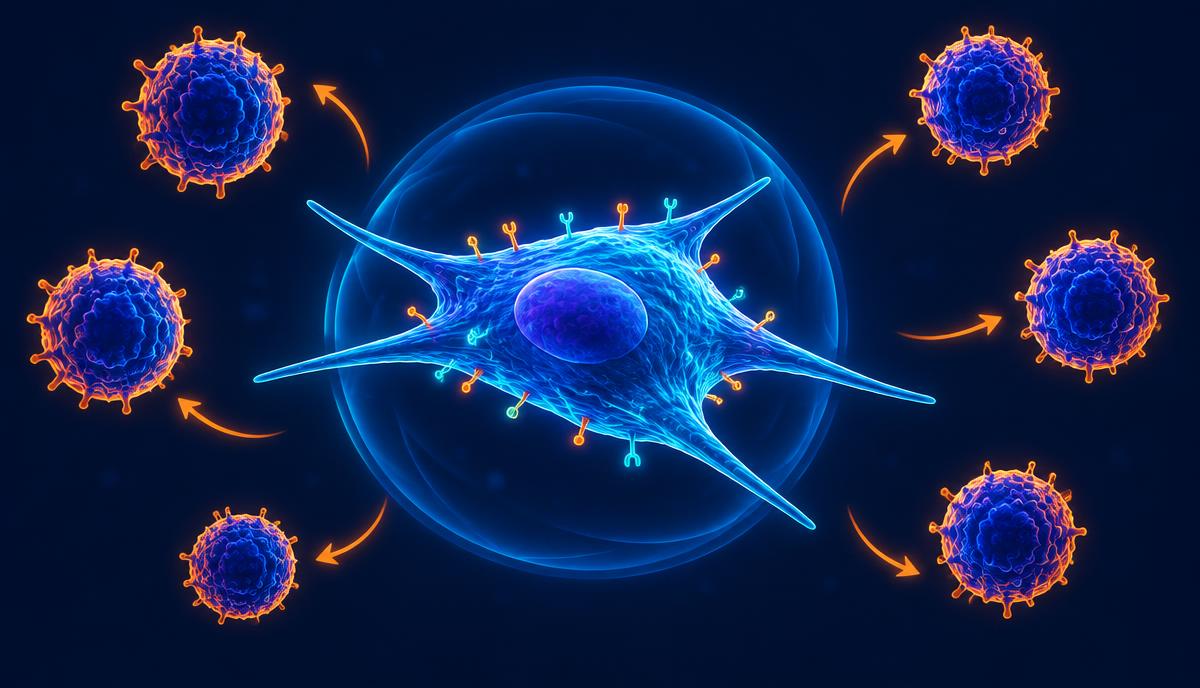
If you've read about "off-the-shelf" stem cell products, you may have wondered why a clinic can inject cells from an unrelated donor into you without the kind of tissue matching and anti-rejection drugs that organ transplants require. The short answer is a property researchers call relative immune privilege, or more precisely, immune evasion: mesenchymal stem cells (MSCs) carry unusually few of the molecular "flags" that normally alert a recipient's immune system to foreign tissue, and they actively release signals that calm nearby immune cells. This article explains the actual biology behind that phenomenon, why it's such a useful trait for scalable cell therapy, and why scientists are careful to call it relative and incomplete rather than absolute.
The Rejection Problem Stem Cells Mostly Avoid
Ordinarily, if you put someone else's cells into your body, your immune system treats them as foreign. T cells recognize protein markers on the cell surface called MHC (major histocompatibility complex) molecules — known in humans as HLA (human leukocyte antigen) — and mount an attack if those markers don't match your own. This is why organ transplants require lifelong immunosuppressive drugs, and why a poorly matched transplant can be rejected within days. MSCs, the cell type most often used in donor-derived regenerative products, largely sidestep this problem, which is exactly why they've become the backbone of "off-the-shelf" cell therapy development.
Why MSCs Fly Under the Immune System's Radar
The core reason lies in what MSCs display — and don't display — on their surface. In their resting, undifferentiated state, MSCs express low levels of MHC class I and little to no MHC class II, the molecule set T cells rely on most heavily to identify foreign cells. Just as important, MSCs generally lack the costimulatory molecules — CD80, CD86, and CD40 — that T cells need alongside an MHC signal to become fully activated. Without that second signal, T cells that do encounter an MSC tend to become inactive (a state called anergy) rather than launching an attack. Early foundational immunology research helped establish that undifferentiated MSCs are comparatively "quiet" from an immune-recognition standpoint.
The Immunosuppressive Toolkit: Calming the Neighborhood
MSCs don't just avoid detection passively — they also secrete a range of immunomodulatory factors that actively dampen immune activity nearby. These include prostaglandin E2, indoleamine 2,3-dioxygenase (IDO, an enzyme that depletes a nutrient T cells need), interleukin-10, hepatocyte growth factor, and TGF-beta, among others. Together, these factors can suppress T cell proliferation, interfere with dendritic cell maturation, and reduce natural killer (NK) cell activity. This combination of "flying under the radar" and "actively soothing the immune system" is why researchers increasingly describe MSCs as immune evasive rather than truly immune privileged — the distinction matters, and we come back to it below.
What This Makes Possible: Off-the-Shelf Cell Therapy
This relative immune tolerance is what makes donor-derived (allogeneic) MSC products commercially and clinically appealing. Instead of harvesting, expanding, and quality-testing a custom batch of cells from each individual patient (an autologous approach, which is slow and expensive), manufacturers can expand large batches of MSCs from a small number of healthy donors, bank them, and distribute standardized doses to many patients — much like a pharmaceutical product. Without a meaningful degree of low immunogenicity, this scalable model simply wouldn't work; every batch would need patient-specific matching, similar to organ transplantation.
Immune Privilege Isn't Absolute
Here's the important caveat, and it's a real and active area of research rather than a settled matter. A widely cited 2014 Nature Biotechnology commentary argued that MSCs are more accurately described as "immune evasive," not "immune privileged," pointing to accumulating evidence that allogeneic MSCs can still provoke immune responses in some settings — including the development of donor-specific antibodies after repeated dosing. A 2017 review in Frontiers in Immunology similarly documented cellular and antibody-based anti-donor responses in animal models, along with evidence that inflammatory conditions can upregulate MHC and costimulatory molecule expression on MSCs, making them more visible to the immune system than they are at rest. This may help explain why allogeneic MSCs are sometimes cleared from the body relatively quickly, and why questions remain about whether repeat dosing becomes less effective over time as a recipient's immune system "learns" to recognize donor cells. Some researchers have proposed that MSCs may work through a brief "hit and run" mechanism — exerting a therapeutic effect through early signaling before being cleared — which would mean that long-term engraftment isn't necessarily required for benefit. That idea is plausible but not fully proven, and it's an area where the science is still developing. The practical takeaway: donor MSCs are far less likely to trigger rejection than most other transplanted tissue, but "far less likely" is not the same as "never."
How This Differs From Bone Marrow and Cord Blood Transplants
It's worth briefly contrasting this with hematopoietic stem cell transplantation — bone marrow or cord blood transplants used to treat blood cancers and immune disorders. Those transplanted cells go on to generate a person's entire blood and immune system, and they don't share the MSC-like combination of low MHC expression and immunosuppressive signaling, so close HLA matching between donor and recipient is critical to avoiding rejection and graft-versus-host disease. RegenMed Review covers HLA matching for that context in a separate dedicated article; the key point here is simply that "donor cells don't need matching" is a rule specific to MSCs and similar cell types, not a universal feature of stem cell therapy.
Bottom Line
MSCs' unusual combination of low MHC/costimulatory molecule expression and active immune-dampening secretions is what allows donor-derived, off-the-shelf cell products to exist without organ-transplant-style matching — a genuinely elegant piece of biology that has reshaped how regenerative medicine is manufactured and delivered. But this relative immune privilege is a matter of degree, not an absolute shield: research continues to find evidence that allogeneic MSCs can be recognized and cleared by the immune system in some circumstances, which may affect how long they persist and how well repeat doses work. Anyone evaluating an allogeneic MSC product should understand it as "usually well-tolerated," not "invisible to the immune system."
Sources
- Mesenchymal stem cells avoid allogeneic rejection — Journal of Inflammation (London), 2005 — https://journal-inflammation.biomedcentral.com/articles/10.1186/1476-9255-2-8
- Mesenchymal stem cells: immune evasive, not immune privileged — Nature Biotechnology, 2014 — https://www.nature.com/articles/nbt.2816
- Immunogenicity of Allogeneic Mesenchymal Stromal Cells: What Has Been Seen in Vitro and in Vivo? — Regenerative Medicine, 2015 — https://pubmed.ncbi.nlm.nih.gov/25933239/
- Anti-Donor Immune Responses Elicited by Allogeneic Mesenchymal Stem Cells and Their Extracellular Vesicles: Are We Still Learning? — Frontiers in Immunology, 2017 — https://www.frontiersin.org/journals/immunology/articles/10.3389/fimmu.2017.01626/full
- The Importance of HLA Assessment in "Off-the-Shelf" Allogeneic Mesenchymal Stem Cells Based-Therapies — International Journal of Molecular Sciences, 2019 — https://pmc.ncbi.nlm.nih.gov/articles/PMC6888380/
- Role of HLA in Hematopoietic Stem Cell Transplantation — Bone Marrow Research (Wiley), 2012 — https://onlinelibrary.wiley.com/doi/10.1155/2012/680841
Related Articles
- Fundamentals
Who Pays for Stem Cell Research? A Beginner's Guide to How Trials and Therapies Get Funded
Stem cell therapies move through a funding relay — NIH and state grants, universities, foundations, then venture capital. Legitimate trials don't charge patients for the experimental product.
- Fundamentals
Why Do Promising Stem Cell Therapies Sometimes Fail Late-Stage Clinical Trials? A Beginner's Guide to Trial Risk
Gene and cell therapies reach approval roughly 10–17% of the time. Here's why late-stage failure is common, what causes it, and how to read trial news carefully.
- Fundamentals
What Are Exosomes, and How Are They Different From Stem Cells?
Exosomes are signaling packets cells release — not cells. No exosome product has FDA approval, and the agency has been warning about them since 2019.