What Are Exosomes, and How Are They Different From Stem Cells?
What this article covers
- What Is an Exosome?
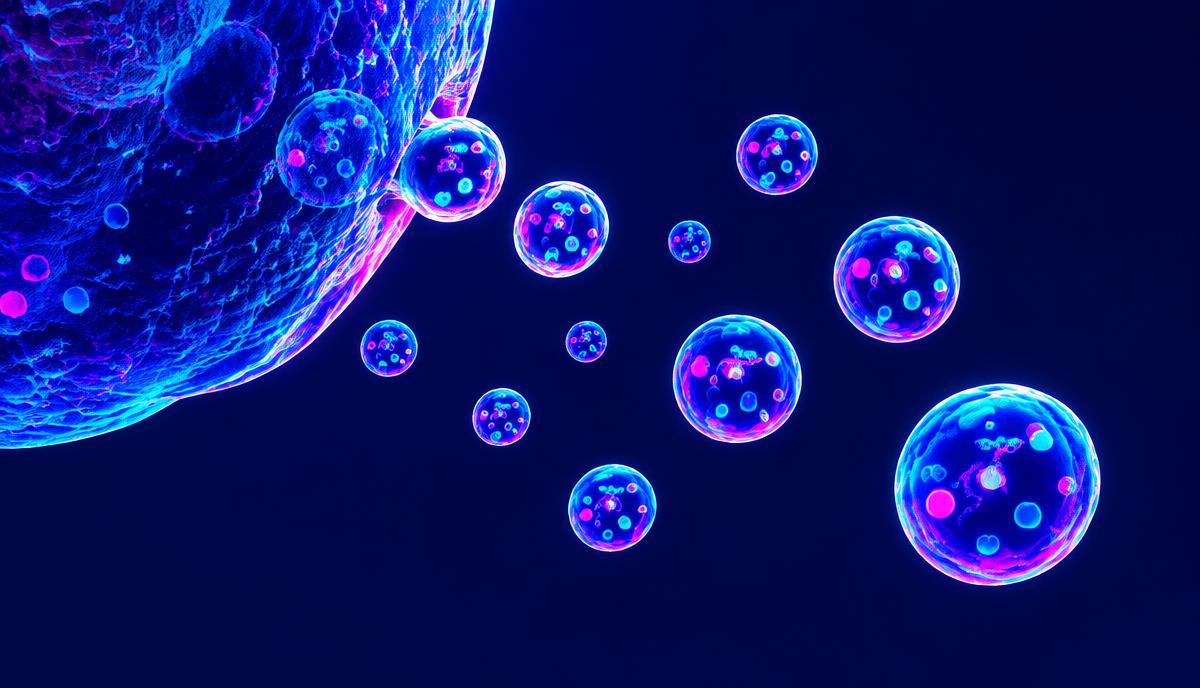
- Exosomes are a type of extracellular vesicle — tiny, membrane-bound particles, far smaller than a cell, that virtually all cells in the body release as a form of intercellular communication. Rather than containing a nucleus or the machinery to divide and grow like a cell, exosomes are essentially cargo packages: they carry proteins, lipids, and genetic material (such as microRNA) between cells, potentially influencing the behavior of the cells that receive them.
- How Exosomes Relate to Stem Cells
- Stem cells are living, self-renewing cells capable of dividing and, depending on type, developing into other specialized cell types. Exosomes are not cells at all — they are byproducts that cells, including stem cells, secrete.
- What Regulators Have Said
- The FDA has been direct on this point since at least 2019, when it issued a public safety alert after multiple patients in Nebraska experienced serious adverse events from unapproved products marketed as containing exosomes. The agency's position is unambiguous: "There are currently no FDA-approved exosome products," and any product intended to treat, cure, or prevent disease using exosomes is regulated as a drug or biological product requiring premarket review — a bar that unapproved clinic-sold products have not cleared.
- Why This Matters for Patients
- The practical risk is twofold, and the FDA has said so explicitly: patients may be exposed to a product manufactured and administered outside any regulatory oversight, with unknown purity, contamination, or dosing risks; and patients may delay or forgo treatments of proven benefit while pursuing an unproven exosome product marketed with confident, unsubstantiated claims. Because "exosome" sounds scientific and is sometimes marketed as gentler or safer than "stem cells," it can be easy to assume it carries a different, lower-risk regulatory status.
- Bottom Line
- An exosome is not a stem cell — it's a submicroscopic signaling packet that cells, including stem cells, release, and the idea that these packets carry some of the therapeutic signal long attributed to stem cells is a genuinely interesting scientific hypothesis. But no exosome product has been proven safe and effective enough to earn FDA approval, the agency has been warning about serious adverse events tied to unapproved exosome products since 2019, and it issued another related enforcement warning as recently as this year.
"Exosome therapy" has become one of the most heavily marketed terms in regenerative medicine — often advertised as a needle-free, cell-free alternative to stem cell therapy. But exosomes are not stem cells, they are not interchangeable with them, and as of today there are no FDA-approved exosome products of any kind. This article explains what exosomes actually are, how they relate to stem cells, and why regulators have specifically flagged exosome products as an area of real patient risk.
What Is an Exosome?
Exosomes are a type of extracellular vesicle — tiny, membrane-bound particles, far smaller than a cell, that virtually all cells in the body release as a form of intercellular communication. Rather than containing a nucleus or the machinery to divide and grow like a cell, exosomes are essentially cargo packages: they carry proteins, lipids, and genetic material (such as microRNA) between cells, potentially influencing the behavior of the cells that receive them. The scientific field studying these particles has worked to standardize how they are defined and characterized; the International Society for Extracellular Vesicles' most recent guidelines, MISEV2023, lay out the specific physical, molecular, and functional criteria researchers should use to confirm they are actually studying extracellular vesicles rather than other cellular debris — a sign of how much rigor and terminology precision this fast-moving field still requires.
How Exosomes Relate to Stem Cells
Stem cells are living, self-renewing cells capable of dividing and, depending on type, developing into other specialized cell types. Exosomes are not cells at all — they are byproducts that cells, including stem cells, secrete. Much of the interest in "stem cell exosomes" stems from research suggesting that at least some of the therapeutic effects historically attributed to stem cells (such as reducing inflammation or supporting tissue repair) may be driven substantially by the signaling molecules those cells release, exosomes included, rather than by the transplanted cells physically integrating into tissue. That is a legitimate and active area of scientific investigation. It is a different claim, however, from saying that a commercial exosome product has been proven safe and effective for any specific condition — which, to date, has not been established for any exosome product on the market.
What Regulators Have Said
The FDA has been direct on this point since at least 2019, when it issued a public safety alert after multiple patients in Nebraska experienced serious adverse events from unapproved products marketed as containing exosomes. The agency's position is unambiguous: "There are currently no FDA-approved exosome products," and any product intended to treat, cure, or prevent disease using exosomes is regulated as a drug or biological product requiring premarket review — a bar that unapproved clinic-sold products have not cleared. That warning has not gone stale. As recently as February 2026, the FDA issued a warning letter to a Nevada stem cell clinic that, among other violations involving an unapproved umbilical cord-derived stem cell product, was separately marketing exosomes as an unapproved drug — evidence that enforcement in this space is ongoing, not a one-time historical episode.
Why This Matters for Patients
The practical risk is twofold, and the FDA has said so explicitly: patients may be exposed to a product manufactured and administered outside any regulatory oversight, with unknown purity, contamination, or dosing risks; and patients may delay or forgo treatments of proven benefit while pursuing an unproven exosome product marketed with confident, unsubstantiated claims. Because "exosome" sounds scientific and is sometimes marketed as gentler or safer than "stem cells," it can be easy to assume it carries a different, lower-risk regulatory status. It does not — if anything, the near-total absence of any approved exosome product anywhere in the world means the evidence bar for these products is, at present, lower than for many stem cell therapies, several of which do have real approved uses.
Bottom Line
An exosome is not a stem cell — it's a submicroscopic signaling packet that cells, including stem cells, release, and the idea that these packets carry some of the therapeutic signal long attributed to stem cells is a genuinely interesting scientific hypothesis. But no exosome product has been proven safe and effective enough to earn FDA approval, the agency has been warning about serious adverse events tied to unapproved exosome products since 2019, and it issued another related enforcement warning as recently as this year. Anyone offered "exosome therapy" outside a registered clinical trial should ask exactly the same questions they would ask about an unproven stem cell clinic — and expect the same absence of solid answers.
Sources
- Public Safety Alert Due to Marketing of Unapproved Stem Cell and Exosome Products — U.S. Food and Drug Administration — https://www.fda.gov/safety/medical-product-safety-information/public-safety-alert-due-marketing-unapproved-stem-cell-and-exosome-products
- Warning Letter: Dynamic Stem Cell Therapy — U.S. Food and Drug Administration, February 11, 2026 — https://www.fda.gov/inspections-compliance-enforcement-and-criminal-investigations/warning-letters/dynamic-stem-cell-therapy-712579-02112026
- Minimal information for studies of extracellular vesicles (MISEV2023): From basic to advanced approaches — Journal of Extracellular Vesicles, 2024 — https://isevjournals.onlinelibrary.wiley.com/doi/10.1002/jev2.12404
- Important Patient and Consumer Information About Regenerative Medicine Therapies — U.S. Food and Drug Administration — https://www.fda.gov/vaccines-blood-biologics/consumers-biologics/important-patient-and-consumer-information-about-regenerative-medicine-therapies
Related Articles
- Fundamentals
Who Pays for Stem Cell Research? A Beginner's Guide to How Trials and Therapies Get Funded
Stem cell therapies move through a funding relay — NIH and state grants, universities, foundations, then venture capital. Legitimate trials don't charge patients for the experimental product.
- Fundamentals
Why Do Promising Stem Cell Therapies Sometimes Fail Late-Stage Clinical Trials? A Beginner's Guide to Trial Risk
Gene and cell therapies reach approval roughly 10–17% of the time. Here's why late-stage failure is common, what causes it, and how to read trial news carefully.
- Fundamentals
What Is Immune Privilege? Why Donor (Allogeneic) Stem Cells Usually Don't Trigger Rejection
Mesenchymal stem cells carry few of the molecular flags that trigger rejection — but researchers now call them immune evasive, not immune privileged.