Why Do Promising Stem Cell Therapies Sometimes Fail Late-Stage Clinical Trials? A Beginner's Guide to Trial Risk
What this article covers
- The Numbers: How Often Do Cell Therapy Trials Succeed?
- Cell and gene therapies fail more often than they succeed in clinical development, and that's true even for approaches with strong scientific rationale. 6% of programs successfully advancing from Phase 2 to Phase 3.
- Common Reasons Trials Fail
- ” The FDA's own review of case studies where Phase 2 and Phase 3 results diverged found that a product's apparent mechanism of action does not automatically predict clinical outcomes, and that biomarker improvements seen in earlier, smaller trials have not reliably predicted clinical outcomes in the larger, longer trials that follow. Beyond that general pattern, several factors show up repeatedly in cell therapy trials specifically: manufacturing and scale-up challenges, since a living cell product made in small batches for a Phase 1 trial can behave differently once production is scaled up for hundreds of patients; placebo response, which can be substantial in conditions with subjective or partly subjective outcome measures; patient heterogeneity, where a diverse patient population responds inconsistently to a therapy that looked effective in a narrower early-trial population; underpowered trial sizes, since cell therapy trials are expensive and often smaller than trials for conventional drugs, making it harder to detect a real but modest effect; and the sheer biological complexity of cell-based products, which are far harder to standardize and replicate precisely than a small-molecule pill.
- A Real Example: What Happened When a Promising Heart Therapy Missed Its Goal
- A concrete, current example helps make this less abstract. In September 2026, Longeveron announced topline results from its ELPIS II Phase 2b trial of laromestrocel, a mesenchymal stem cell therapy being studied in infants with hypoplastic left heart syndrome (HLHS), a severe congenital heart defect.
- Why Trial Failures Are a Feature of the System, Not Just a Setback
- The FDA structures drug and biologic development into phases specifically because early, small studies cannot reliably predict what will happen in larger, longer, more diverse trials. Phase 1 typically involves a few dozen participants and focuses on basic safety.
- How to Read Trial News Like an Informed Patient
- When you see a headline about a stem cell trial “failing,” resist treating it as either meaningless noise or proof the whole field doesn't work. Ask instead: was it the primary endpoint or a secondary one that missed?
If you follow stem cell and regenerative medicine news for very long, you'll notice a pattern: a therapy generates excitement after early trials, gathers investment and media coverage, and then — sometimes years later — a Phase 2 or Phase 3 readout arrives that “misses the primary endpoint.” For a newcomer, this can feel like a betrayal of hope or a sign the whole field is overhyped. It's neither. Late-stage trial failure is a well-documented, statistically common outcome across cell and gene therapy development, and understanding why it happens — and why it's actually evidence the safety system is working — is one of the most useful things you can learn before following any specific therapy's progress.
The Numbers: How Often Do Cell Therapy Trials Succeed?
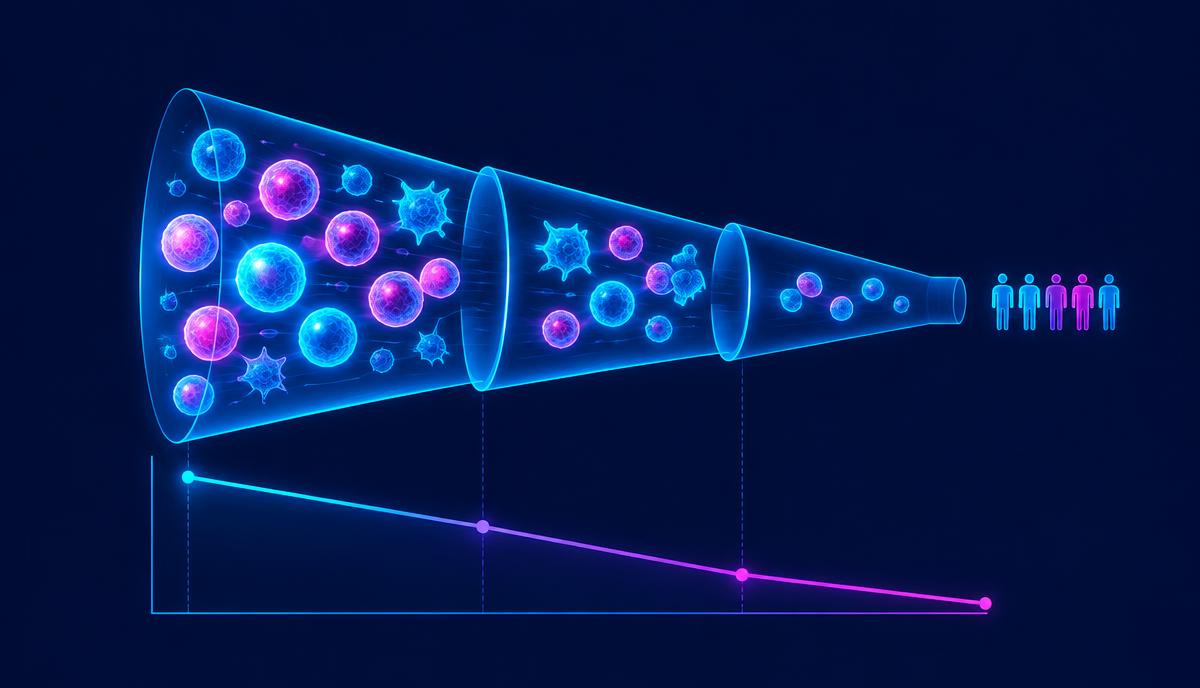
Cell and gene therapies fail more often than they succeed in clinical development, and that's true even for approaches with strong scientific rationale. A widely cited industry analysis — the “Clinical Development Success Rates and Contributing Factors, 2011–2020” report from the Biotechnology Innovation Organization (BIO), Informa Pharma Intelligence, and QLS Advisors — found that gene therapies had an overall likelihood of approval from Phase 1 of just 10.0%, with only 38.6% of programs successfully advancing from Phase 2 to Phase 3. Cell therapies, represented in that dataset largely by CAR-T programs, performed notably better, with an overall Phase 1-to-approval success rate of 17.3% — still meaning that a majority of cell therapy programs that clear Phase 2 do not make it all the way through Phase 3 and approval. A related 2025 analysis in Nature Reviews Drug Discovery examined success rates specifically for “durable” cell and gene therapies and confirmed that clinical development probability of success remains a central, well-documented challenge shaping how these programs are funded and designed. In plain terms: even therapies that look genuinely promising after early trials fail more often than they succeed by the time they reach late-stage testing — and that has been true for over a decade of industry data, not just a recent bad stretch.
Common Reasons Trials Fail
Late-stage failure isn't usually about a therapy being fraudulent or the science being wrong at the cellular level — it's usually about the gap between “this looks biologically active” and “this reliably, measurably helps patients better than the current standard of care.” The FDA's own review of case studies where Phase 2 and Phase 3 results diverged found that a product's apparent mechanism of action does not automatically predict clinical outcomes, and that biomarker improvements seen in earlier, smaller trials have not reliably predicted clinical outcomes in the larger, longer trials that follow. Beyond that general pattern, several factors show up repeatedly in cell therapy trials specifically: manufacturing and scale-up challenges, since a living cell product made in small batches for a Phase 1 trial can behave differently once production is scaled up for hundreds of patients; placebo response, which can be substantial in conditions with subjective or partly subjective outcome measures; patient heterogeneity, where a diverse patient population responds inconsistently to a therapy that looked effective in a narrower early-trial population; underpowered trial sizes, since cell therapy trials are expensive and often smaller than trials for conventional drugs, making it harder to detect a real but modest effect; and the sheer biological complexity of cell-based products, which are far harder to standardize and replicate precisely than a small-molecule pill.
A Real Example: What Happened When a Promising Heart Therapy Missed Its Goal
A concrete, current example helps make this less abstract. In September 2026, Longeveron announced topline results from its ELPIS II Phase 2b trial of laromestrocel, a mesenchymal stem cell therapy being studied in infants with hypoplastic left heart syndrome (HLHS), a severe congenital heart defect. The trial missed its primary endpoint: the change in right ventricular ejection fraction at 12 months showed only a −0.7 percentage-point difference between treatment and control groups, which was not statistically significant. Longeveron's stock fell roughly 59% on the news, and the company announced cost-cutting measures while reviewing its strategic options. But the readout wasn't uniformly negative. Secondary and exploratory data showed encouraging signals: zero deaths occurred in the laromestrocel-treated group over 12 months compared with one death in the control arm; longer-term follow-up out to five years showed one transplant-free survival event in the treated group versus two in standard care; the treated group had roughly 31% fewer major adverse cardiovascular events, though this difference also did not reach statistical significance; and no new safety signals were attributed to the therapy itself. Longeveron said it plans further analysis of the exploratory data and intends to consult the FDA on a possible path forward. This is exactly the pattern a newcomer should learn to recognize: a missed primary endpoint alongside a clean safety profile and some encouraging — but not yet statistically proven — secondary signals. It's disappointing, not necessarily the end of the story, and it is not evidence the underlying science is fraudulent.
Why Trial Failures Are a Feature of the System, Not Just a Setback
The FDA structures drug and biologic development into phases specifically because early, small studies cannot reliably predict what will happen in larger, longer, more diverse trials. Phase 1 typically involves a few dozen participants and focuses on basic safety. Phase 2 expands to test whether there's a real efficacy signal in patients with the condition being studied. Phase 3 then tests hundreds to thousands of participants across more diverse populations and longer time periods — explicitly designed to catch problems, weaker-than-hoped effects, or safety issues that smaller earlier trials could miss. A therapy only advances to the next phase after showing acceptable evidence at the prior one, and the FDA's own case-study analysis of divergent Phase 2/3 results makes clear that this escalating, skeptical structure is intentional: it exists to prevent therapies that only work in a narrow or lucky sample from reaching the market. Every well-publicized late-stage failure is, in a real sense, the system doing exactly what it's supposed to do.
How to Read Trial News Like an Informed Patient
When you see a headline about a stem cell trial “failing,” resist treating it as either meaningless noise or proof the whole field doesn't work. Ask instead: was it the primary endpoint or a secondary one that missed? Were there safety concerns, or was safety clean while efficacy fell short? Was the trial adequately powered, and does the company plan further analysis or a follow-up study? A missed primary endpoint with a clean safety record, like ELPIS II, is a very different signal than a trial halted for safety concerns. Calibrating your expectations around these distinctions — rather than around headlines alone — is one of the most useful skills for following regenerative medicine responsibly.
Bottom Line
Late-stage failure is a normal, statistically common part of cell and gene therapy development — not a sign the science is broken. Industry data shows overall approval likelihoods in the range of roughly 10–17% for gene and cell therapies respectively, with substantial attrition even between Phase 2 and Phase 3. Real, recent examples like Longeveron's ELPIS II trial show that a missed efficacy endpoint can still come packaged with a clean safety profile and encouraging secondary signals — a nuance worth understanding rather than reducing to “success” or “failure.” The FDA's phased trial system exists precisely to catch these gaps before a therapy reaches patients broadly, which means that trial failure, while disappointing, is evidence the safeguards are functioning as intended.
Sources
- Clinical Development Success Rates and Contributing Factors, 2011–2020 — BIO, Informa Pharma Intelligence & QLS Advisors, 2021 — https://go.bio.org/rs/490-EHZ-999/images/ClinicalDevelopmentSuccessRates2011_2020.pdf
- Clinical development success rates for durable cell and gene therapies — Nature Reviews Drug Discovery, 2025 — https://www.nature.com/articles/d41573-025-00036-8
- Longeveron Announces Topline Results from ELPIS II Phase 2b Clinical Trial Evaluating Laromestrocel as a Potential Treatment for Hypoplastic Left Heart Syndrome (HLHS) — Longeveron/GlobeNewswire, 2026 — https://www.globenewswire.com/news-release/2026/09/16/3363591/0/en/longeveron-announces-topline-results-from-elpis-ii-phase-2b-clinical-trial-evaluating-laromestrocel-as-a-potential-treatment-for-hypoplastic-left-heart-syndrome-hlhs.html
- Longeveron's phase 2b stem cell flop spurs cost cutting, exploration of 'all options' — Fierce Biotech, 2026 — https://www.fiercebiotech.com/biotech/longeverons-phase-2b-stem-cell-flop-spurs-cost-cutting-exploration-all-options
- The FDA's Drug Review Process: Ensuring Drugs Are Safe and Effective — U.S. Food and Drug Administration — https://www.fda.gov/drugs/information-consumers-and-patients-drugs/fdas-drug-review-process-ensuring-drugs-are-safe-and-effective
- 22 Case Studies Where Phase 2 and Phase 3 Trials Had Divergent Results — U.S. Food and Drug Administration — https://www.fda.gov/media/102332/download
Related Articles
- Fundamentals
Who Pays for Stem Cell Research? A Beginner's Guide to How Trials and Therapies Get Funded
Stem cell therapies move through a funding relay — NIH and state grants, universities, foundations, then venture capital. Legitimate trials don't charge patients for the experimental product.
- Fundamentals
What Is Immune Privilege? Why Donor (Allogeneic) Stem Cells Usually Don't Trigger Rejection
Mesenchymal stem cells carry few of the molecular flags that trigger rejection — but researchers now call them immune evasive, not immune privileged.
- Fundamentals
What Are Exosomes, and How Are They Different From Stem Cells?
Exosomes are signaling packets cells release — not cells. No exosome product has FDA approval, and the agency has been warning about them since 2019.