Can Exercise Boost Your Body's Own Stem Cell Activity? What the Evidence Actually Shows
What this article covers
- What This Article Covers
- Long before anyone talked about stem cell clinics, the body already had its own repair crews: resident stem and progenitor cells that help rebuild muscle, patch blood vessels, and support the brain. A growing body of research shows that physical activity measurably engages these systems — activating muscle's satellite cells, temporarily mobilizing progenitor cells into the bloodstream, and, in animal studies, stimulating the birth of new neurons in the hippocampus.
- Muscle Satellite Cells: Exercise as a Trigger for the Body's Own Repair System
- Skeletal muscle contains its own dedicated stem cells, called satellite cells, which sit dormant along muscle fibers until called into action by damage or growth signals. Resistance exercise is one of the most reliable known triggers: a 2022 Frontiers in Physiology review on satellite cells and sarcopenia (age-related muscle loss) reports that increases in satellite cell and muscle nuclei content accompany the hypertrophy seen with long-term resistance exercise, in both healthy young and older adults.
- Circulating Progenitor Cells: A Measurable but Temporary Response
- A separate, well-documented phenomenon is that acute exercise pushes stem and progenitor cells out of the bone marrow and into circulating blood. A 2021 systematic review and meta-analysis in Stem Cell Reviews and Reports, pooling 55 studies, found significant increases in circulating hematopoietic and endothelial progenitor cell populations within minutes of exercise, with endothelial progenitor cell elevations detectable up to 48 hours later in some studies.
- Exercise and Brain Stem Cells: What Animal Studies Show
- The most striking findings on exercise and neurogenesis — the birth of new neurons from neural stem/progenitor cells in the hippocampus — come almost entirely from animal models. Studies of voluntary running in rodents consistently show increased proliferation of hippocampal neural progenitor cells and improved measures of learning and memory.
- What We Still Don't Know
- " Most human studies measure short-term cell counts or markers, not long-term tissue outcomes. Optimal exercise type, intensity, and dose for these effects are not well established, and individual variation (age, fitness level, health status) is large.
What This Article Covers
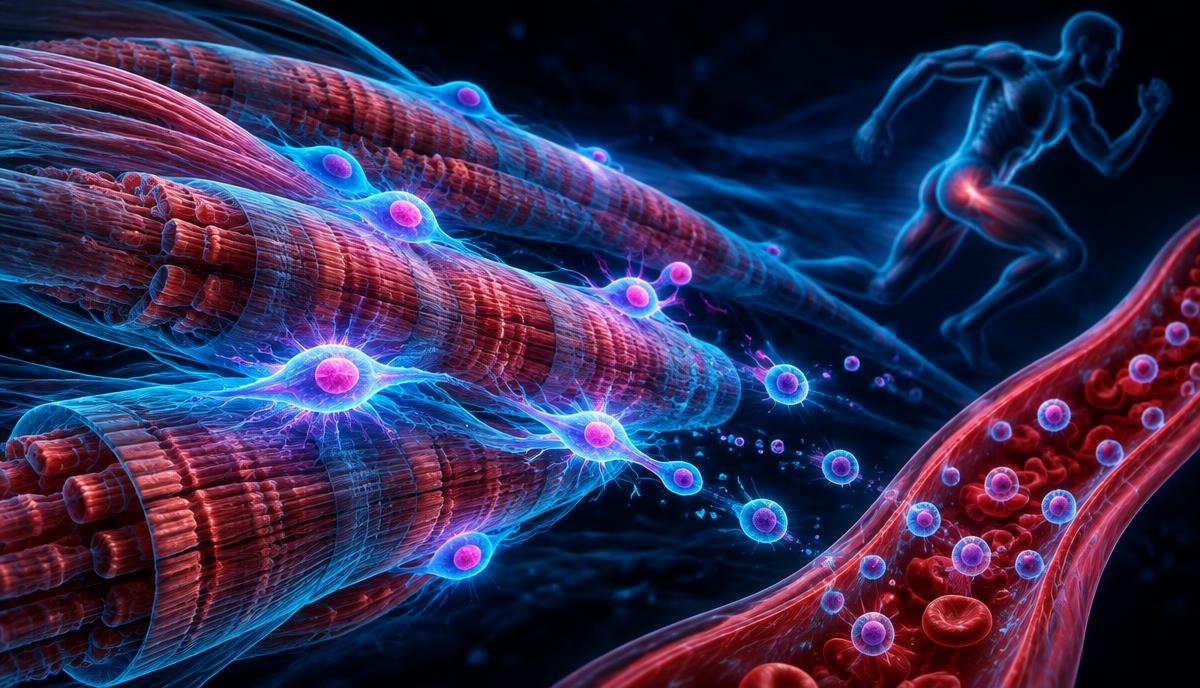
Long before anyone talked about stem cell clinics, the body already had its own repair crews: resident stem and progenitor cells that help rebuild muscle, patch blood vessels, and support the brain. A growing body of research shows that physical activity measurably engages these systems — activating muscle's satellite cells, temporarily mobilizing progenitor cells into the bloodstream, and, in animal studies, stimulating the birth of new neurons in the hippocampus. This is genuinely encouraging science. It is not, however, evidence that exercise "regenerates" organs in the way a medical stem cell therapy claims to, and much of it comes with real caveats about duration, species, and long-term clinical meaning. Here's what the evidence actually supports.
Muscle Satellite Cells: Exercise as a Trigger for the Body's Own Repair System
Skeletal muscle contains its own dedicated stem cells, called satellite cells, which sit dormant along muscle fibers until called into action by damage or growth signals. Resistance exercise is one of the most reliable known triggers: a 2022 Frontiers in Physiology review on satellite cells and sarcopenia (age-related muscle loss) reports that increases in satellite cell and muscle nuclei content accompany the hypertrophy seen with long-term resistance exercise, in both healthy young and older adults. That's a meaningful finding: it suggests older adults retain the capacity to activate this repair system, not just younger ones. The same review is careful to note the limits of current understanding — the precise mechanism by which exercise activates satellite cells remains largely unknown at a molecular level, and human data on the topic remain largely descriptive rather than mechanistic. It also cautions that even physically active older adults still experience significant age-related muscle loss over time, meaning exercise supports the satellite cell system rather than fully reversing aging's effects on it.
Circulating Progenitor Cells: A Measurable but Temporary Response
A separate, well-documented phenomenon is that acute exercise pushes stem and progenitor cells out of the bone marrow and into circulating blood. A 2021 systematic review and meta-analysis in Stem Cell Reviews and Reports, pooling 55 studies, found significant increases in circulating hematopoietic and endothelial progenitor cell populations within minutes of exercise, with endothelial progenitor cell elevations detectable up to 48 hours later in some studies. An earlier, frequently cited study in the Journal of the American College of Cardiology similarly found that a single bout of exercise acutely increased circulating endothelial progenitor cells and related angiogenic cells in humans. This is a real, reproducible physiological event — but its practical significance is still being worked out. The 2021 meta-analysis explicitly flags that inconsistent cell-marker definitions across studies hinder mechanistic understanding, and researchers have not established how much this transient mobilization translates into durable improvements in vascular repair or long-term health outcomes.
Exercise and Brain Stem Cells: What Animal Studies Show
The most striking findings on exercise and neurogenesis — the birth of new neurons from neural stem/progenitor cells in the hippocampus — come almost entirely from animal models. Studies of voluntary running in rodents consistently show increased proliferation of hippocampal neural progenitor cells and improved measures of learning and memory. But whether this translates directly to humans is genuinely unsettled science: a 2018 Cell Stem Cell study reported evidence that human hippocampal neurogenesis persists throughout aging, while another study published the same year in the same journal reported the opposite — that new neuron production becomes undetectable in adulthood. Direct, in-vivo measurement of neurogenesis in living human brains remains technically very difficult, so this is an area where enthusiasm should stay well ahead of certainty until the human data settles.
What We Still Don't Know
Across all three areas, the honest summary is: exercise clearly engages the body's endogenous stem/progenitor cell systems, but "engages" is not the same as "clinically regenerates." Most human studies measure short-term cell counts or markers, not long-term tissue outcomes. Optimal exercise type, intensity, and dose for these effects are not well established, and individual variation (age, fitness level, health status) is large.
Bottom Line
Exercise is one of the few interventions with real, peer-reviewed evidence that it activates the body's own stem and progenitor cell populations — a genuinely hopeful finding for muscle health, vascular repair signaling, and possibly brain health. But this is supportive, largely mechanistic and preliminary science, not a substitute for medically supervised stem cell therapy or a validated treatment for disease. Framing regular physical activity as one input into long-term tissue health, rather than a regenerative cure-all, is what the current evidence actually supports.
Sources
- Changes in Circulating Stem and Progenitor Cell Numbers Following Acute Exercise in Healthy Human Subjects: a Systematic Review and Meta-analysis — Stem Cell Reviews and Reports (PMC), 2021 — https://pmc.ncbi.nlm.nih.gov/articles/PMC8316227/
- Contribution of muscle satellite cells to sarcopenia — Frontiers in Physiology, 2022 — https://www.frontiersin.org/journals/physiology/articles/10.3389/fphys.2022.892749/full
- Exercise acutely increases circulating endothelial progenitor cells and monocyte-/macrophage-derived angiogenic cells — Journal of the American College of Cardiology, 2004 — https://www.jacc.org/doi/10.1016/j.jacc.2004.02.049
- Human Hippocampal Neurogenesis Persists throughout Aging — Cell Stem Cell, 2018 — https://www.cell.com/cell-stem-cell/fulltext/S1934-5909(18)30121-8
- Does Adult Neurogenesis Persist in the Human Hippocampus? — Cell Stem Cell, 2018 — https://www.cell.com/cell-stem-cell/fulltext/S1934-5909(18)30542-3
- Mechanisms underlying the effect of voluntary running on adult hippocampal neurogenesis — PMC, 2023 — https://pmc.ncbi.nlm.nih.gov/articles/PMC10566571/
Related Articles
- Fundamentals
Types of Cartilage Damage: What Regenerative Options Exist for Each?
Focal cartilage defects, osteochondritis dissecans, osteoarthritis and meniscus tears need different evidence. Where MACI is approved and where MSCs remain experimental.
- Fundamentals
What Is Rheumatoid Arthritis?
Rheumatoid arthritis symptoms, diagnosis and proven DMARD treatments explained, with a look at why MSC therapy remains an early-stage research question.
- Fundamentals
How Are Stem Cells Delivered? IV Infusion, Injection, and Implantation Compared
IV infusion, local injection, and surgical implantation send stem cells to very different places. How each delivery route works, what it's used for, and why the lungs trap most IV-infused cells.