What Are Organoids, and How Are They Grown From Stem Cells?
What this article covers
- What This Article Covers
- An organoid is a tiny, three-dimensional structure grown in a lab dish from stem cells that organizes itself to resemble a miniature version of a real organ, complete with several cell types arranged the way they would be in the body. This article explains what organoids actually are (and are not), how scientists coax stem cells into building them, why they have become one of the most important tools in modern biomedical research — from predicting which cystic fibrosis patients will respond to a specific drug to reducing reliance on animal testing — and where their real limitations lie, including why a brain organoid is nowhere close to a thinking brain.
- What Is an Organoid?
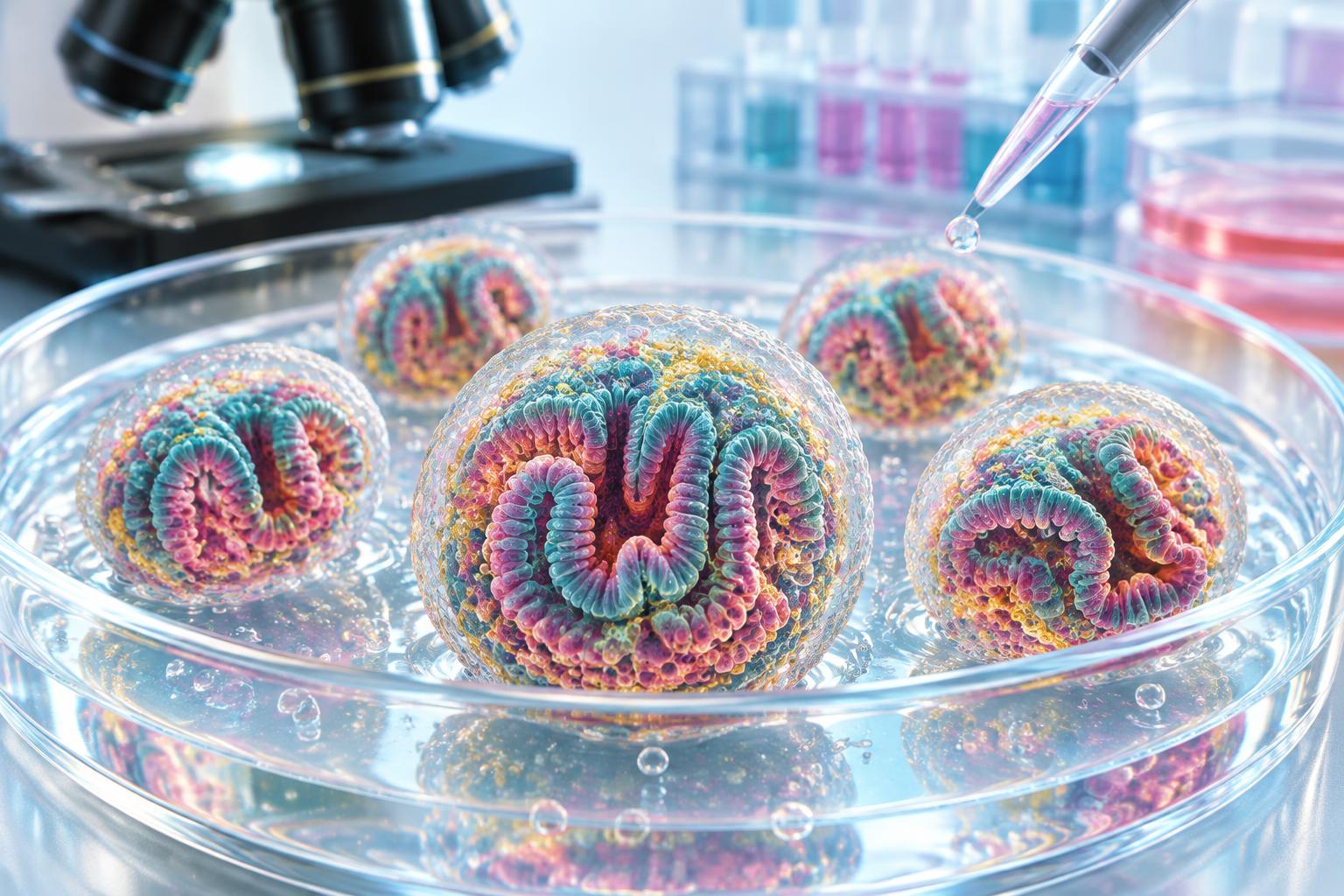
- " It is a self-organized, three-dimensional cell culture — usually just a few millimeters across, often smaller than a grain of rice — grown from stem cells that spontaneously arrange themselves into structures that mimic the architecture and some of the function of a real organ. Depending on the starting cells and the growth conditions, researchers have grown organoids that resemble simplified versions of the intestine, stomach, liver, kidney, lung, retina, and brain, among others.
- How Scientists Grow an Organoid From Stem Cells
- Growing an organoid generally starts with placing stem cells into a gel-like scaffold that mimics the extracellular matrix — the protein mesh that normally surrounds and supports cells in tissue — and bathing them in a precisely tuned cocktail of growth factors that mirrors the signals those cells would receive during normal development. Over days to weeks, the cells proliferate, change into the various specialized cell types found in the target organ, and self-assemble into organ-like structures — crypts and villi in a gut organoid, for example, or layered, cortex-like zones in a brain organoid.
- Why Organoids Matter
- The excitement around organoids is well-earned, because they fill a real gap: ordinary 2D cell cultures are often too simple to capture how tissues really behave, while animal studies — though essential for many purposes — don't always predict human drug responses accurately. Organoids sit usefully in between, offering living human tissue architecture without the risk of experimenting directly on a patient.
- What Organoids Are Not: Limitations and Open Questions
- It's important to be precise about what an organoid is — and is not. An organoid is not a lab-grown organ ready for transplant, and a cerebral organoid is not a brain capable of thought, consciousness, or sensation; it is a simplified, partial model of certain developmental and cellular features of brain tissue.
What This Article Covers
An organoid is a tiny, three-dimensional structure grown in a lab dish from stem cells that organizes itself to resemble a miniature version of a real organ, complete with several cell types arranged the way they would be in the body. This article explains what organoids actually are (and are not), how scientists coax stem cells into building them, why they have become one of the most important tools in modern biomedical research — from predicting which cystic fibrosis patients will respond to a specific drug to reducing reliance on animal testing — and where their real limitations lie, including why a brain organoid is nowhere close to a thinking brain.
What Is an Organoid?
"Organoid" literally means "resembling an organ." It is a self-organized, three-dimensional cell culture — usually just a few millimeters across, often smaller than a grain of rice — grown from stem cells that spontaneously arrange themselves into structures that mimic the architecture and some of the function of a real organ. Depending on the starting cells and the growth conditions, researchers have grown organoids that resemble simplified versions of the intestine, stomach, liver, kidney, lung, retina, and brain, among others.
Organoids are built from two main stem cell sources: adult (tissue-specific) stem cells taken from a biopsy, which tend to form organoids resembling the epithelial lining of their organ of origin, and pluripotent stem cells — either embryonic stem cells or induced pluripotent stem cells (iPSCs) — which can be coaxed into more complex, multi-cell-type organoids that better approximate whole-organ development. Either way, the defining feature is self-organization: scientists provide the right biochemical signals and physical environment, and the stem cells do the architectural work themselves, without a blueprint being imposed from outside.
How Scientists Grow an Organoid From Stem Cells
Growing an organoid generally starts with placing stem cells into a gel-like scaffold that mimics the extracellular matrix — the protein mesh that normally surrounds and supports cells in tissue — and bathing them in a precisely tuned cocktail of growth factors that mirrors the signals those cells would receive during normal development. Over days to weeks, the cells proliferate, change into the various specialized cell types found in the target organ, and self-assemble into organ-like structures — crypts and villi in a gut organoid, for example, or layered, cortex-like zones in a brain organoid.
A landmark 2009 paper from Hans Clevers' lab, published in Nature, showed that even single Lgr5-positive intestinal stem cells could build crypt-villus "mini-gut" structures in a dish without any supporting mesenchymal tissue, simply by supplying the right growth factors (including a Wnt-pathway agonist, EGF, and a BMP inhibitor). That experiment helped launch the modern organoid field. A few years later, in 2013, Madeline Lancaster and Jürgen Knoblich's lab published in Nature a method for growing "cerebral organoids" — three-dimensional brain-like tissue derived from human pluripotent stem cells that recapitulated features of early human brain development, including aspects of a developmental brain-size disorder called microcephaly. Together, these two papers established organoids as a genuinely new way to study human biology directly, rather than relying solely on flat cell cultures or animal models that don't always reflect human physiology.
Why Organoids Matter
The excitement around organoids is well-earned, because they fill a real gap: ordinary 2D cell cultures are often too simple to capture how tissues really behave, while animal studies — though essential for many purposes — don't always predict human drug responses accurately. Organoids sit usefully in between, offering living human tissue architecture without the risk of experimenting directly on a patient.
One of the clearest real-world payoffs has come in cystic fibrosis care. Researchers in the Netherlands, building on Clevers-lab organoid technology, grew rectal organoids from the biopsies of individual cystic fibrosis patients and used them to test, in the dish, how well different CFTR-modulator drugs corrected each patient's specific defect — work that has gone on to help identify effective treatment options for patients with rare CFTR mutations too uncommon to study in traditional clinical trials. This kind of "patient-in-a-dish" drug testing is one of the most tangible, already-useful applications of stem cell-derived organoids in medicine today.
Organoids are also reshaping how new drugs get tested more broadly. In December 2022, the U.S. Congress passed the FDA Modernization Act 2.0, which formally removed the long-standing requirement that new drugs be tested in animals before human trials, explicitly opening the door for alternatives such as organoids, organ-on-chip systems, and other cell-based and computational models. This doesn't mean animal testing disappears overnight, but it is a meaningful regulatory signal that organoid-based testing is being taken seriously as a scientifically credible tool for predicting how a drug might behave in human tissue — with the added appeal of reducing animal use. Beyond drug testing, patient-derived tumor organoids are also being used as research tools to study how individual cancers might respond to different chemotherapy regimens, an active area of ongoing investigation rather than a routine clinical service.
What Organoids Are Not: Limitations and Open Questions
It's important to be precise about what an organoid is — and is not. An organoid is not a lab-grown organ ready for transplant, and a cerebral organoid is not a brain capable of thought, consciousness, or sensation; it is a simplified, partial model of certain developmental and cellular features of brain tissue. Most organoids max out at just a few millimeters in size because they typically lack blood vessels (vasculature), which limits how much oxygen and nutrients can reach their interior and caps how large and long-lived they can grow. They also usually lack immune cells and the full complexity of supporting tissues found in a real organ, and they generally model fetal or early developmental stages of tissue more faithfully than fully mature adult organ function. Active research is underway to add vascular networks and immune components to organoids to make them more physiologically realistic, but this remains a work in progress rather than a solved problem.
The rapid sophistication of organoid models — especially brain organoids and the even more advanced "embryo models" built from stem cells — has also raised genuine ethical questions, which the International Society for Stem Cell Research (ISSCR) addressed in its 2021 Guidelines for Stem Cell Research and Clinical Translation. The guidelines call for specialized scientific and ethical review of research involving organoids and stem cell-based embryo models that begin to approach features of more complex, organized human tissue, reflecting the field's own recognition that oversight needs to keep pace with the technology.
Bottom Line
Organoids are one of the most genuinely exciting tools in modern stem cell science — tiny, self-organizing, lab-grown structures that let researchers study human tissue biology, test drugs, and even help choose treatments for individual patients, all without experimenting directly on a person or relying solely on animal models. But they remain simplified, partial stand-ins for real organs: small, usually without blood vessels or immune cells, and better at modeling development than mature adult organ function. Understanding that balance — real scientific power paired with real, well-documented limitations — is the key to reading any news story about what an organoid has or hasn't achieved.
Key Questions Answered
- How are organoids grown from stem cells?
- Scientists place adult or pluripotent stem cells in a supportive gel and supply growth-factor signals. The cells proliferate, specialize and self-organize into three-dimensional tissue-like structures.
- How are organoids useful in cystic fibrosis?
- Patient-derived rectal organoids can help test how CFTR-modulator drugs correct a patient's specific defect, including rare mutations difficult to study in conventional trials.
- Are organoids complete organs or thinking brains?
- No. They are simplified tissue models, usually lacking blood vessels, immune cells and mature organ complexity. Cerebral organoids are not brains capable of thought, consciousness or sensation.
Sources
- Miniature Models Made to Aid Drug Development, NIH Record, National Institutes of Health, 2022, https://nihrecord.nih.gov/2022/10/14/miniature-models-made-aid-drug-development
- Single Lgr5 stem cells build crypt-villus structures in vitro without a mesenchymal niche, Sato T, et al., Nature, 2009, https://www.nature.com/articles/nature07935
- Cerebral organoids model human brain development and microcephaly, Lancaster MA, Knoblich JA, et al., Nature, 2013, https://pubmed.ncbi.nlm.nih.gov/23995685/
- FDA Modernization Act 2.0 allows for alternatives to animal testing, PubMed, 2023, https://pubmed.ncbi.nlm.nih.gov/36762462/
- Guidelines for Stem Cell Research and Clinical Translation (2021 update), International Society for Stem Cell Research (ISSCR), https://www.isscr.org/stem-cell-guidelines
- Tiny "mini-me" organs grown from children's cells transforming cystic fibrosis care, UNSW Sydney Newsroom, 2026, https://www.unsw.edu.au/newsroom/news/2026/02/tiny-mini-me-organs-grown-from-childrens-cells-transforming-cystic-fibrosis-care
- Are intestinal organoids the key to developing personalized therapy for cystic fibrosis?, BioTechniques, https://www.biotechniques.com/precision-medicine/are-intestinal-organoids-the-key-to-developing-personalized-therapy-for-cystic-fibrosis
Related Articles
- Fundamentals
What Is Angiogenesis, and Why Does It Matter for Stem Cell Therapy?
New blood vessels don't just show up — they're built, through a process called angiogenesis. Here's what it is, why the body depends on it for healing, and why so much stem cell research is focused on helping it along.
- Fundamentals
Myth: If a Treatment Is Listed on ClinicalTrials.gov, It Must Be Safe and Effective
Seeing a treatment listed on ClinicalTrials.gov can feel like a stamp of approval — but registering a trial costs nothing, requires no proof the treatment works, and isn't vetted by the government for safety or scientific quality.
- Fundamentals
Myth: A Stem Cell Treatment Being "Minimally Manipulated" Automatically Makes It Legal Under FDA Rules
Minimal manipulation is only one of four criteria for avoiding FDA premarket review. Homologous use and recent SVF court rulings also matter.