What Is Psoriatic Arthritis?
What this article covers
- What This Article Covers
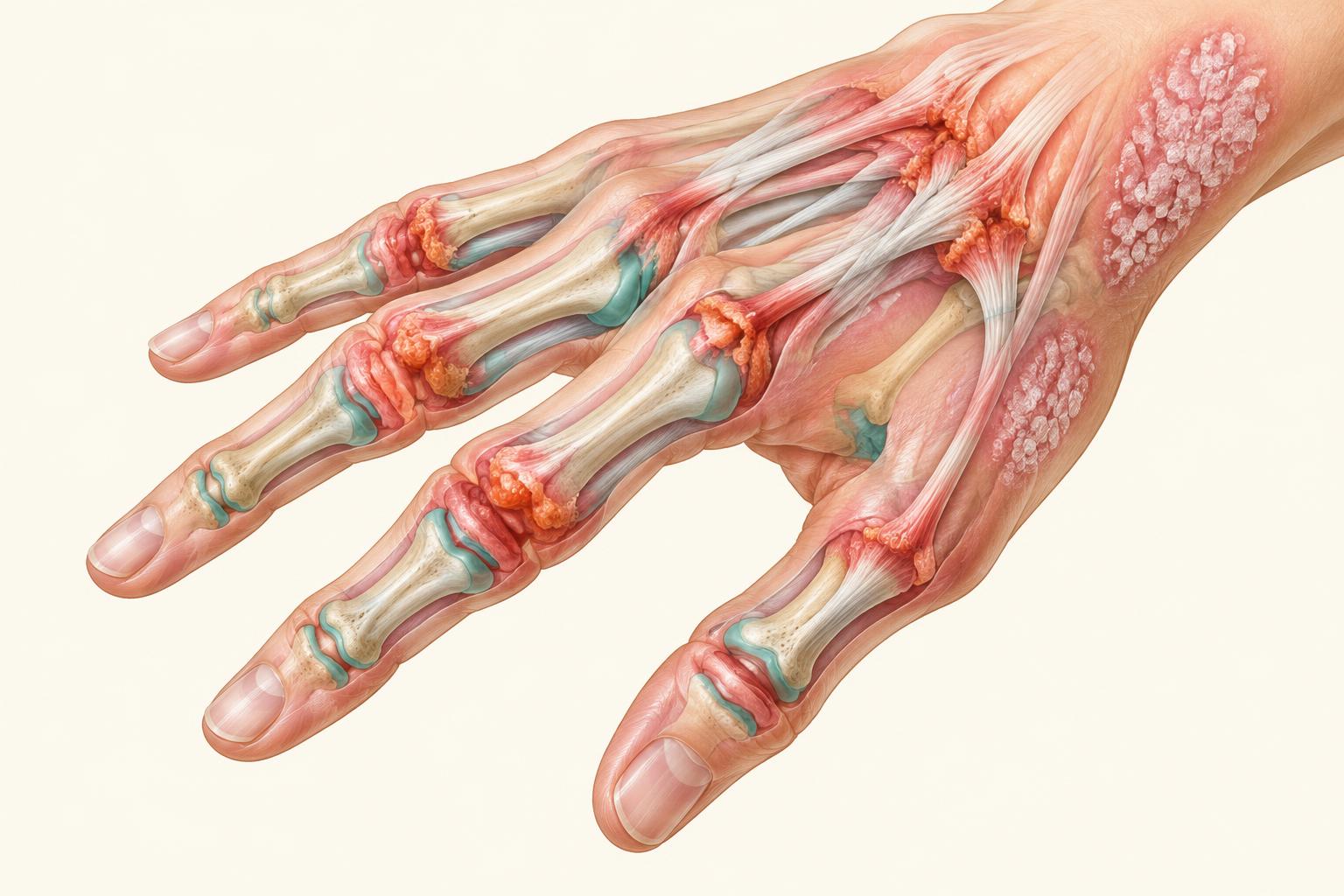
- Psoriatic arthritis (PsA) is a chronic inflammatory disease that combines the skin changes of psoriasis with joint, tendon, and spine inflammation. This article explains what causes it, how it presents and is diagnosed, the medications rheumatologists use today (NSAIDs, DMARDs, and biologics including TNF, IL-17, and IL-23 inhibitors, plus JAK inhibitors), and gives an honest accounting of where stem cell and cell-therapy research stands for this specific disease — which, as of now, is very early and almost entirely limited to isolated case reports rather than controlled trials.
- What Causes It
- Psoriatic arthritis is an immune-mediated disease: the immune system becomes chronically overactive against the body's own tissue, for reasons researchers don't yet fully understand.
- Symptoms
- PsA symptoms vary considerably from person to person, which NIAMS notes can make the disease difficult to diagnose.
- How It's Diagnosed
- There is no single definitive lab test for psoriatic arthritis. Rheumatologists typically diagnose it through a combination of clinical examination (looking for joint swelling, dactylitis, enthesitis, and nail or skin changes), a personal or family history of psoriasis, imaging (X-rays, ultrasound, or MRI to detect joint and tendon involvement), and blood tests used mainly to rule out other forms of arthritis such as rheumatoid arthritis.
- Standard Care Today
- There is currently no cure for psoriatic arthritis, but a substantial and growing set of medications can control inflammation, relieve symptoms, and slow or prevent joint damage. Treatment is generally guided by a "treat-to-target" strategy — adjusting therapy based on ongoing disease activity — a conditional recommendation in the joint American College of Rheumatology (ACR) and National Psoriasis Foundation (NPF) guideline.
What This Article Covers
Psoriatic arthritis (PsA) is a chronic inflammatory disease that combines the skin changes of psoriasis with joint, tendon, and spine inflammation. This article explains what causes it, how it presents and is diagnosed, the medications rheumatologists use today (NSAIDs, DMARDs, and biologics including TNF, IL-17, and IL-23 inhibitors, plus JAK inhibitors), and gives an honest accounting of where stem cell and cell-therapy research stands for this specific disease — which, as of now, is very early and almost entirely limited to isolated case reports rather than controlled trials.
What Causes It
Psoriatic arthritis is an immune-mediated disease: the immune system becomes chronically overactive against the body's own tissue, for reasons researchers don't yet fully understand. According to the National Institute of Arthritis and Musculoskeletal and Skin Diseases (NIAMS), several factors appear to combine to trigger it:
- Genetics — many people with PsA have a family history of psoriasis or psoriatic arthritis, and researchers have identified some of the genes involved.
- Immune dysregulation — the same inflammatory pathways that drive psoriasis in the skin also drive inflammation in joints, tendons, and the spine.
- Environmental triggers — obesity, infection, physical injury, and stress have all been linked to disease onset or flares, and obesity and more severe psoriasis are associated with a higher risk of developing PsA among people who already have psoriasis.
PsA most often develops in people who already have psoriasis, typically years after the skin disease appears, though in some people joint symptoms come first.
Symptoms
PsA symptoms vary considerably from person to person, which NIAMS notes can make the disease difficult to diagnose. Common features include:
- Psoriasis skin plaques — scaly, inflamed patches, often on the scalp, elbows, or knees
- Joint pain, stiffness, and swelling — which can affect the spine and is often worse in the morning or after rest
- Dactylitis — "sausage-like" swelling of an entire finger or toe
- Enthesitis — tenderness where tendons or ligaments attach to bone, commonly at the heel or sole of the foot
- Nail changes — pitting, crumbling, or separation from the nail bed
- Fatigue
- Eye inflammation (uveitis) — which requires prompt treatment to prevent vision loss
- Inflammatory bowel disease — occurs in some people with PsA alongside the joint and skin disease
How It's Diagnosed
There is no single definitive lab test for psoriatic arthritis. Rheumatologists typically diagnose it through a combination of clinical examination (looking for joint swelling, dactylitis, enthesitis, and nail or skin changes), a personal or family history of psoriasis, imaging (X-rays, ultrasound, or MRI to detect joint and tendon involvement), and blood tests used mainly to rule out other forms of arthritis such as rheumatoid arthritis. Because symptoms can overlap with other conditions and may appear gradually, diagnosis is sometimes delayed — and clinical guidance consistently emphasizes that earlier treatment is linked to better long-term outcomes.
Standard Care Today
There is currently no cure for psoriatic arthritis, but a substantial and growing set of medications can control inflammation, relieve symptoms, and slow or prevent joint damage. Treatment is generally guided by a "treat-to-target" strategy — adjusting therapy based on ongoing disease activity — a conditional recommendation in the joint American College of Rheumatology (ACR) and National Psoriasis Foundation (NPF) guideline.
- NSAIDs (nonsteroidal anti-inflammatory drugs) are often used first for mild joint pain and stiffness but do not treat skin or nail disease and do not alter the disease's underlying course.
- Conventional DMARDs, especially methotrexate, are typically the first disease-modifying step for active disease; sulfasalazine and leflunomide are other oral options. Apremilast, an oral PDE-4 inhibitor, is another non-biologic option.
- Biologic therapies target specific immune pathways and are often introduced when conventional treatment isn't enough: TNF inhibitors (adalimumab, etanercept, infliximab, golimumab, certolizumab pegol) are recommended as the preferred first-line biologic for many treatment-naïve patients under the 2018 ACR/NPF guideline; IL-17 inhibitors (secukinumab, ixekizumab, brodalumab) are often considered for patients with more severe psoriasis or when TNF inhibitors aren't appropriate, though generally avoided with concurrent inflammatory bowel disease; IL-12/23 and IL-23 inhibitors (such as ustekinumab) may be preferred for patients with coexisting inflammatory bowel disease, severe psoriasis, or who prefer less frequent dosing.
- JAK inhibitors, such as tofacitinib, are oral alternatives to injectable biologics, often considered after a TNF inhibitor fails or isn't tolerated, with caution around infection risk.
- Other measures include intra-articular steroid injections for isolated flares, short oral steroid courses used sparingly, physical and occupational therapy, exercise, weight management, and smoking cessation.
Where Stem Cell Research Stands
This is the area where expectations need to be kept firmly in check: dedicated stem cell or cell-therapy research specifically for psoriatic arthritis is essentially nonexistent in the form of registered, controlled clinical trials. What does exist is limited almost entirely to isolated, uncontrolled case reports. The clearest example is a single case report published in Medical Research Archives (2025) describing one 68-year-old woman with a 25-year history of psoriatic arthritis and extensive psoriasis, treated with adipose-derived mesenchymal stem cells (MSCs). The report describes early reductions in pain and stiffness and, at five years of patient-reported follow-up, sustained improvement in mobility and a marked reduction in visible skin involvement. This is informative as a single clinical observation, but it is not a clinical trial: it involved one patient, had no control group, relied substantially on subjective and patient-reported outcomes, and did not report standardized dosing, cell-preparation details, or systematic safety monitoring. No conclusions about efficacy or safety can be drawn from one uncontrolled case. A separate first-in-human case report (International Medical Case Reports Journal) examined intravenous stromal vascular fraction in a patient with severe psoriasis; it showed a dramatic drop in a standard psoriasis severity score, but it addressed skin disease only — not joint involvement — and was partly funded by the stem cell company providing the product, with a company officer as a co-author, a relevant conflict of interest. Beyond these, registered trials involving MSCs in psoriatic disease have focused on moderate-to-severe skin psoriasis, not the joint, tendon, and spine inflammation that defines psoriatic arthritis. There is no body of peer-reviewed, controlled trial evidence at this time establishing that any stem cell or cell-based therapy is safe or effective specifically for psoriatic arthritis.
Bottom Line
Psoriatic arthritis is a manageable, though not curable, chronic inflammatory disease, and modern rheumatology offers a genuinely effective, evidence-based toolkit — from NSAIDs and methotrexate through TNF, IL-17, and IL-23 inhibitors to JAK inhibitors — that can control symptoms and protect joints for most patients when started early. Stem cell and cell-based therapy research for psoriatic arthritis specifically is, by contrast, in its earliest and most preliminary stage: the published evidence amounts to a small number of uncontrolled single-patient case reports, not clinical trials, and none of it currently supports stem cell therapy as a proven or guideline-recommended treatment for this disease. Anyone exploring this option should discuss it candidly with a rheumatologist and treat marketing claims about stem cell "cures" for psoriatic arthritis with significant skepticism until controlled trial data exist.
Key Questions Answered
- How is psoriatic arthritis diagnosed?
- There is no single definitive laboratory test. Rheumatologists combine examination, psoriasis history, imaging and blood tests used mainly to rule out other arthritis types.
- What treatments can control psoriatic arthritis today?
- Options include NSAIDs, conventional DMARDs, biologics targeting immune pathways and JAK inhibitors, supported by exercise and other measures. Treat-to-target care aims to control inflammation and protect joints.
- Is stem cell therapy proven for psoriatic arthritis?
- No. Disease-specific evidence is limited largely to uncontrolled single-patient case reports. Skin-psoriasis studies do not establish benefits for joint disease, and controlled safety and efficacy evidence is lacking.
Sources
- Psoriatic Arthritis, National Institute of Arthritis and Musculoskeletal and Skin Diseases (NIAMS), https://www.niams.nih.gov/health-topics/psoriatic-arthritis
- New Treatment Guideline for PsA Recommends First-line Anti-TNF Biologics, Center for Biosimilars, 2018, https://www.centerforbiosimilars.com/news/new-treatment-guideline-for-psa-recommends-firstline-antitnf-biologics
- Joint ACR/NPF Psoriatic Arthritis Treatment Guidelines Emphasize Treat-to-Target Approach, Cleveland Clinic ConsultQD, 2018, https://consultqd.clevelandclinic.org/joint-acr-npf-psoriatic-arthritis-treatment-guidelines-emphasize-treat-to-target-approach
- 2018 ACR/NPF Guideline for the Treatment of Psoriatic Arthritis (Pocket Guide), Guideline Central, https://guidelinecentral.com/guideline/7040/pocket-guide/7918
- Case Report: Psoriatic Arthritis and Stem Cell Therapy – A Five-Year Follow-Up Report, Medical Research Archives, 2025, https://esmed.org/MRA/mra/article/view/6547
- First-in-Man Intravenous Implantation of Stromal Vascular Fraction in Psoriasis, International Medical Case Reports Journal, Dove Press, https://www.dovepress.com/first-in-man-intravenous-implantation-of-stromal-vascular-fraction-in--peer-reviewed-article-IMCRJ
Related Articles
- Fundamentals
What Is Angiogenesis, and Why Does It Matter for Stem Cell Therapy?
New blood vessels don't just show up — they're built, through a process called angiogenesis. Here's what it is, why the body depends on it for healing, and why so much stem cell research is focused on helping it along.
- Fundamentals
Myth: If a Treatment Is Listed on ClinicalTrials.gov, It Must Be Safe and Effective
Seeing a treatment listed on ClinicalTrials.gov can feel like a stamp of approval — but registering a trial costs nothing, requires no proof the treatment works, and isn't vetted by the government for safety or scientific quality.
- Fundamentals
What Are Organoids, and How Are They Grown From Stem Cells?
Organoids are tiny, self-organizing models grown from stem cells. They help study human biology and drug responses but are not complete transplant-ready organs.