Can Stem Cells Help With Osteochondral Lesions of the Talus (Ankle Cartilage Damage)?
What this article covers
- What This Article Covers
- Osteochondral lesions of the talus (OLT) — localized damage to the cartilage and underlying bone of the ankle joint, usually from a sprain, fracture, or repetitive impact — are a common source of chronic ankle pain that standard arthroscopic treatment doesn't always fully resolve. Over the past decade, surgeons have increasingly paired traditional "marrow stimulation" surgery with injected mesenchymal stem cells (MSCs) in hopes of improving cartilage repair.
- How It's Thought to Work
- The standard surgical treatment for OLT, arthroscopic marrow stimulation (microfracture), drills small holes into the bone beneath a cartilage lesion to trigger bleeding and clot formation, recruiting the body's own marrow-derived cells to form repair tissue. That repair tissue, however, is typically fibrocartilage — a tissue that is structurally weaker and less durable than the smooth hyaline cartilage normally found in joints.
- What the Evidence Shows
- The evidence here is genuinely encouraging in its direction, though still early by surgical-research standards:
- Who Might Be a Candidate
- Based on the current evidence, relevant candidates are a fairly narrow surgical population, not a general audience for injections alone:
- Bottom Line
- Adding mesenchymal stem cells to standard arthroscopic marrow-stimulation surgery for ankle osteochondral lesions has produced a genuinely encouraging, statistically significant signal in at least one sizable comparative study, and the field has matured enough to support an ongoing Phase 3 randomized trial — real progress for a joint where surgery alone often leaves patients short of a full recovery. But the broader evidence base remains dominated by small, low-quality studies, and no regulatory body has approved an MSC product for this specific use.
What This Article Covers
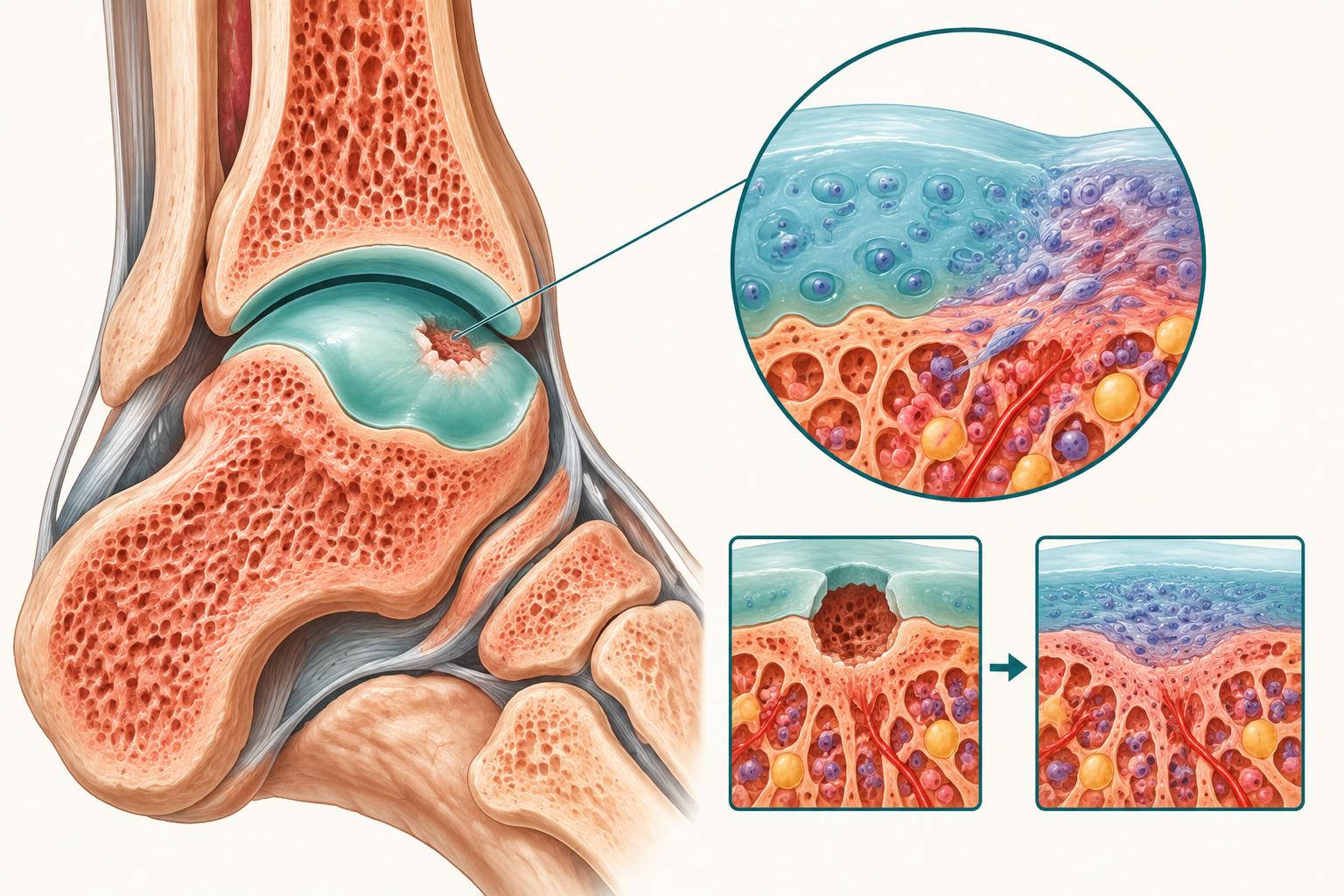
Osteochondral lesions of the talus (OLT) — localized damage to the cartilage and underlying bone of the ankle joint, usually from a sprain, fracture, or repetitive impact — are a common source of chronic ankle pain that standard arthroscopic treatment doesn't always fully resolve. Over the past decade, surgeons have increasingly paired traditional "marrow stimulation" surgery with injected mesenchymal stem cells (MSCs) in hopes of improving cartilage repair. This article covers what OLT is, how MSCs are thought to help, what the actual evidence shows, and who might realistically be a candidate for this still-developing combination approach.
How It's Thought to Work
The standard surgical treatment for OLT, arthroscopic marrow stimulation (microfracture), drills small holes into the bone beneath a cartilage lesion to trigger bleeding and clot formation, recruiting the body's own marrow-derived cells to form repair tissue. That repair tissue, however, is typically fibrocartilage — a tissue that is structurally weaker and less durable than the smooth hyaline cartilage normally found in joints. The rationale for adding MSCs, usually injected into the joint at the time of surgery or afterward, is that supplementing the repair site with a concentrated, living source of cartilage-forming cells and their secreted signaling factors may improve the quality of the resulting repair tissue and reduce pain more than marrow stimulation alone.
What the Evidence Shows
The evidence here is genuinely encouraging in its direction, though still early by surgical-research standards:
- A 2013 retrospective cohort study in The American Journal of Sports Medicine compared 65 patients over age 50 with talar osteochondral lesions: one group (37 ankles) received arthroscopic marrow stimulation alone, while a second group (31 ankles) received marrow stimulation plus an MSC injection. At a mean follow-up of nearly two years, the MSC group showed significantly greater improvement in pain (VAS score dropping from 7.1 to 3.2, versus 7.2 to 4.0 in the surgery-alone group) and ankle function (AOFAS score rising from 68.1 to 82.6, versus 68.0 to 77.2), with both differences statistically significant (p<.001).
- That same study found the MSC group also saw a significant improvement in activity level (Tegner score), while the surgery-alone group did not — a secondary but encouraging signal that the benefit wasn't limited to pain scores alone.
- The field has since progressed toward a registered Phase 3 randomized controlled trial (ClinicalTrials.gov, NCT03905824), sponsored by the University of Chile, comparing standard debridement-and-microfracture surgery with or without an added scaffold embedded with allogeneic umbilical-cord-derived MSCs in roughly 70 patients — a meaningfully more rigorous design than the earlier retrospective data, and one still in progress rather than completed.
It's important to weigh that promising signal against the state of the field as a whole. A 2017 systematic review in the World Journal of Orthopedics, examining cell- and scaffold-based repair strategies for OLT across 28 studies (897 ankles), found that 96% of the included studies were low-quality evidence (Level III or IV, mostly case series), with no study rated good or excellent on a standard methodology score. The reviewers concluded that while these approaches "may produce favorable clinical outcomes," inconsistent reporting and generally poor study design across the field "have confounded" efforts to confirm how effective they truly are. In short: individual studies, including the one above, show real and statistically significant improvements, but the overall evidence base is still thin and would benefit substantially from more, and better-designed, controlled trials.
No MSC-based product is FDA-approved for treating osteochondral lesions of the talus; where it's used today, it is as an adjunct to standard arthroscopic surgery, typically within a research protocol or as an off-label addition at a surgeon's discretion, not as a standalone or guaranteed treatment.
Who Might Be a Candidate
Based on the current evidence, relevant candidates are a fairly narrow surgical population, not a general audience for injections alone:
- Patients with a confirmed osteochondral lesion of the talus (typically diagnosed by MRI or CT) who are already being evaluated for arthroscopic surgery, since nearly all of the supporting evidence involves MSCs used alongside, not instead of, marrow-stimulation surgery.
- Patients whose lesions have failed to improve with conservative measures (rest, bracing, physical therapy) and who are discussing surgical options with an orthopedic foot-and-ankle surgeon.
- This is not a substitute for surgical debridement itself, not something available as a standalone injection with proven benefit outside that surgical context, and not appropriate for patients seeking a nonsurgical "regenerative" shortcut — the real evidence here is specifically about a surgical adjunct, not an alternative to surgery.
Bottom Line
Adding mesenchymal stem cells to standard arthroscopic marrow-stimulation surgery for ankle osteochondral lesions has produced a genuinely encouraging, statistically significant signal in at least one sizable comparative study, and the field has matured enough to support an ongoing Phase 3 randomized trial — real progress for a joint where surgery alone often leaves patients short of a full recovery. But the broader evidence base remains dominated by small, low-quality studies, and no regulatory body has approved an MSC product for this specific use. Patients considering this option should treat it as a research-supported adjunct to discuss with an orthopedic surgeon, not a proven standalone cure, and should wait for the maturing trial data before expecting guaranteed results.
Key Questions Answered
- Can MSCs replace ankle cartilage surgery?
- No. The supporting evidence concerns MSCs added to arthroscopic marrow-stimulation surgery, not a proven standalone injection or alternative to surgical debridement.
- What benefits have comparative studies reported?
- A 2013 retrospective study reported significantly greater pain and ankle-function improvements with MSCs added to surgery. The broader evidence base remains dominated by low-quality studies.
- Is an MSC product approved for osteochondral lesions of the talus?
- No MSC-based product is FDA-approved for this use. A registered Phase 3 randomized trial is still in progress, and guaranteed results are not supported.
Sources
- Kim YS, et al., "Clinical Outcomes of Mesenchymal Stem Cell Injection With Arthroscopic Treatment in Older Patients With Osteochondral Lesions of the Talus," The American Journal of Sports Medicine, 2013, https://pubmed.ncbi.nlm.nih.gov/23460335/
- The Effectiveness of Adding Allogenic Stem Cells After Traditional Treatment of Osteochondral Lesions of the Talus, ClinicalTrials.gov (NCT03905824), University of Chile, https://clinicaltrials.gov/study/NCT03905824
- Shimozono Y, et al., "Scaffold-Based Therapy for Osteochondral Lesions of the Talus: A Systematic Review," World Journal of Orthopedics, 2017, https://pmc.ncbi.nlm.nih.gov/articles/PMC5656496/
- What Are Osteochondral Lesions?, FootCareMD (American Orthopaedic Foot & Ankle Society), https://www.footcaremd.org/conditions-treatments/ankle/osteochondral-lesion
Related Articles
- Clinical Applications
Stem Cell-Derived Neuron Therapy Shows Durable Safety Four Years After Parkinson's Transplant
Four years after a single surgery, the first patients to receive BlueRock Therapeutics' stem cell-derived neuron therapy for Parkinson's disease are still showing stable safety and encouraging motor trends — a rare long-term look at how a lab-grown dopamine neuron graft holds up over time.
- Clinical Applications
Can Stem Cells Help With Medication-Related Osteonecrosis of the Jaw (MRONJ)?
MRONJ is a rare drug side effect in which exposed jawbone fails to heal. Animal studies and one small human series test stem cells; none is FDA-approved.
- Clinical Applications
Can Stem Cells Help With Psoriasis?
Early human research is testing whether mesenchymal stem cells can recalibrate the immune dysfunction behind psoriasis. The signal is real — but the evidence is still small, uncontrolled, and experimental.