Can Stem Cells Help With Medication-Related Osteonecrosis of the Jaw (MRONJ)?
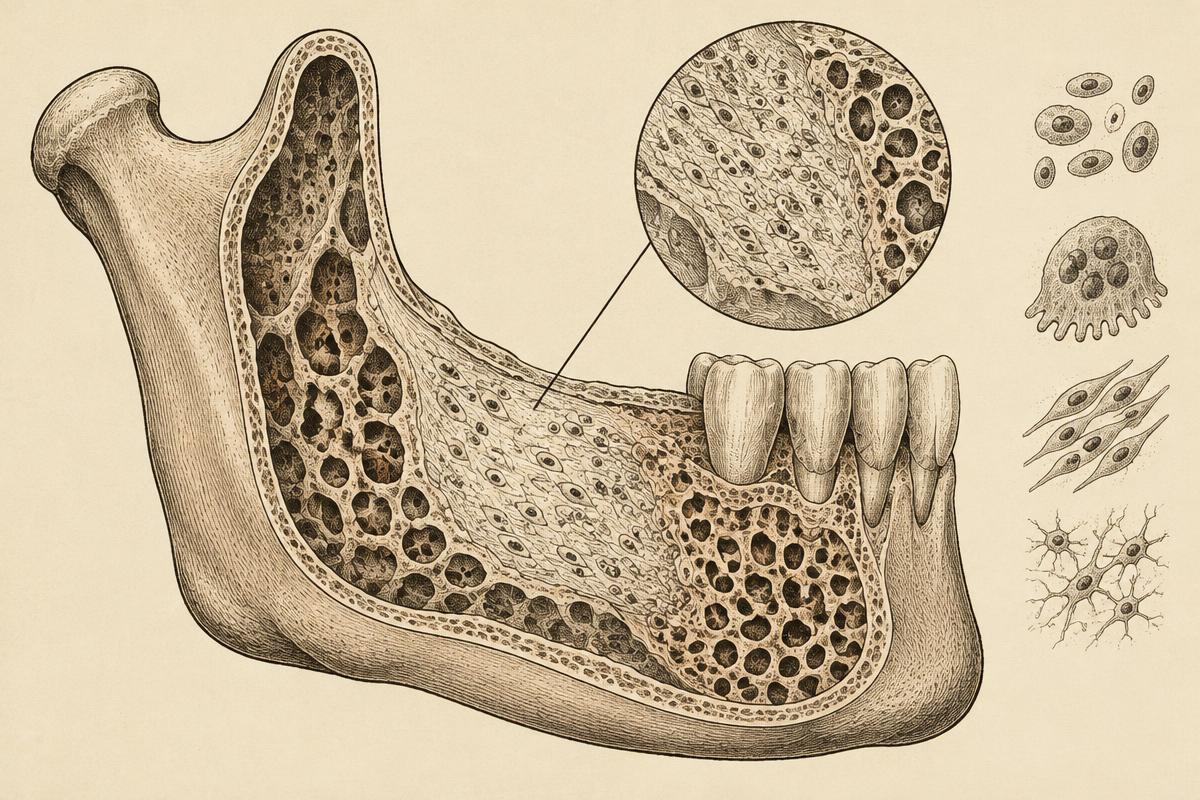
What this article covers
- What This Article Covers
- Medication-related osteonecrosis of the jaw (MRONJ) is a rare but serious side effect of bone-targeting and antiangiogenic drugs, in which exposed jawbone fails to heal. Because standard care — from conservative wound management to jaw resection — leaves gaps, researchers have tested whether mesenchymal stem/stromal cells (MSCs) can help regenerate the damaged bone and soft tissue.
- Overview
- MRONJ is diagnosed when a patient taking an antiresorptive drug such as a bisphosphonate or denosumab — or, less commonly, an antiangiogenic agent — develops jawbone that is exposed, or probeable through a fistula, for more than eight weeks, with no history of jaw radiation or jaw metastasis, per the AAOMS 2022 position paper. 3%).
- How It's Thought to Work
- Antiresorptive drugs over-suppress osteoclasts and, at high doses, impair new blood vessel formation in bone, leaving necrotic tissue the body cannot clear or rebuild. MSCs are thought to help through overlapping mechanisms: secreting growth factors like VEGF and hepatocyte growth factor to spur angiogenesis, differentiating toward bone- and vessel-supporting cell types, and modulating immune activity.
- What the Evidence Shows
- The evidence is encouraging but still early and mostly preclinical. , 2010), systemic MSC infusion both prevented and reversed bisphosphonate/dexamethasone-induced jaw lesions, which the authors called proof-of-concept rather than a validated treatment.
- Bottom Line
- Mouse, rat, and dog studies, plus one small uncontrolled human case series, suggest MSCs and related cell fractions may help MRONJ lesions heal by restoring blood vessel growth, bone turnover, and immune balance in tissue antiresorptive drugs have left unable to repair itself. That's a genuinely promising signal for a condition with few good options — but it remains a signal, not proof.
What This Article Covers
Medication-related osteonecrosis of the jaw (MRONJ) is a rare but serious side effect of bone-targeting and antiangiogenic drugs, in which exposed jawbone fails to heal. Because standard care — from conservative wound management to jaw resection — leaves gaps, researchers have tested whether mesenchymal stem/stromal cells (MSCs) can help regenerate the damaged bone and soft tissue. This article reviews what MRONJ is, how cell-based approaches are thought to work, and what the early animal and small human studies actually show — while being direct that no stem cell therapy is currently FDA-approved for this condition.
Overview
MRONJ is diagnosed when a patient taking an antiresorptive drug such as a bisphosphonate or denosumab — or, less commonly, an antiangiogenic agent — develops jawbone that is exposed, or probeable through a fistula, for more than eight weeks, with no history of jaw radiation or jaw metastasis, per the AAOMS 2022 position paper. Risk is highest in cancer patients on high, frequent IV doses of zoledronate or denosumab (cumulative incidence generally under 5%, some series up to 18%), and much lower in osteoporosis patients on standard dosing (roughly 0.02%–0.3%). Tooth extraction is the biggest trigger. Once established, MRONJ is hard to heal because the causative drugs also suppress the bone remodeling and vascular turnover the jaw needs to repair itself.
How It's Thought to Work
Antiresorptive drugs over-suppress osteoclasts and, at high doses, impair new blood vessel formation in bone, leaving necrotic tissue the body cannot clear or rebuild. MSCs are thought to help through overlapping mechanisms: secreting growth factors like VEGF and hepatocyte growth factor to spur angiogenesis, differentiating toward bone- and vessel-supporting cell types, and modulating immune activity. A notable 2010 mouse study found zoledronate plus dexamethasone shifted immune balance toward inflammatory Th17 cells and away from regulatory T cells, and that infused MSCs helped restore it — suggesting MRONJ may be as much an immune problem as a healing one. More recent work has explored MSC "cell sheets," grown scaffold-free on temperature-responsive dishes and applied directly over debrided lesions, to avoid the infection risk synthetic scaffolds can carry.
What the Evidence Shows
The evidence is encouraging but still early and mostly preclinical. In the mouse model above (Kikuiri et al., 2010), systemic MSC infusion both prevented and reversed bisphosphonate/dexamethasone-induced jaw lesions, which the authors called proof-of-concept rather than a validated treatment. Building on this, Japanese researchers showed in rats that allogeneic bone-marrow MSC sheets produced significant healing of MRONJ-like lesions within two weeks, with more new blood vessels and osteoclast activity than untreated lesions; a follow-up beagle study using adipose-derived MSC sheets showed healing on the treated side. A 2024 Frontiers in Cell and Developmental Biology study moved into real patients: nine people (ten lesions) with established MRONJ underwent a single surgery combining debridement, autologous adipose-derived stromal vascular fraction, and leukocyte-platelet-rich fibrin. Soft tissue fully healed within one month in nine of ten lesions, and six-month imaging showed bone healing in eight of ten cases, with no adverse reactions over roughly 15 months of follow-up — results the authors called "encouraging" while flagging the lack of a control group and their inability to separate the effects of surgery, the cell fraction, and the fibrin scaffold. No MSC cell-sheet product has yet reached human trials, and the review proposing that approach comes from the same team developing it, so independent replication matters.
Who Might Be a Candidate
- Patients with diagnosed stage II or III MRONJ who have not responded to conservative wound care, under consideration for a research protocol or surgical procedure
- Patients already scheduled for surgical debridement or resection, where cell-containing fractions might be added as an investigational adjunct
- Anyone exploring this route should look for a registered clinical trial (searchable on ClinicalTrials.gov) rather than a commercial clinic offering "stem cell" injections outside a trial setting
- Patients should not delay guideline-based nonoperative or operative care in favor of unproven cell therapy
Bottom Line
Mouse, rat, and dog studies, plus one small uncontrolled human case series, suggest MSCs and related cell fractions may help MRONJ lesions heal by restoring blood vessel growth, bone turnover, and immune balance in tissue antiresorptive drugs have left unable to repair itself. That's a genuinely promising signal for a condition with few good options — but it remains a signal, not proof. There is no FDA-approved stem cell or cell-based therapy for MRONJ, or for orthopedic and dental bone regeneration generally; approved cell and gene therapies remain concentrated in blood cancers and inherited blood disorders, not jaw bone repair. The human data comes from one uncontrolled series of nine patients, with no comparison group isolating the cell therapy's contribution from surgery itself. Anyone with MRONJ should be treated per established AAOMS guidance, and view cell-based add-on therapy as investigational — best pursued, if at all, through a registered clinical trial rather than a direct-to-consumer clinic.
Key Questions Answered
- What is MRONJ?
- Jawbone that stays exposed for more than eight weeks in a patient taking an antiresorptive or antiangiogenic drug, with no history of jaw radiation or jaw metastasis, per the AAOMS 2022 position paper.
- What does the human evidence show?
- One uncontrolled 2024 series of nine patients (ten lesions) combining surgery, fat-derived cells and platelet-rich fibrin reported soft-tissue healing in nine of ten lesions and bone healing in eight of ten, with no control group.
- Is any stem cell therapy FDA-approved for MRONJ?
- No. Cell-based add-on therapy is investigational and best pursued, if at all, through a registered clinical trial.
Sources
- Medication-Related Osteonecrosis of the Jaw-2022 Update (AAOMS Position Paper), Journal of Oral and Maxillofacial Surgery, 2022 — https://aaoms.org/wp-content/uploads/2024/03/mronj_position_paper.pdf
- Treatment of medication-related osteonecrosis of the jaw with cell therapy, Frontiers in Cell and Developmental Biology, 2024 — https://pmc.ncbi.nlm.nih.gov/articles/PMC10853393/
- Novel Cell Therapy Using Mesenchymal Stromal Cell Sheets for Medication-Related Osteonecrosis of the Jaw, Frontiers in Bioengineering and Biotechnology, 2022 — https://www.frontiersin.org/journals/bioengineering-and-biotechnology/articles/10.3389/fbioe.2022.902349/full
- Cell-based immunotherapy with mesenchymal stem cells cures bisphosphonate-related osteonecrosis of the jaw-like disease in mice, California Institute for Regenerative Medicine (CIRM) summary of Kikuiri et al., 2010 — https://www.cirm.ca.gov/about-cirm/publications/cell-based-immunotherapy-mesenchymal-stem-cells-cures-bisphosphonate-related-osteonecrosis-jaw-disease-mice
- Updated 2025 List of FDA-Approved Cell and Gene Therapies, ipscell.com, 2025 — https://ipscell.com/2025/01/updated-2025-list-of-fda-approved-cell-and-gene-therapies/
Related Articles
- Clinical Applications
Stem Cell-Derived Neuron Therapy Shows Durable Safety Four Years After Parkinson's Transplant
Four years after a single surgery, the first patients to receive BlueRock Therapeutics' stem cell-derived neuron therapy for Parkinson's disease are still showing stable safety and encouraging motor trends — a rare long-term look at how a lab-grown dopamine neuron graft holds up over time.
- Clinical Applications
Can Stem Cells Help With Osteochondral Lesions of the Talus (Ankle Cartilage Damage)?
MSCs added to ankle cartilage surgery show encouraging pain and function improvements, but the broader evidence remains low quality and no product is FDA-approved.
- Clinical Applications
Can Stem Cells Help With Psoriasis?
Early human research is testing whether mesenchymal stem cells can recalibrate the immune dysfunction behind psoriasis. The signal is real — but the evidence is still small, uncontrolled, and experimental.