Can Stem Cells Help With Dermatomyositis and Polymyositis?
What this article covers
- What Causes DM/PM and Who It Affects
- Both are inflammatory myopathies in which the immune system attacks muscle tissue (and, in dermatomyositis, skin and blood vessels as well), causing progressive proximal muscle weakness — typically affecting the shoulders, hips, and thighs first. Dermatomyositis also produces characteristic skin changes, including a violet rash on the eyelids (heliotrope rash) and scaly patches over the knuckles (Gottron's papules).
- Standard Treatment
- First-line treatment is corticosteroids, usually combined with a steroid-sparing immunosuppressant such as methotrexate, azathioprine, or mycophenolate. Patients who don't respond adequately may be escalated to intravenous immunoglobulin (IVIG), rituximab, or other biologic agents.
- Where Stem Cell Research Currently Stands
- For the minority of patients whose disease doesn't respond to these standard treatments, researchers have studied autologous HSCT — using a patient's own blood-forming stem cells after an immune-resetting conditioning regimen, the same general approach that has shown benefit in severe scleroderma and lupus. The most detailed published results come from a small case series of three children with severe, refractory juvenile dermatomyositis, followed for 23 to 144 months after transplant.
- Who Might Be a Candidate
- Because this remains a specialized, high-intensity procedure backed by a very small evidence base, candidacy is determined by a rheumatologist and a transplant specialist together, generally for patients who share:
- Bottom Line
- For most people with dermatomyositis or polymyositis, standard immunosuppressive therapy controls the disease reasonably well. For the smaller group with severe, refractory disease, early stem cell transplant case series have shown a genuinely promising signal — complete, lasting remission off all medication in the cases reported — but the evidence currently rests on a handful of patients, not large controlled trials.
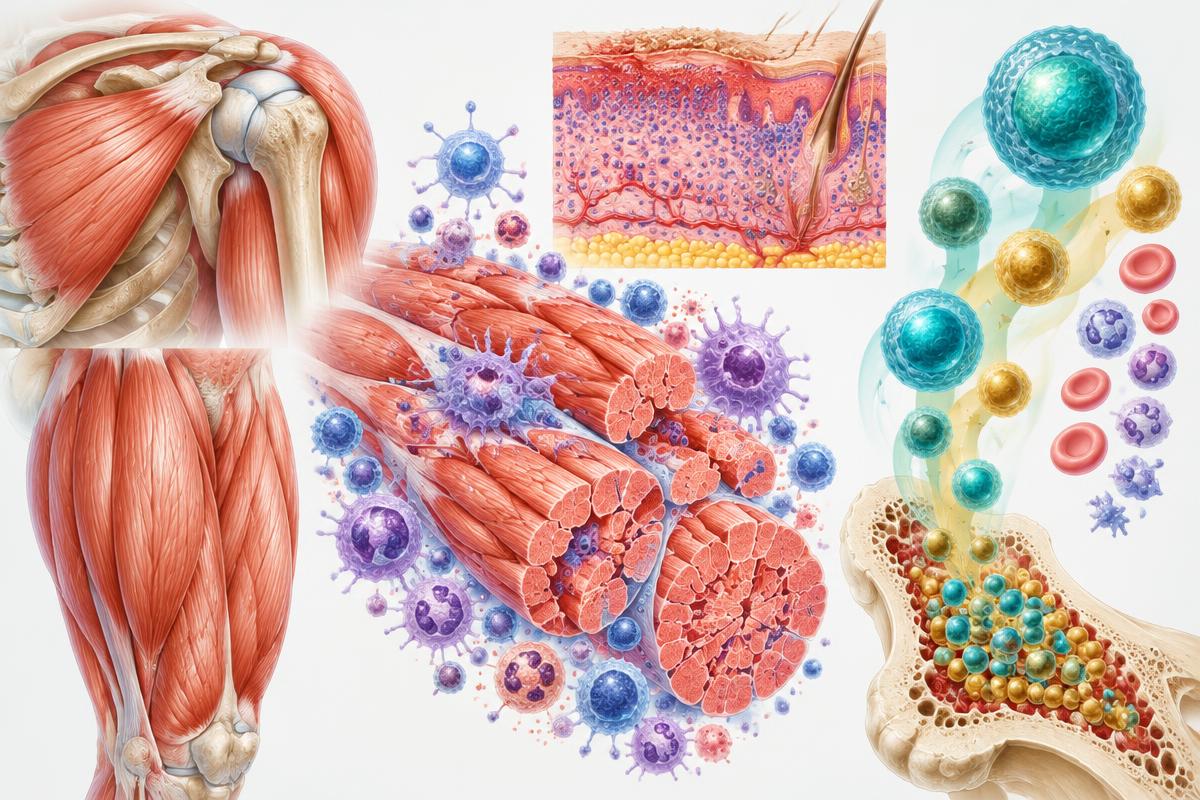
Dermatomyositis (DM) and polymyositis (PM) are rare autoimmune diseases that cause progressive muscle weakness and, in DM, a distinctive skin rash. Most patients respond to standard immunosuppressive therapy, but a subset develop severe, treatment-refractory disease with few good options left. For that specific group, small case series of autologous hematopoietic stem cell transplant (HSCT) have reported genuinely striking remission results — tempered by very small sample sizes that mean the evidence is promising rather than proven. This article covers what DM/PM are, how they're normally treated, and what the stem cell transplant evidence does and doesn't show.
What Causes DM/PM and Who It Affects
Both are inflammatory myopathies in which the immune system attacks muscle tissue (and, in dermatomyositis, skin and blood vessels as well), causing progressive proximal muscle weakness — typically affecting the shoulders, hips, and thighs first. Dermatomyositis also produces characteristic skin changes, including a violet rash on the eyelids (heliotrope rash) and scaly patches over the knuckles (Gottron's papules). Both conditions can occur in children (juvenile dermatomyositis) and adults, are more common in women, and their exact triggers aren't fully understood, though genetic susceptibility and immune dysregulation are both involved.
Standard Treatment
First-line treatment is corticosteroids, usually combined with a steroid-sparing immunosuppressant such as methotrexate, azathioprine, or mycophenolate. Patients who don't respond adequately may be escalated to intravenous immunoglobulin (IVIG), rituximab, or other biologic agents. Physical therapy to preserve muscle strength and function is an important complement to drug therapy throughout.
Where Stem Cell Research Currently Stands
For the minority of patients whose disease doesn't respond to these standard treatments, researchers have studied autologous HSCT — using a patient's own blood-forming stem cells after an immune-resetting conditioning regimen, the same general approach that has shown benefit in severe scleroderma and lupus. The most detailed published results come from a small case series of three children with severe, refractory juvenile dermatomyositis, followed for 23 to 144 months after transplant. All three achieved complete remission and were able to stop all medication within 3 to 12 months, with no relapses during follow-up and no treatment-related deaths — two experienced manageable viral infections (Epstein-Barr virus and cytomegalovirus) that resolved with antiviral treatment. The authors describe the approach as appearing safe and effective in this small group, while explicitly cautioning that "more cases are needed for further confirmation" before broader conclusions can be drawn. Broader autoimmune disease transplant registries maintained by groups like the European Society for Blood and Marrow Transplantation have also tracked outcomes for myositis patients within larger autoimmune-disease HSCT cohorts, reflecting the fact that this remains a specialized, closely monitored procedure rather than routine care.
Separately, early-phase research is exploring mesenchymal stem cell (MSC) infusions — a gentler approach than transplant that doesn't require the same intensive conditioning — for PM/DM; a registered Phase 1 trial of umbilical cord-derived MSCs in polymyositis and dermatomyositis patients is a reminder that this line of research is still at the basic safety stage, not an established treatment.
The honest caveat on the HSCT data is important: three patients, from one center, without a control group, is a genuinely encouraging signal and nothing more. It is not proof that transplant works reliably across a broader population, and the procedure carries real risks from intensive conditioning chemotherapy, including infection, that make it appropriate only for severe, treatment-refractory disease evaluated at a specialized transplant center.
Who Might Be a Candidate
Because this remains a specialized, high-intensity procedure backed by a very small evidence base, candidacy is determined by a rheumatologist and a transplant specialist together, generally for patients who share:
- Dermatomyositis or polymyositis that has not responded adequately to corticosteroids plus at least one steroid-sparing immunosuppressant
- Disease severe enough to significantly impair function or threaten organ health despite standard treatment
- No active, uncontrolled infection and adequate overall organ function to tolerate conditioning chemotherapy
- Willingness to be treated and monitored at a specialized transplant center, given the procedure's intensity and the limited evidence base
Bottom Line
For most people with dermatomyositis or polymyositis, standard immunosuppressive therapy controls the disease reasonably well. For the smaller group with severe, refractory disease, early stem cell transplant case series have shown a genuinely promising signal — complete, lasting remission off all medication in the cases reported — but the evidence currently rests on a handful of patients, not large controlled trials. Anyone with refractory disease considering this route should do so through a specialized transplant center, with a clear understanding that the encouraging results so far come from a very small body of evidence.
Key Questions Answered
- What did the juvenile dermatomyositis transplant case series report?
- All three children with severe, refractory disease achieved complete remission, stopped medication within 3 to 12 months and had no relapses during 23 to 144 months of follow-up. No treatment-related deaths occurred; two children had viral infections that resolved with antiviral treatment.
- Does this prove that transplant reliably treats dermatomyositis or polymyositis?
- No. The HSCT evidence described here involves three patients from one center without a control group. The results are encouraging, not proof of reliable benefit across a broader population, and conditioning chemotherapy carries real risks, including infection.
- How do MSC infusions and transplant candidacy fit into current care?
- Umbilical cord-derived MSC infusions are being investigated in a registered Phase 1 trial at the basic safety stage. HSCT candidacy is assessed jointly by a rheumatologist and transplant specialist for severe, treatment-refractory disease, with adequate organ function and no uncontrolled infection.
Sources
- Long-term follow-up of autologous hematopoietic stem cell transplantation for refractory juvenile dermatomyositis: a case-series study, Zhu et al., Pediatric Rheumatology, 2018 - https://pmc.ncbi.nlm.nih.gov/articles/PMC6245778
- Phase 1 Study of Umbilical Cord-Derived MSCs in Patients With Polymyositis and Dermatomyositis, ClinicalTrials.gov, NCT04723303 - https://clinicaltrials.gov/study/NCT04723303
- EBMT Autoimmune Diseases Working Party overview, European Society for Blood and Marrow Transplantation - https://www.ebmt.org/sites/default/files/2020-08/Autoimmune%20Diseases%20Working%20Party.pdf
Related Articles
- Clinical Applications
Myth vs. Fact: Does a Higher Price Tag Mean a Better Stem Cell Treatment?
Does a higher price mean a better stem cell treatment? Research and regulator warnings show no established link between cost and quality in the direct-to-consumer market.
- Clinical Applications
Can Stem Cells Help With Chronic Pancreatitis?
MSC research for chronic pancreatitis: engineered-vesicle animal findings, two recruiting safety trials and why no approved treatment exists yet.
- Clinical Applications
Can Stem Cells Help With Plantar Fasciitis?
Stem cell injections for plantar fasciitis remain largely unproven and un-approved — PRP has better evidence, but true MSC therapies are still early-stage and investigational.