Can Stem Cells Help With Psoriasis?
What this article covers
- Overview
- Psoriasis affects roughly 2 to 3 percent of people worldwide and is driven by an overactive Th17 immune response that pushes skin cells to multiply too quickly, producing the thick, scaly plaques characteristic of the disease. Standard treatment includes topical steroids, phototherapy, and biologic drugs targeting cytokines like IL-17 or IL-23 — effective for many, but a meaningful subset of patients become resistant to one biologic after another over time, leaving few remaining options.
- How It's Thought to Work
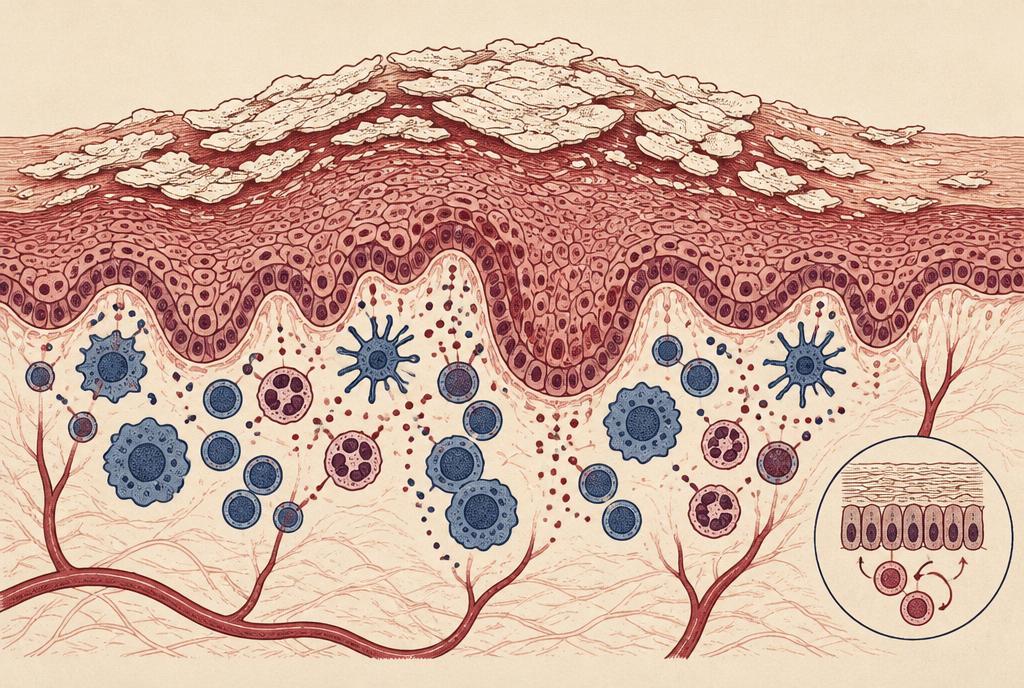
- Mesenchymal stem cells, typically sourced from umbilical cord tissue or bone marrow, are not believed to work by becoming new skin cells. Instead, researchers think they act as immune regulators.
- What the Evidence Shows
- This is where caution matters most: the human data is real, but still thin.
- Who Might Be a Candidate
- Based on where the research currently stands, interest in MSC therapy for psoriasis is most relevant to:
- Bottom Line
- There's genuine, published signal that mesenchymal stem cells can shift the immune dysfunction underlying psoriasis, and the early human data — a 47 percent response rate in a 17-person trial, and a striking case series in biologic-refractory patients — is more substantive than exists for many other conditions explored in regenerative medicine. But a genuine signal is not the same as a proven treatment.
Psoriasis is a chronic, immune-driven skin disease, and a small but growing body of early human research is testing whether mesenchymal stem cells (MSCs) — rather than the biologics and topical treatments that dominate current care — can help recalibrate the immune dysfunction behind it. The evidence is real but still preliminary: small trials, short follow-up, and no FDA-approved stem cell product for psoriasis exist today.
Overview
Psoriasis affects roughly 2 to 3 percent of people worldwide and is driven by an overactive Th17 immune response that pushes skin cells to multiply too quickly, producing the thick, scaly plaques characteristic of the disease. Standard treatment includes topical steroids, phototherapy, and biologic drugs targeting cytokines like IL-17 or IL-23 — effective for many, but a meaningful subset of patients become resistant to one biologic after another over time, leaving few remaining options. That treatment gap is where stem cell research has started to look genuinely interesting, though it remains firmly experimental.
How It's Thought to Work
Mesenchymal stem cells, typically sourced from umbilical cord tissue or bone marrow, are not believed to work by becoming new skin cells. Instead, researchers think they act as immune regulators. In psoriasis, there is an imbalance between inflammatory Th17 cells and calming regulatory T cells (Tregs). MSCs appear to help shift that balance — in published research, MSC infusion has been associated with increases in Tregs and CD4+ memory T cells, decreases in Th17 cells, and lower circulating IL-17, a key inflammatory driver in psoriasis. A 2022 review in Anais Brasileiros de Dermatologia also noted that MSCs isolated from psoriatic skin itself show reduced immune-regulatory function, a possible clue to why the disease persists.
What the Evidence Shows
This is where caution matters most: the human data is real, but still thin.
A phase 1/2a single-arm trial of allogeneic umbilical cord-derived MSCs in 17 psoriasis patients, published in Signal Transduction and Targeted Therapy (2022), found that 47.1 percent (8 of 17) achieved at least a 40 percent reduction in PASI score, with no serious adverse events during treatment or six-month follow-up. Responders showed the predicted immune shifts — more Tregs, less Th17 activity. It's a genuinely encouraging signal, but with no control group and only 17 participants, it cannot establish how much of that improvement came from the cells themselves versus natural fluctuation in disease activity.
A 2025 case series in Frontiers in Immunology described three women with severe, biologic-refractory psoriasis who received two umbilical cord-derived MSC infusions a week apart. One patient's PASI score dropped 87 percent within four weeks; the other two regained responsiveness to biologics that had previously stopped working, sustaining very low disease-activity scores for over two years. Reported side effects were mild — transient nausea and infusion-site irritation. It's a compelling case report, not proof of efficacy: three patients under a compassionate-use protocol, two of whom also used other therapies, cannot be generalized.
The 2022 Anais Brasileiros de Dermatologia review surveying this field concluded that most favorable MSC findings come from early-phase or preclinical work, and that more extensive controlled trials are needed before efficacy or long-term safety can be determined.
No large randomized, placebo-controlled trial of MSCs for psoriasis has yet been published, and no stem cell-based therapy is FDA-approved for psoriasis or any autoimmune skin condition.
Who Might Be a Candidate
Based on where the research currently stands, interest in MSC therapy for psoriasis is most relevant to:
- People with moderate-to-severe plaque psoriasis who have failed or lost response to multiple biologic therapies
- Patients already enrolled in, or being evaluated for, a registered clinical trial (searchable on ClinicalTrials.gov) rather than an off-label clinic offering
- Those who understand this remains investigational — not a replacement for guideline-based dermatologic care, and not something with established dosing, long-term safety data, or insurance coverage
Bottom Line
There's genuine, published signal that mesenchymal stem cells can shift the immune dysfunction underlying psoriasis, and the early human data — a 47 percent response rate in a 17-person trial, and a striking case series in biologic-refractory patients — is more substantive than exists for many other conditions explored in regenerative medicine. But a genuine signal is not the same as a proven treatment. These are small, uncontrolled, short-follow-up studies. No stem cell therapy is FDA-approved for psoriasis, and anyone considering this path should treat it as experimental, ideally pursued only through a registered clinical trial with informed consent — never through a commercial clinic promising a cure.
Key Questions Answered
- Is stem cell therapy approved for psoriasis?
- No. No stem cell-based therapy is FDA-approved for psoriasis or any autoimmune skin condition; all human research so far is early-phase and investigational.
- What did the largest MSC trial in psoriasis find?
- A 2022 phase 1/2a single-arm trial of umbilical cord-derived MSCs in 17 patients found 47.1 percent achieved at least a 40 percent PASI reduction, with no serious adverse events over six months — but no control group.
- How are stem cells thought to work in psoriasis?
- As immune regulators, not new skin cells: MSC infusion has been associated with more regulatory T cells, fewer inflammatory Th17 cells, and lower circulating IL-17.
Sources
- Human umbilical cord mesenchymal stem cells for psoriasis: a phase 1/2a, single-arm study — Cheng L, Wang S, Peng C, et al., Signal Transduction and Targeted Therapy, 2022;7:263 — https://doi.org/10.1038/s41392-022-01059-y
- Mesenchymal stromal cells as rescue therapy in biologic-refractory psoriasis: insights from a case series — Lwin SM, et al., Frontiers in Immunology, 2025;16:1656724 — https://doi.org/10.3389/fimmu.2025.1656724
- Stem cell therapy as a potential treatment option for psoriasis — Naik PP, Anais Brasileiros de Dermatologia, 2022;97(4):471-477 — https://new.scielo.br/j/abd/a/qgMK855474THdXrLW9TWF9L/?lang=en
- Clinical Research on Treatment of Psoriasis by Human Umbilical Cord-derived Mesenchymal Stem Cells (NCT03765957) — ClinicalTrials.gov — https://clinicaltrials.gov/study/NCT03765957
Related Articles
- Clinical Applications
Stem Cell-Derived Neuron Therapy Shows Durable Safety Four Years After Parkinson's Transplant
Four years after a single surgery, the first patients to receive BlueRock Therapeutics' stem cell-derived neuron therapy for Parkinson's disease are still showing stable safety and encouraging motor trends — a rare long-term look at how a lab-grown dopamine neuron graft holds up over time.
- Clinical Applications
Can Stem Cells Help With Osteochondral Lesions of the Talus (Ankle Cartilage Damage)?
MSCs added to ankle cartilage surgery show encouraging pain and function improvements, but the broader evidence remains low quality and no product is FDA-approved.
- Clinical Applications
Can Stem Cells Help With Medication-Related Osteonecrosis of the Jaw (MRONJ)?
MRONJ is a rare drug side effect in which exposed jawbone fails to heal. Animal studies and one small human series test stem cells; none is FDA-approved.