Stem Cell-Derived Neuron Therapy Shows Durable Safety Four Years After Parkinson's Transplant
What this article covers
- What This Article Covers
- Four-year follow-up data from the first human trial of bemdaneprocel, an investigational cell therapy that transplants lab-grown dopamine neuron progenitors directly into the brain, were presented in October 2026 and reported by Healio Neurology on November 3, 2026. The update is notable less for a single new headline number than for what it represents: one of the longest continuous safety and motor-function tracking periods yet published for a stem cell-derived brain graft in Parkinson's disease, in patients who received their transplant as part of a tiny, carefully monitored Phase 1 study years ago.
- What Happened
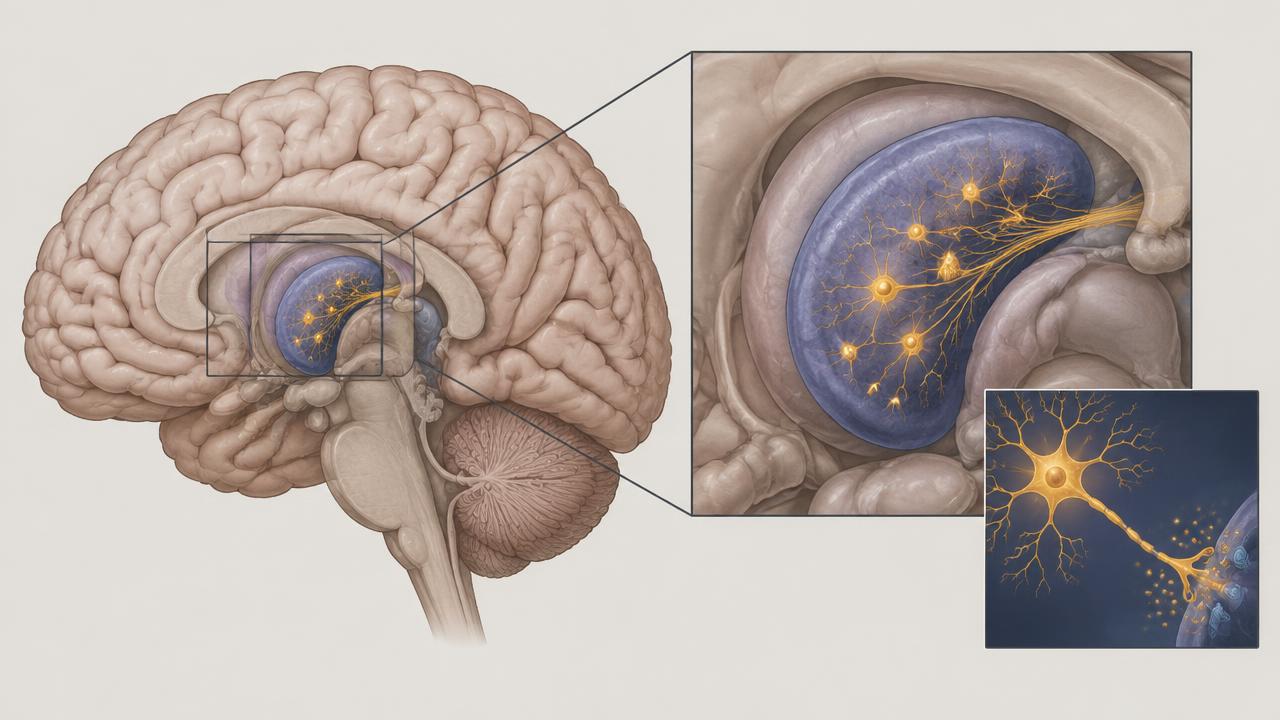
- Bemdaneprocel is made from allogeneic (donor-derived) pluripotent stem cells that are differentiated in the lab into midbrain dopaminergic neuron progenitor cells — the same cell type that is progressively lost in Parkinson's disease. In a single stereotactic neurosurgical procedure, researchers implanted the cells bilaterally into the posterior putamen, a deep brain region central to movement control, in 12 patients ages 50 to 78 who had lived with idiopathic Parkinson's for five to fifteen years.
- What the Data Actually Show
- The headline finding is durability rather than dramatic improvement, and that distinction matters. On brain imaging (F-DOPA PET, which tracks dopamine neuron activity), uptake in the posterior putamen — the exact region where the cells were placed — held roughly stable from 12 through 36 months, consistent with surviving, functioning graft tissue in a region that would otherwise be expected to continue losing dopaminergic signal as the disease progresses.
- Safety, Honestly Reported
- Across four years, most treatment-related adverse events were mild to moderate. Ten serious adverse events occurred in total; one — a seizure shortly after the surgical procedure — was deemed related to the surgery itself, two were attributed to the underlying Parkinson's disease, and the remainder were judged unrelated to either the cells or the procedure.
- What's Still Unknown
- This is still, fundamentally, a 12-patient, open-label, uncontrolled study — far too small and too unblinded to prove that bemdaneprocel changes the course of Parkinson's disease. Without a sham-surgery control group, it's not possible to rule out placebo response, especially for subjective measures like patient-reported "off" time.
What This Article Covers
Four-year follow-up data from the first human trial of bemdaneprocel, an investigational cell therapy that transplants lab-grown dopamine neuron progenitors directly into the brain, were presented in October 2026 and reported by Healio Neurology on November 3, 2026. The update is notable less for a single new headline number than for what it represents: one of the longest continuous safety and motor-function tracking periods yet published for a stem cell-derived brain graft in Parkinson's disease, in patients who received their transplant as part of a tiny, carefully monitored Phase 1 study years ago.
What Happened
Bemdaneprocel is made from allogeneic (donor-derived) pluripotent stem cells that are differentiated in the lab into midbrain dopaminergic neuron progenitor cells — the same cell type that is progressively lost in Parkinson's disease. In a single stereotactic neurosurgical procedure, researchers implanted the cells bilaterally into the posterior putamen, a deep brain region central to movement control, in 12 patients ages 50 to 78 who had lived with idiopathic Parkinson's for five to fifteen years. Five participants received a lower dose (0.9 million cells) and seven received a higher dose (2.7 million cells). The new data, presented as a poster at the American Neurological Association's annual meeting in San Diego (October 17–20, 2026) and sponsored by BlueRock Therapeutics (an independently operated subsidiary of Bayer), extend follow-up on this same small cohort out to four years post-transplant — two full years beyond the one-year primary endpoint the trial was originally designed to assess.
What the Data Actually Show
The headline finding is durability rather than dramatic improvement, and that distinction matters. On brain imaging (F-DOPA PET, which tracks dopamine neuron activity), uptake in the posterior putamen — the exact region where the cells were placed — held roughly stable from 12 through 36 months, consistent with surviving, functioning graft tissue in a region that would otherwise be expected to continue losing dopaminergic signal as the disease progresses. On clinical motor scores (MDS-UPDRS Part III), both dose groups showed modest improvement sustained out to four years. In the "off" medication state — arguably the more meaningful measure, since it isolates the graft's effect from patients' existing Parkinson's drugs — the high-dose group's score improved from a baseline of 49 down to 33.4, and the low-dose group from 43.2 to 39. Patient-reported "off" time also fell in both groups. These are exploratory, open-label observations in a 12-person study, not formally tested efficacy outcomes, and they should be read that way.
Safety, Honestly Reported
Across four years, most treatment-related adverse events were mild to moderate. Ten serious adverse events occurred in total; one — a seizure shortly after the surgical procedure — was deemed related to the surgery itself, two were attributed to the underlying Parkinson's disease, and the remainder were judged unrelated to either the cells or the procedure. Critically, there were no deaths and no discontinuations due to treatment-related adverse events across the full follow-up period. Because the transplanted cells are donor-derived rather than the patient's own, all participants required a year of immunosuppressive therapy (basiliximab, methylprednisolone, and tacrolimus) to prevent graft rejection — a real and clinically significant burden that any future approved version of this therapy would have to carry or resolve. One less reassuring signal: F-DOPA uptake declined by roughly 25% in the caudate nucleus, a nearby brain region that did not receive the transplant, at 36 months in both hemispheres. Researchers interpreted this as ongoing natural disease progression outside the grafted area — a reminder that this approach targets a specific brain region's neuron loss rather than halting Parkinson's disease as a whole.
What's Still Unknown
This is still, fundamentally, a 12-patient, open-label, uncontrolled study — far too small and too unblinded to prove that bemdaneprocel changes the course of Parkinson's disease. Without a sham-surgery control group, it's not possible to rule out placebo response, especially for subjective measures like patient-reported "off" time. The therapy remains investigational and is not FDA-approved for any use. BlueRock has since advanced a randomized, sham-controlled, double-blind Phase 3 trial called exPDite-2 (ClinicalTrials.gov identifier NCT06944522), which is the study actually designed to test whether these early signals hold up under rigorous controlled conditions. That trial, not this four-year extension of the original Phase 1 cohort, will be the real test of whether bemdaneprocel works.
What This Means for Patients
For the small group of patients who volunteered for the original trial, the four-year data are good news in a narrow but genuine sense: a one-time brain surgery delivering living donor cells has not caused late-emerging harm, graft-related tumors, or loss of the apparent benefit seen in earlier reporting. That is not a trivial result for a first-in-human cell transplant into the brain. For the broader Parkinson's community, this is a promising but early marker on a long road; it does not mean a stem cell cure for Parkinson's is imminent, and no one should pursue bemdaneprocel outside of a registered clinical trial, since it is not an approved or commercially available treatment anywhere.
Bottom Line
Four years out, BlueRock's stem cell-derived dopamine neuron graft for Parkinson's disease has not caused safety problems that would derail the program, and the small cohort that received it continues to show stable imaging and modestly improved motor scores. That is a meaningfully positive long-term safety signal for a novel cell-transplant approach — but it comes from an open-label study of just 12 people, requires a year of immunosuppression, and has not yet been tested against a controlled comparison group. The ongoing Phase 3 exPDite-2 trial is the study that will determine whether bemdaneprocel actually works, and until it reads out, this remains a promising investigational therapy, not an available treatment.
Key Questions Answered
- What is bemdaneprocel?
- An investigational therapy made from donor-derived pluripotent stem cells differentiated into dopamine neuron progenitors and implanted into the posterior putamen in a single surgery.
- What did the four-year data show?
- No deaths or treatment-related discontinuations, stable F-DOPA imaging in the grafted region, and modest sustained motor score improvements in a 12-patient open-label study.
- Is bemdaneprocel available as a treatment?
- No. It is not FDA-approved. The randomized, sham-controlled Phase 3 exPDite-2 trial (NCT06944522) is designed to test whether it works.
Sources
- "Bemdaneprocel shows favorable safety profile over 4 years in Parkinson's disease," Healio Neurology, November 3, 2026, https://www.healio.com/news/neurology/20261103/bemdaneprocel-shows-favorable-safety-profile-over-4-years-in-parkinsons-disease
- "AAN 2026: BlueRock reports positive safety data for bemdaneprocel in Parkinson's," Clinical Trials Arena, April 2026, https://www.clinicaltrialsarena.com/analyst-comment/aan-2026-bluerock-reports-positive-safety-data-for-bemdaneprocel-in-parkinsons/
- "Investigational cell therapy bemdaneprocel shows sustained safety and promising motor improvements at 36 months in Parkinson's disease trial," PatientWorthy, 2025, https://patientworthy.com/2025/10/15/investigational-cell-therapy-bemdaneprocel-shows-sustained-safety-and-promising-motor-improvements-at-36-months-in-parkinsons-disease-trial/
- "Bemdaneprocel for Treating Parkinson's," Bayer AG, https://www.bayer.com/en/us/news-stories/bemdaneprocel-for-treating-parkinsons
- A Study to Investigate the Efficacy and Safety of Bemdaneprocel in Adults Who Have Parkinson's Disease (exPDite-2), ClinicalTrials.gov identifier NCT06944522, https://clinicaltrials.gov/study/NCT06944522
- "Cell therapy bemdaneprocel advances phase 3 registrational trial Parkinson disease," NeurologyLive, https://neurologylive.com/view/cell-therapy-bemdaneprocel-advances-phases-3-registrational-trial-parkinson-disease
Related Articles
- Clinical Applications
Can Stem Cells Help With Osteochondral Lesions of the Talus (Ankle Cartilage Damage)?
MSCs added to ankle cartilage surgery show encouraging pain and function improvements, but the broader evidence remains low quality and no product is FDA-approved.
- Clinical Applications
Can Stem Cells Help With Medication-Related Osteonecrosis of the Jaw (MRONJ)?
MRONJ is a rare drug side effect in which exposed jawbone fails to heal. Animal studies and one small human series test stem cells; none is FDA-approved.
- Clinical Applications
Can Stem Cells Help With Psoriasis?
Early human research is testing whether mesenchymal stem cells can recalibrate the immune dysfunction behind psoriasis. The signal is real — but the evidence is still small, uncontrolled, and experimental.