Can Stem Cells Help With Keloid and Hypertrophic Scars?
What this article covers
- Overview
- A keloid grows beyond the borders of the original wound and rarely shrinks on its own; a hypertrophic scar stays within the wound's borders and can flatten somewhat over time. Both result from fibroblasts that keep producing collagen (especially collagen I and III) long after a normal wound would have stopped remodeling.
- How It's Thought to Work
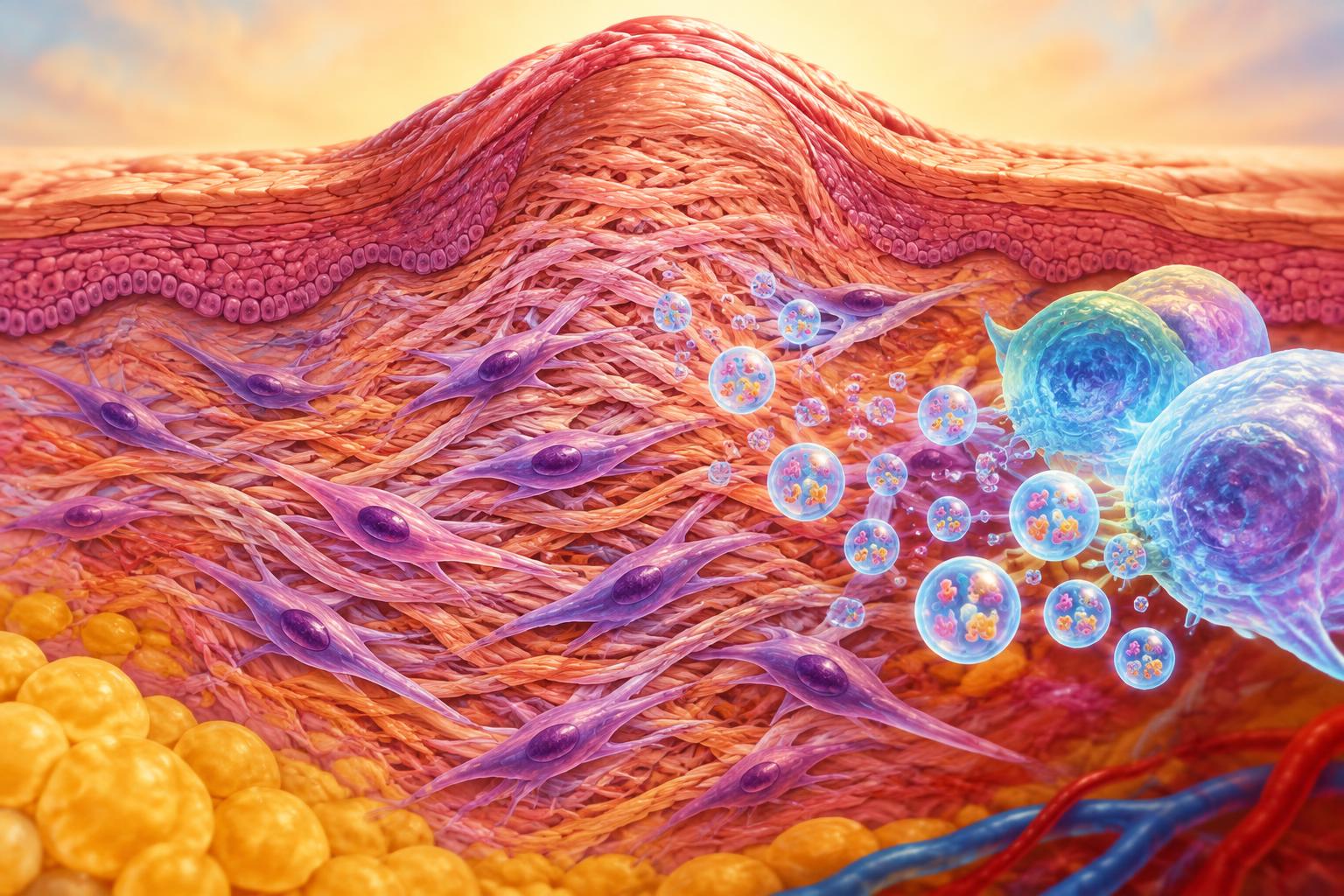
- MSCs and ADSCs appear to act less by replacing tissue and more by "talking" to the scar environment. Preclinical work describes several proposed mechanisms: MSCs secrete anti-inflammatory, anti-fibrotic signals (such as PGE2, IL-10, and HGF) that can dial down the chronic inflammation feeding fibroblast overactivity, and may reduce mast cell activity, which otherwise helps drive collagen synthesis.
- What the Evidence Shows
- The evidence base is real but still mostly preclinical. A 2021 systematic review in Cell and Tissue Research pooled 11 animal studies (156 subjects total) using MSCs or MSC-conditioned media for hypertrophic or keloid scarring; every included study reported visible or histological improvement with no complications — a genuinely encouraging signal — though the authors noted that, at that time, no human clinical trial of MSCs for abnormal scarring had yet been conducted.
- Who Might Be a Candidate
- No stem cell or exosome product is FDA-approved for keloid or hypertrophic scar treatment, so there are no established candidacy criteria yet.
- Bottom Line
- Stem cell and exosome-based approaches to keloid and hypertrophic scars are a mechanistically promising frontier, with consistently positive animal data and an early, genuinely encouraging human pilot result. But the field is still young: most evidence comes from rodent and rabbit models, the handful of human studies are small and often uncontrolled, and no product has FDA approval for this use.
Keloid and hypertrophic scars form when the skin's wound-healing process overshoots, laying down excess collagen that raises, thickens, and sometimes spreads beyond the original injury. Because these scars resist steroids, surgery, and laser treatment, researchers have spent the past several years exploring whether mesenchymal stem cells (MSCs), adipose-derived stem cells (ADSCs), and the exosomes these cells secrete can calm the overactive fibroblasts behind the scarring. This article covers how that idea is supposed to work, what the evidence shows so far, and who current research suggests might someday be a candidate once more rigorous human trials exist.
Overview
A keloid grows beyond the borders of the original wound and rarely shrinks on its own; a hypertrophic scar stays within the wound's borders and can flatten somewhat over time. Both result from fibroblasts that keep producing collagen (especially collagen I and III) long after a normal wound would have stopped remodeling. Standard treatments — intralesional corticosteroids, silicone sheeting, pressure therapy, laser, cryotherapy, and surgical excision (often combined with steroids or radiation to curb recurrence) — help many patients but frequently fall short, particularly for keloids, which can recur after excision alone. That treatment gap has pushed stem cell and exosome research into this space.
How It's Thought to Work
MSCs and ADSCs appear to act less by replacing tissue and more by "talking" to the scar environment. Preclinical work describes several proposed mechanisms: MSCs secrete anti-inflammatory, anti-fibrotic signals (such as PGE2, IL-10, and HGF) that can dial down the chronic inflammation feeding fibroblast overactivity, and may reduce mast cell activity, which otherwise helps drive collagen synthesis. A growing focus is on exosomes — tiny vesicles MSCs release rather than the cells themselves — which in lab studies have shifted the balance of matrix-building and matrix-breaking enzymes, reduced fibroblast proliferation and migration, and in one 2024 study restored normal mitochondrial function inside keloid fibroblasts.
What the Evidence Shows
The evidence base is real but still mostly preclinical. A 2021 systematic review in Cell and Tissue Research pooled 11 animal studies (156 subjects total) using MSCs or MSC-conditioned media for hypertrophic or keloid scarring; every included study reported visible or histological improvement with no complications — a genuinely encouraging signal — though the authors noted that, at that time, no human clinical trial of MSCs for abnormal scarring had yet been conducted. A 2026 meta-analysis in Frontiers in Cell and Developmental Biology pooled 15 animal studies (253 animals) testing MSC-derived exosomes and found statistically significant reductions in scar size, collagen I and III, fibroblast proliferation and migration, and TGF-β1 — strong, consistent effects, though entirely in mice, rats, and rabbits, with substantial heterogeneity between studies. A 2021 Frontiers review on adipose-derived stem cells describes similar signaling but is a narrative review without its own trial data. Encouragingly, human evidence is starting to emerge: a 2025 systematic review in Reports identified a small pilot study in which 18 of 21 patients treated with exosome-based therapy after keloid excision had no recurrence over two years — a notably positive real-world result — though it had no control group, and reviewers stress the overall human evidence (just six small studies) remains preliminary. A 2024 study in Stem Cell Research & Therapy adds mechanistic support, showing adipose stem cell exosomes reduced keloid fibroblast activity in cultured cells and a mouse graft model.
Who Might Be a Candidate
No stem cell or exosome product is FDA-approved for keloid or hypertrophic scar treatment, so there are no established candidacy criteria yet. Based on where research is headed, people most likely to be discussed in future trials include:
- Patients with keloids that have recurred after excision, steroid injection, or laser therapy
- Patients with early, actively thickening hypertrophic scars where conventional options have plateaued
- Patients recovering from keloid excision surgery, where adjunct cellular therapy is being studied to reduce recurrence
- Individuals who have not responded to intralesional corticosteroids, pressure therapy, or radiation
Anyone considering an experimental treatment for scarring should seek it only through a registered clinical trial, discussing realistic expectations, risks, and costs with a board-certified dermatologist or plastic surgeon first.
Bottom Line
Stem cell and exosome-based approaches to keloid and hypertrophic scars are a mechanistically promising frontier, with consistently positive animal data and an early, genuinely encouraging human pilot result. But the field is still young: most evidence comes from rodent and rabbit models, the handful of human studies are small and often uncontrolled, and no product has FDA approval for this use. People dealing with problematic scarring today should rely on established treatments and watch stem cell therapy as a research direction, not yet an available option.
Key Questions Answered
- Can stem cells treat keloid or hypertrophic scars today?
- No. No stem cell or exosome product is FDA-approved for scar treatment. The evidence is mostly animal studies, with only a few small, often uncontrolled human studies so far.
- What did the human pilot study on exosomes after keloid excision find?
- A 2025 systematic review identified a small pilot study in which 18 of 21 patients treated with exosome-based therapy after keloid excision had no recurrence over two years, though it had no control group.
- How are stem cells thought to reduce scarring?
- MSCs appear to secrete anti-inflammatory, anti-fibrotic signals (such as PGE2, IL-10, and HGF), and their exosomes have shifted matrix enzyme balance and reduced fibroblast proliferation and migration in lab studies.
Sources
- Mesenchymal stem cell therapy in hypertrophic and keloid scars — Cell and Tissue Research (Springer), 2021 — https://www.ncbi.nlm.nih.gov/pmc/articles/PMC7960584/
- Use of Adipose Stem Cells Against Hypertrophic Scarring or Keloid — Frontiers in Cell and Developmental Biology, 2021/2022 — https://www.frontiersin.org/journals/cell-and-developmental-biology/articles/10.3389/fcell.2021.823694/full
- Therapeutic value of mesenchymal stem cell-derived extracellular vesicles in hypertrophic and keloid scars: a systematic review and meta-analysis — Frontiers in Cell and Developmental Biology, 2026 — https://www.frontiersin.org/articles/10.3389/fcell.2026.1739106/full
- Adipose stem cell exosomes promote mitochondrial autophagy through the PI3K/AKT/mTOR pathway to alleviate keloids — Stem Cell Research & Therapy, 2024 — https://stemcellres.biomedcentral.com/articles/10.1186/s13287-024-03928-5
- The Efficacy of MSC-Derived Exosome-Based Therapies in Treating Scars, Aging and Hyperpigmentation: A Systematic Review of Human Clinical Outcomes — Reports (MDPI), 2025 — https://www.ncbi.nlm.nih.gov/pmc/articles/PMC12736761/
Related Articles
- Clinical Applications
Can Stem Cells Help With Achilles Tendinopathy?
A ten-person Achilles tendinopathy trial reported encouraging safety and function results, but without a control group the stem cell approach remains investigational.
- Clinical Applications
Can Stem Cells Help With Cystic Fibrosis?
Cystic fibrosis MSC safety-trial findings, preclinical anti-inflammatory research and lung organoids for drug testing — without established treatment efficacy.
- Clinical Applications
Exosome Therapy for Hair Loss in Turkey: What's Actually Happening
Turkey's exosome hair-treatment add-ons, new tissue and cell rules, limited human evidence and product-traceability questions for patients.