Can Stem Cells Help With Plantar Fasciitis?
What this article covers
- Brief Overview
- Plantar fasciitis is one of the most common causes of heel pain, caused by irritation and microtears in the thick band of tissue (the plantar fascia) running along the bottom of the foot. Most cases resolve within 6 to 12 months with conservative measures — stretching, supportive footwear or orthotics, physical therapy, and sometimes a night splint.
- How It's Thought to Work
- The theoretical case for MSC-based injections is that these cells, or the signaling molecules and extracellular vesicles they secrete, can shift a chronically degenerated, poorly healing fascia toward a more favorable repair environment: dialing down low-grade inflammation, encouraging blood vessel formation, and supporting more organized collagen remodeling at the site of microtears. Much of this reasoning is borrowed from MSC research in tendinopathy and other musculoskeletal tissue rather than from plantar-fascia-specific human data.
- What the Evidence Shows
- Here the picture is genuinely mixed, and it matters to separate PRP from stem cells proper, since the evidence quality differs substantially. ) pooling 15 randomized trials found PRP produced significantly better pain and function scores than corticosteroid injections at 6 and 12 months — a genuinely encouraging, durable result.
- Bottom Line
- PRP has a reasonably solid, if imperfect, evidence base for chronic plantar fasciitis, with real and durable pain and function benefits shown in meta-analyses — genuinely good news, tempered by risk-of-bias concerns and inconsistent protocols. True stem cell injections are a different story: mechanistically plausible and actively being studied, but not yet backed by the controlled human trials needed to call them an established treatment for this condition.
This article looks at whether stem cell injections — distinct from the more widely studied platelet-rich plasma (PRP) — have a real evidence base for treating chronic plantar fasciitis, what the FDA's regulatory stance actually is, and who might reasonably consider an orthobiologic injection after conservative care has failed.
Brief Overview
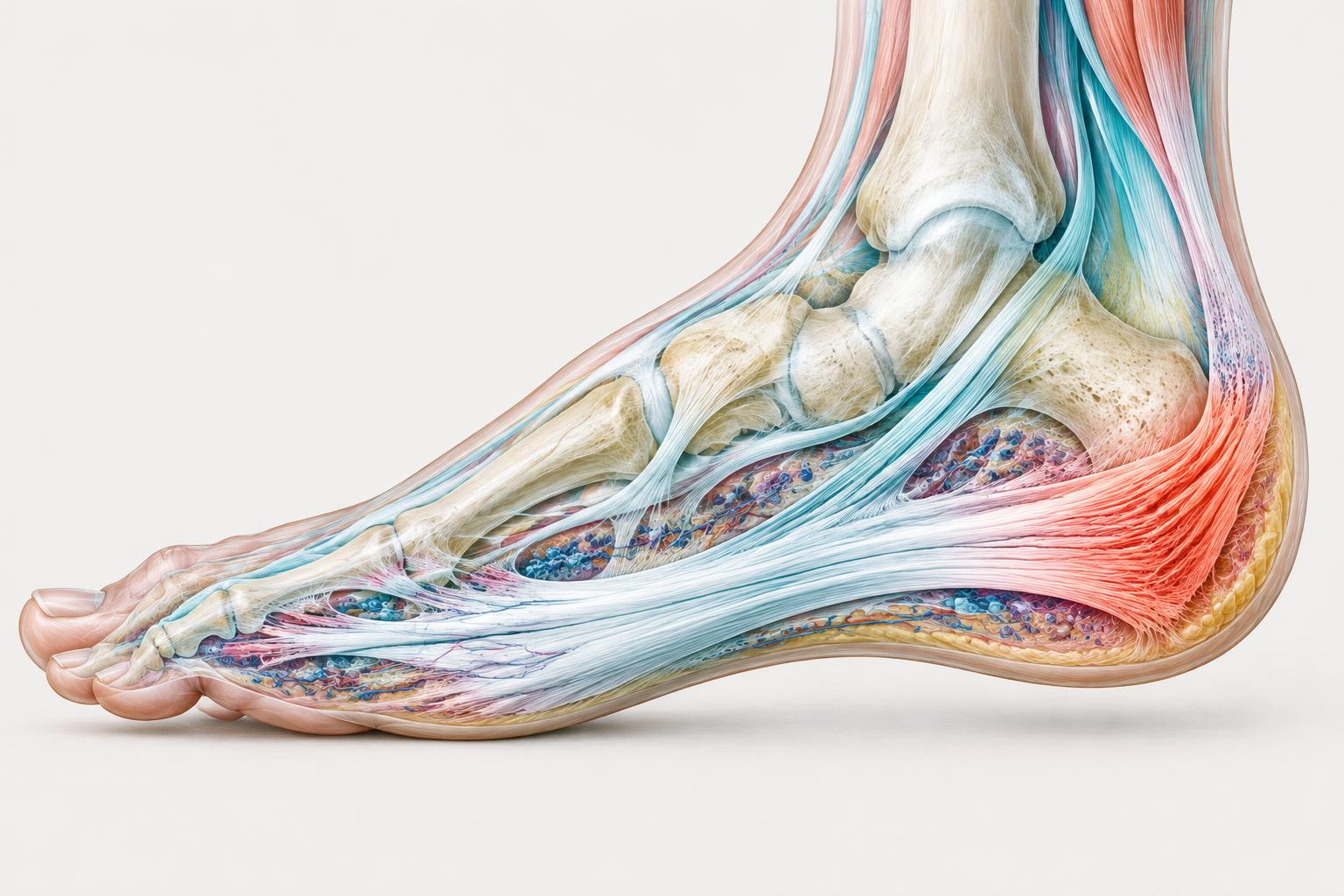
Plantar fasciitis is one of the most common causes of heel pain, caused by irritation and microtears in the thick band of tissue (the plantar fascia) running along the bottom of the foot. Most cases resolve within 6 to 12 months with conservative measures — stretching, supportive footwear or orthotics, physical therapy, and sometimes a night splint. When pain persists despite consistent conservative care, clinicians sometimes escalate to corticosteroid injections, shockwave therapy, or injections derived from the patient's own blood or tissue, loosely marketed under the "stem cell" or "regenerative" umbrella. These include platelet-rich plasma (PRP), autologous whole blood, and, less commonly, bone-marrow-derived or adipose-derived cell concentrates that actually contain mesenchymal stem/stromal cells (MSCs).
How It's Thought to Work
The theoretical case for MSC-based injections is that these cells, or the signaling molecules and extracellular vesicles they secrete, can shift a chronically degenerated, poorly healing fascia toward a more favorable repair environment: dialing down low-grade inflammation, encouraging blood vessel formation, and supporting more organized collagen remodeling at the site of microtears. Much of this reasoning is borrowed from MSC research in tendinopathy and other musculoskeletal tissue rather than from plantar-fascia-specific human data. A 2025 review in Biomedicines explicitly frames MSC-derived extracellular vesicles as a promising but still preclinical, theoretical approach for plantar fasciitis rather than an established one.
What the Evidence Shows
Here the picture is genuinely mixed, and it matters to separate PRP from stem cells proper, since the evidence quality differs substantially. PRP has the more mature track record: a 2021 systematic review and meta-analysis in the American Journal of Sports Medicine (Hohmann et al.) pooling 15 randomized trials found PRP produced significantly better pain and function scores than corticosteroid injections at 6 and 12 months — a genuinely encouraging, durable result. That said, the authors were candid that most included trials carried a high or moderate risk of bias, PRP preparation protocols varied widely, and there was no measurable advantage at one month, meaning PRP's edge builds over time rather than appearing immediately. A related 2020 meta-analysis in PM&R (Tseng et al.) likewise found autologous blood-derived products outperforming steroid injections, reinforcing the signal without resolving the quality concerns. True stem cell injections — bone-marrow aspirate concentrate or adipose-derived cell products actually enriched for MSCs rather than just platelets — have far less human trial evidence specific to plantar fasciitis. Much of what's published is small case series rather than controlled trials, and a head-to-head randomized comparison of bone marrow aspirate versus platelet-rich fibrin (ClinicalTrials.gov NCT07242729, recruiting in Brazil) is still underway, underscoring how early-stage this question remains. Not every biologic add-on helps, either: a 2022 double-blind RCT in Foot & Ankle International found that adding autologous whole blood to a dry-needling procedure gave no additional benefit over needling alone — a reminder that "biologic" doesn't automatically mean "effective."
Who Might Be a Candidate
- Adults with heel pain lasting longer than 6 to 12 months despite consistent stretching, orthotics, and physical therapy
- People who have already tried, or want to avoid, corticosteroid injections because of their own risks, such as fascia weakening or fat-pad atrophy
- Those hoping to delay or avoid surgical fasciotomy
- Patients willing to discuss realistic expectations with a foot and ankle specialist, understanding stem-cell-specific products remain largely investigational for this condition
- Not generally appropriate for someone who hasn't completed a genuine trial of first-line conservative care
- Not appropriate for anyone with an active local infection, an uncontrolled bleeding disorder, or contraindications to a bone-marrow aspiration site
Bottom Line
PRP has a reasonably solid, if imperfect, evidence base for chronic plantar fasciitis, with real and durable pain and function benefits shown in meta-analyses — genuinely good news, tempered by risk-of-bias concerns and inconsistent protocols. True stem cell injections are a different story: mechanistically plausible and actively being studied, but not yet backed by the controlled human trials needed to call them an established treatment for this condition. No stem cell or orthobiologic injection is FDA-approved as a standard therapy for plantar fasciitis. A product that is minimally processed and reimplanted into the same patient during the same procedure may fall under FDA's narrow "same surgical procedure exception," but concentrating or isolating cells — for example, isolating the stromal vascular fraction from fat — generally takes a product outside that exception, into territory without an approved pathway for this use. In practice, these injections are offered off-label, under exception frameworks, or sometimes outside standard FDA oversight entirely. Anyone considering one should ask what product is being used, how it is processed, and what evidence supports it for plantar fasciitis specifically — not musculoskeletal conditions in general.
Key Questions Answered
- Does PRP have better evidence than true stem cell injections for plantar fasciitis?
- Yes. A review of 15 randomized trials found better pain and function scores with PRP than corticosteroids at 6 and 12 months, though bias and inconsistent preparation protocols limit certainty. True MSC products have much less controlled human evidence.
- Are stem cell injections FDA-approved for plantar fasciitis?
- No stem cell or orthobiologic injection is FDA-approved as a standard therapy for plantar fasciitis. Narrow procedural exceptions do not establish effectiveness for this condition.
- Who might discuss an orthobiologic injection?
- Adults with persistent pain after 6 to 12 months of consistent conservative care may discuss realistic expectations with a specialist. Active infection, uncontrolled bleeding disorders or aspiration-site contraindications can make these procedures inappropriate.
Sources
- Platelet-Rich Plasma Versus Corticosteroids for Plantar Fasciitis: A Systematic Review of Randomized Controlled Trials, Hohmann E, Tetsworth K, Glatt V — American Journal of Sports Medicine (2021) — https://pubmed.ncbi.nlm.nih.gov/32426407/
- The Comparative Effectiveness of Autologous Blood-Derived Products Versus Steroid Injections in Plantar Fasciitis: A Systematic Review and Meta-analysis of Randomized Controlled Trials, Tseng WC, Uy J, Chiu YH, Chen WS, Vora A — PM&R (2020) — https://doi.org/10.1002/pmrj.12373
- Plantar Fasciitis Pathophysiology and the Potential Role of Mesenchymal Stem Cell-Derived Extracellular Vesicles as Therapy, Liebmann K, Kimbrough DW, Best TM, Kouroupis D, Rodriguez Materon S — Biomedicines (2025) — https://www.ncbi.nlm.nih.gov/pmc/articles/PMC12292611/
- Bone Marrow Aspirate Versus Platelet-Rich Fibrin for the Treatment of Chronic Plantar Fasciitis — ClinicalTrials.gov, NCT07242729 — https://clinicaltrials.gov/study/NCT07242729
- Same Surgical Procedure Exception Under 21 CFR 1271.15(b): Questions and Answers Regarding the Scope of the Exception — U.S. FDA/HHS guidance — https://www.hhs.gov/guidance/sites/default/files/hhs-guidance-documents/FDA/Same-Surgical-Procedure-Exception-under-21-CFR-1271.15%28b%29-_Questions-and-Answers-Regarding-the-Scope-of-the-Exception.pdf
Related Articles
- Clinical Applications
Myth: Stem Cell Injections Can Regrow Lost Cartilage in an Arthritic Joint
Knee osteoarthritis MSC trials show pain and function benefits, but do not establish cartilage regeneration; imaging findings, adverse events and FDA limits.
- Clinical Applications
Can Stem Cells Help With Myasthenia Gravis?
Autologous HSCT for severe refractory myasthenia gravis: durable remission signals, immune-reset biology, candidate profiles and substantial transplant risks.
- Clinical Applications
Can Stem Cells Help With Tennis Elbow (Lateral Epicondylitis)?
MSC and bone marrow injections for tennis elbow show encouraging small-study signals, but controlled evidence remains limited and no product is FDA-approved for this use.