Stem Cell Therapy for Epidermolysis Bullosa
What this article covers
- What This Article Covers
- Epidermolysis bullosa (EB) is a group of rare, inherited disorders that cause the skin to blister and tear from minor friction, due to mutations affecting proteins that anchor the skin's layers together. Researchers have explored bone marrow transplantation and mesenchymal stromal cell (MSC) infusions — particularly for recessive dystrophic EB (RDEB), the most severe form — as ways to deliver healthy cells capable of producing the missing structural protein, type VII collagen.
- How It's Thought to Work
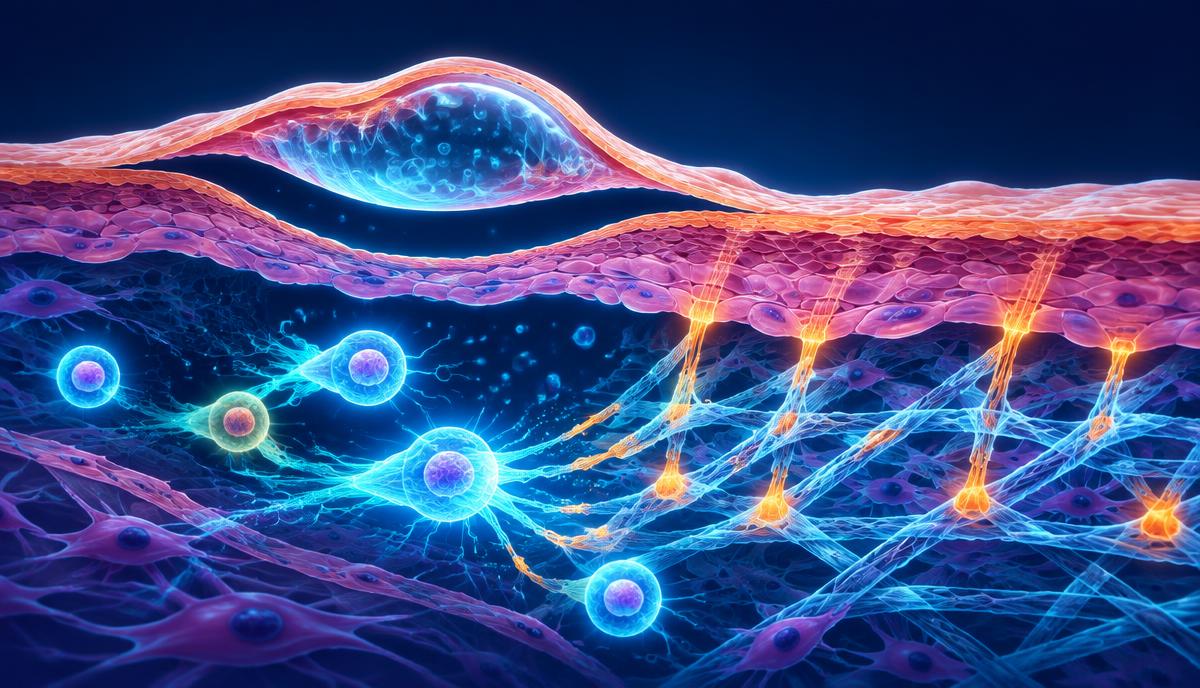
- In RDEB, mutations in the COL7A1 gene prevent the body from making functional type VII collagen, the protein that forms anchoring fibrils holding the epidermis to the deeper dermis. Without it, even gentle friction causes the skin layers to separate and blister.
- What the Evidence Shows
- A landmark 2010 New England Journal of Medicine study by Wagner and colleagues treated seven children with severe RDEB using bone marrow or cord blood transplantation. Two of the seven died — one from toxicity related to the pre-transplant conditioning regimen and one from post-transplant infection — while the remaining five showed increased collagen VII in the skin and improved wound healing, at least for a period of time.
- Bottom Line
- The research on stem cell and stromal cell approaches for epidermolysis bullosa offers real, warranted reasons for cautious optimism: MSC infusion trials have shown good tolerability and meaningful reductions in itch and pain, and even the earliest bone marrow transplant studies documented genuine wound healing and increased collagen VII in most survivors. But this optimism has to sit alongside sober facts.
What This Article Covers
Epidermolysis bullosa (EB) is a group of rare, inherited disorders that cause the skin to blister and tear from minor friction, due to mutations affecting proteins that anchor the skin's layers together. Researchers have explored bone marrow transplantation and mesenchymal stromal cell (MSC) infusions — particularly for recessive dystrophic EB (RDEB), the most severe form — as ways to deliver healthy cells capable of producing the missing structural protein, type VII collagen. This article summarizes what clinical research actually shows, who might be considered for these approaches, and where the evidence currently stands.
How It's Thought to Work
In RDEB, mutations in the COL7A1 gene prevent the body from making functional type VII collagen, the protein that forms anchoring fibrils holding the epidermis to the deeper dermis. Without it, even gentle friction causes the skin layers to separate and blister. Bone marrow transplantation introduces donor stem cells that can migrate to the skin and, in some patients, contribute cells capable of producing type VII collagen. Mesenchymal stromal cells, given intravenously rather than through a full bone marrow transplant, are not thought to directly rebuild skin structure to the same degree; instead, researchers believe they work largely through paracrine and immunomodulatory effects — calming inflammation, supporting wound healing, and potentially easing pain and itch — with more modest and inconsistent effects on collagen VII levels.
What the Evidence Shows
A landmark 2010 New England Journal of Medicine study by Wagner and colleagues treated seven children with severe RDEB using bone marrow or cord blood transplantation. Two of the seven died — one from toxicity related to the pre-transplant conditioning regimen and one from post-transplant infection — while the remaining five showed increased collagen VII in the skin and improved wound healing, at least for a period of time. The collagen fibrils formed, however, were structurally different from normal ones, and durability was uncertain. Later work shifted toward safer, non-myeloablative approaches and toward MSC infusion instead of full transplant. A phase I/II open-label trial of intravenous allogeneic MSC therapy in adults with RDEB, published in the Journal of the American Academy of Dermatology in 2019, reported that the infusions were generally well tolerated. Most recently, the MissionEB trial — a randomized, double-blind, placebo-controlled, crossover phase 3 study of umbilical cord-derived MSCs (CORDStrom) in 30 children with RDEB, published in eClinicalMedicine in 2025 — found no serious treatment-related adverse events and reported a sustained reduction in itch of more than 27% at six months in patients with severe disease, along with improvements in pain and skin involvement in those with intermediate-severity disease. A 2023 review in the journal Bioengineering summarizing the broader stem cell literature for EB concluded that MSC approaches show encouraging safety and symptom benefits, while noting that structural, disease-modifying repair of the skin remains inconsistent and unproven at scale.
Who Might Be a Candidate
- Children and adults with confirmed severe or intermediate recessive dystrophic EB have been the focus of nearly all clinical trials to date, not milder or other EB subtypes.
- Candidacy for bone marrow transplant has generally been limited to patients enrolled in specialized research protocols at major transplant centers, given the procedure's serious risks.
- MSC infusion trials have enrolled patients with significant symptom burden, such as chronic wounds, pain, or itch, who have exhausted standard wound-care approaches.
- Anyone considering these therapies should understand they are investigational: no FDA- or EMA-approved stem-cell-specific product currently exists for epidermolysis bullosa.
- Patients and families should discuss eligibility, risks, and active clinical trial enrollment (searchable on ClinicalTrials.gov) directly with an EB specialist or genetics center rather than seeking treatment outside a monitored research setting.
Bottom Line
The research on stem cell and stromal cell approaches for epidermolysis bullosa offers real, warranted reasons for cautious optimism: MSC infusion trials have shown good tolerability and meaningful reductions in itch and pain, and even the earliest bone marrow transplant studies documented genuine wound healing and increased collagen VII in most survivors. But this optimism has to sit alongside sober facts. The original 2010 transplant trial carried a real mortality risk — two of seven children died — and even in survivors, the repaired collagen fibrils were structurally imperfect and of uncertain durability. Newer MSC trials look considerably safer, but they remain small, rare-disease studies, and no stem-cell-based product has FDA or EMA approval for EB as of this writing. Vyjuvek, an FDA-approved topical gel therapy for dystrophic EB approved in 2023, shows that disease-modifying treatments are reaching patients — but it is a gene therapy, not a stem cell therapy, and its approval does not extend to any cell-based approach. For now, stem cell therapy for EB remains a promising but unproven, investigational path, best pursued through clinical trials under specialist supervision.
Sources
- Bone Marrow Transplantation for Recessive Dystrophic Epidermolysis Bullosa — New England Journal of Medicine, 2010 — https://www.nejm.org/doi/full/10.1056/NEJMoa0910501
- Phase I/II open-label trial of intravenous allogeneic mesenchymal stromal cell therapy in adults with recessive dystrophic epidermolysis bullosa — Journal of the American Academy of Dermatology, 2019 — https://www.sciencedirect.com/science/article/pii/S0190962219331305
- Mesenchymal stromal cell infusions of umbilical cord-derived mesenchymal stromal cells in children with recessive dystrophic epidermolysis bullosa (MissionEB): a randomised, double-blind, placebo controlled, crossover, phase 3 trial — eClinicalMedicine (The Lancet), 2025 — https://www.thelancet.com/journals/eclinm/article/PIIS2589-5370(25)00349-9/fulltext
- Stem Cell Therapies for Epidermolysis Bullosa Treatment — Bioengineering (MDPI), 2023 — https://pmc.ncbi.nlm.nih.gov/articles/PMC10135837/
- Vyjuvek (beremagene geperpavec-svdt) Approval Letter — U.S. Food and Drug Administration, 2023 — https://www.fda.gov/media/168356/download
Related Articles
- Clinical Applications
Stem Cell Therapy for Radiation-Induced Dry Mouth (Xerostomia)
Injecting MSCs into radiation-damaged salivary glands showed early promise — but the 120-patient MESRIX-III placebo-controlled trial did not confirm a significant benefit. What the evidence really says.
- Clinical Applications
Stem Cell Therapy for Peyronie's Disease
Small human studies of adipose-derived and placental stem cells show shrinking plaques and less distress in Peyronie's disease, but the best trial missed its curvature goal and nothing is FDA-approved.
- Clinical Applications
Stem Cell Therapy for Hidradenitis Suppurativa
Lab studies and a small case series suggest mesenchymal stem cells may calm hidradenitis suppurativa inflammation and help stubborn tunnels heal — but the approach is experimental and not FDA-approved.