Stem Cell Therapy for Radiation-Induced Dry Mouth (Xerostomia)
What this article covers
- What This Article Covers
- Radiation therapy for head and neck cancer often damages the salivary glands, leaving many survivors with chronic dry mouth (xerostomia) that standard treatments only partially relieve. In the past several years, researchers in Denmark and elsewhere have tested injecting mesenchymal stem cells (MSCs) directly into damaged salivary glands to see if they can help the tissue recover.
- How It's Thought to Work
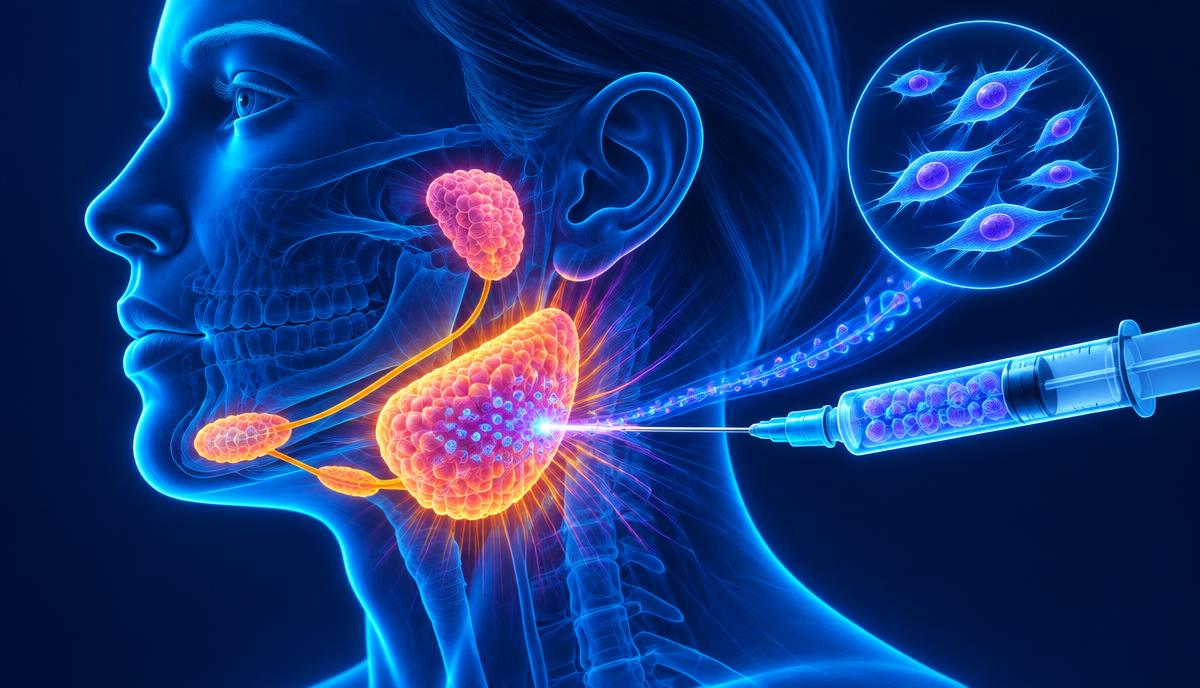
- Radiotherapy kills or impairs the stem and progenitor cells that normally maintain and repair salivary gland tissue, leading to gland shrinkage, fibrosis, and reduced saliva output. The theory behind MSC therapy is that injecting mesenchymal stem cells — typically derived from adipose (fat) tissue — directly into the submandibular or parotid glands under ultrasound guidance might support tissue repair.
- What the Evidence Shows
- The most-studied program is the Danish MESRIX series of trials, run primarily out of Copenhagen. An early randomized, placebo-controlled phase 1/2 trial (MESRIX-I) injected patients' own (autologous) fat-derived MSCs into the submandibular gland and reported meaningful improvements in unstimulated saliva flow and dry-mouth symptom scores compared with placebo.
- Bottom Line
- There is real, published clinical evidence behind this idea — smaller trials genuinely suggested MSC injections could raise saliva output and ease dry-mouth symptoms in people whose glands were damaged by radiation, and long-term follow-up found those early gains didn't simply vanish. That is a meaningfully more mature evidence base than most experimental stem cell applications get.
What This Article Covers
Radiation therapy for head and neck cancer often damages the salivary glands, leaving many survivors with chronic dry mouth (xerostomia) that standard treatments only partially relieve. In the past several years, researchers in Denmark and elsewhere have tested injecting mesenchymal stem cells (MSCs) directly into damaged salivary glands to see if they can help the tissue recover. This article summarizes what the actual clinical trial data show — including a large, rigorous trial that did not confirm the early promising signal — and what that means for anyone considering this experimental approach today.
How It's Thought to Work
Radiotherapy kills or impairs the stem and progenitor cells that normally maintain and repair salivary gland tissue, leading to gland shrinkage, fibrosis, and reduced saliva output. The theory behind MSC therapy is that injecting mesenchymal stem cells — typically derived from adipose (fat) tissue — directly into the submandibular or parotid glands under ultrasound guidance might support tissue repair. MSCs are not thought to physically regenerate large amounts of new glandular tissue; instead, researchers hypothesize they act mainly through paracrine signaling — releasing growth factors and anti-inflammatory molecules that could reduce fibrosis and support surviving gland cells. This remains a working hypothesis rather than an established mechanism.
What the Evidence Shows
The most-studied program is the Danish MESRIX series of trials, run primarily out of Copenhagen. An early randomized, placebo-controlled phase 1/2 trial (MESRIX-I) injected patients' own (autologous) fat-derived MSCs into the submandibular gland and reported meaningful improvements in unstimulated saliva flow and dry-mouth symptom scores compared with placebo. A follow-up open-label safety study using off-the-shelf donor (allogeneic) MSCs — MESRIX-II — treated 10 patients and reported unstimulated saliva flow rising from about 0.13 to 0.18 mL/min and stimulated flow from about 0.66 to 0.75 mL/min at four months, alongside a roughly 22-point drop in Xerostomia Questionnaire scores; three-year follow-up of this small cohort found the gains in stimulated saliva flow and symptom scores persisted, with no treatment-related serious adverse events. However, MESRIX-II was not randomized or placebo-controlled, which limits how much weight its numbers can carry. The more decisive test came from MESRIX-III, a single-center, double-blinded, randomized, placebo-controlled phase II trial (published 2024 in Clinical Cancer Research) that treated 120 patients with allogeneic MSCs versus a placebo injection. This was the field's largest and most rigorous trial to date, and its primary result was sobering: unstimulated saliva flow improved significantly within the MSC group but not within the placebo group, yet the difference between the two groups did not reach statistical significance (P = 0.11). A subsequent systematic review and meta-analysis (Stem Cell Research & Therapy, 2025) pooling this and other trials found saliva-flow improvements were inconsistent and often not statistically significant overall, with safety data across roughly 126 treated patients showing no treatment-related serious adverse events but a higher rate of mild, transient local adverse events (swelling, soreness) than placebo.
Who Might Be a Candidate
- Adults with confirmed chronic dry mouth caused by prior head and neck radiotherapy, rather than other causes of xerostomia such as Sjögren's syndrome or medication side effects.
- People who have already tried standard treatments — such as pilocarpine, cevimeline, or saliva substitutes — with limited relief.
- Patients enrolled in, or eligible for, an actively recruiting clinical trial, since this remains an investigational therapy outside of research settings.
- Individuals in reasonably good general health who can tolerate an outpatient, ultrasound-guided injection procedure into the salivary glands.
- Patients who understand this is not an approved treatment and are seeking it specifically to contribute to research evidence, not as a guaranteed cure.
Bottom Line
There is real, published clinical evidence behind this idea — smaller trials genuinely suggested MSC injections could raise saliva output and ease dry-mouth symptoms in people whose glands were damaged by radiation, and long-term follow-up found those early gains didn't simply vanish. That is a meaningfully more mature evidence base than most experimental stem cell applications get. But the field's largest and best-designed trial to date, a 120-patient double-blind placebo-controlled study, did not confirm a statistically significant benefit over placebo on its primary saliva-flow measure, even though the treated group did improve on its own. Combined with small sample sizes, single-center designs, and the absence of any FDA- or EMA-approved MSC product for xerostomia, the honest read is that this is a genuinely promising but still unproven therapy — worth watching, and worth discussing with your care team as a clinical-trial option, but not yet a validated substitute for standard dry-mouth management.
Sources
- Intraglandular Off-the-Shelf Allogeneic Mesenchymal Stem Cell Treatment in Patients with Radiation-Induced Xerostomia: A Safety Study (MESRIX-II) — Stem Cells Translational Medicine (Oxford Academic), 2022 — https://academic.oup.com/stcltm/article/11/5/478/6568988
- Long-Term Outcome Following Treatment With Allogeneic Mesenchymal Stem/Stromal Cells for Radiation-Induced Hyposalivation and Xerostomia — Stem Cells Translational Medicine (Oxford Academic), 2024 — https://doi.org/10.1093/stcltm/szae017
- Mesenchymal Stem/Stromal Cell Therapy for Radiation-Induced Xerostomia in Previous Head and Neck Cancer Patients: A Phase II Randomized, Placebo-Controlled Trial (MESRIX-III) — Clinical Cancer Research (AACR), 2024 — https://doi.org/10.1158/1078-0432.CCR-23-3675
- Mesenchymal stem cell therapy for radiation-induced xerostomia: a systematic review and network meta-analysis — Stem Cell Research & Therapy, 2025 — https://link.springer.com/article/10.1186/s13287-025-04824-2
- First-in-man mesenchymal stem cells for radiation-induced xerostomia (MESRIX): study protocol for a randomized controlled trial — Trials (Springer Nature), 2017 — https://link.springer.com/article/10.1186/s13063-017-1856-0
Related Articles
- Clinical Applications
Stem Cell Therapy for Epidermolysis Bullosa
Epidermolysis bullosa causes skin to blister from minor friction. What bone marrow transplant and MSC infusion trials — including the 2025 MissionEB phase 3 study — actually show for severe recessive dystrophic EB.
- Clinical Applications
Stem Cell Therapy for Peyronie's Disease
Small human studies of adipose-derived and placental stem cells show shrinking plaques and less distress in Peyronie's disease, but the best trial missed its curvature goal and nothing is FDA-approved.
- Clinical Applications
Stem Cell Therapy for Hidradenitis Suppurativa
Lab studies and a small case series suggest mesenchymal stem cells may calm hidradenitis suppurativa inflammation and help stubborn tunnels heal — but the approach is experimental and not FDA-approved.