Stem Cell Therapy for Hidradenitis Suppurativa
What this article covers
- How It's Thought to Work
- HS is driven by chronic inflammation in and around hair follicles, which leads to blocked follicles, painful abscesses, and tunnels that connect under the skin and never fully heal. Standard anti-inflammatory drugs target specific immune signals, but they don't always close established tunnels or fistulas.
- What the Evidence Shows
- The research base here is small but growing, and it spans lab studies, case series, and one registered clinical trial.
- Who Might Be a Candidate
- No one should consider stem cell therapy for HS a replacement for approved treatment right now.
- Bottom Line
- Stem cell therapy for hidradenitis suppurativa is a real and genuinely promising area of research — the early lab findings and small case series are more encouraging than "no effect," and that's worth taking seriously. But it is early-stage, exploratory science, not standard of care.
Hidradenitis suppurativa (HS) is a chronic, painful inflammatory skin condition that causes recurring abscesses, nodules, and draining tunnels, most often in the armpits, groin, and skin folds. Because standard treatments — antibiotics, biologic drugs, and surgery — don't work well enough for everyone, especially when tunnels and fistulas persist, researchers have started exploring mesenchymal stem cells (MSCs) as a possible add-on therapy. The early results are genuinely encouraging in small, preliminary studies, but stem cell therapy for HS remains experimental: there is no FDA-approved stem cell product for this condition, and it has not been validated in large controlled trials.
How It's Thought to Work
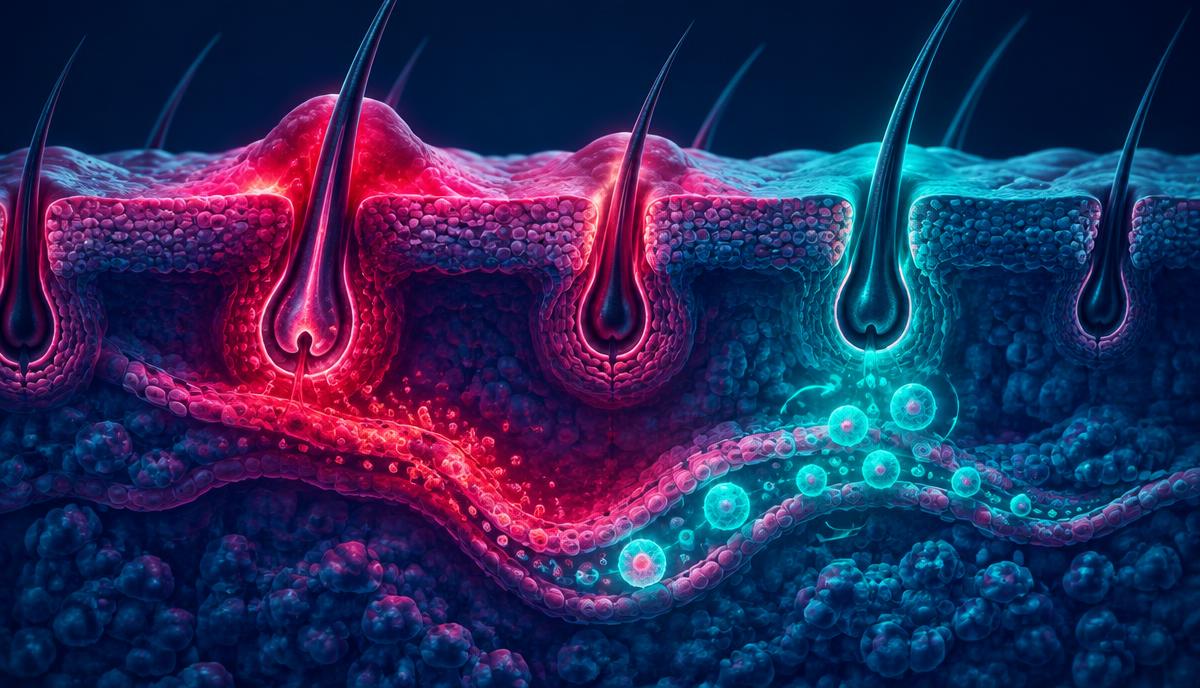
HS is driven by chronic inflammation in and around hair follicles, which leads to blocked follicles, painful abscesses, and tunnels that connect under the skin and never fully heal. Standard anti-inflammatory drugs target specific immune signals, but they don't always close established tunnels or fistulas.
Mesenchymal stem cells are being studied because of their immunomodulatory properties — their ability to calm an overactive immune response and potentially support tissue repair. In HS, the theory is that injecting MSCs (or a patient's own fat tissue, which is rich in MSCs) directly into a stubborn tunnel or fistula might quiet local inflammation and encourage the tract to heal, in cases where medication and surgery alone haven't been enough. This is still a hypothesis being tested, not an established mechanism of cure.
What the Evidence Shows
The research base here is small but growing, and it spans lab studies, case series, and one registered clinical trial.
A 2025 study in Frontiers in Immunology offers some of the clearest lab evidence yet. Researchers exposed immune cells and skin tissue from HS patients to placental-derived MSCs and found that the MSCs meaningfully calmed the inflammatory response — reducing key inflammatory signals like IL-17A and IFN-γ and shifting T-cell populations toward a less inflammatory profile. The study even suggested MSCs might offer a broader anti-inflammatory effect than adalimumab (Humira) does in these lab models. That's a promising signal about why stem cells might help — but it's important to be clear this was in vitro and ex vivo lab work on a small number of samples, not a patient treatment study.
On the clinical side, a small case series described three men with severe (Hurley stage III) HS who received injections of their own freshly processed fat tissue alongside surgery. All three reported improvement in pain, disease activity, and quality of life, and two of the three also saw their odor symptoms improve — a meaningfully positive result for patients who had run out of easy options. Reported side effects were mild and temporary (some pain, bruising, and numbness at the injection site). The catch: this was just three patients, with no control group, and the authors themselves flagged it as an early, hypothesis-generating study that needs to be confirmed in larger trials.
A 2021 letter in Dermatologic Therapy by Cuenca-Barrales and colleagues raised the idea of using allogeneic (donor-derived) mesenchymal cells for refractory HS fistulas, drawing a parallel to MSC therapy already used for Crohn's disease fistulas. It's a commentary proposing the approach rather than a completed treatment trial.
The most rigorous evidence should come from a registered trial, NCT05934825, testing allogeneic adipose-derived MSCs against placebo in a Phase I/II study of roughly 30 participants with draining HS fistulas who have already tried adalimumab. This is the kind of study that could actually tell us whether the approach works — but it is still underway, and results are not yet available.
Who Might Be a Candidate
No one should consider stem cell therapy for HS a replacement for approved treatment right now. That said, the research so far points toward the specific patient profile investigators are studying:
- People with moderate-to-severe HS (Hurley stage II or III) who have persistent draining tunnels or fistulas
- Patients who have already tried and not fully responded to standard therapy, including biologics like adalimumab
- Patients being treated within a registered clinical trial or academic research setting, with appropriate oversight
- People who understand this is investigational — not an established, FDA-approved treatment — and are engaging with it as research participation rather than a guaranteed cure
Anyone considering this route should talk to a dermatologist familiar with HS and, ideally, look into enrolling in an actual clinical trial rather than seeking treatment at a clinic marketing unproven stem cell injections outside of research settings.
Bottom Line
Stem cell therapy for hidradenitis suppurativa is a real and genuinely promising area of research — the early lab findings and small case series are more encouraging than "no effect," and that's worth taking seriously. But it is early-stage, exploratory science, not standard of care. There is no FDA-approved stem cell product for HS. The current evidence comes from lab studies, a handful of case reports, and one small trial still in progress, not from large randomized trials. Until stronger clinical trial data exist, the proven path for HS remains antibiotics, biologics (like adalimumab and secukinumab), and surgery, with stem cell therapy best pursued — if at all — through a legitimate registered clinical trial rather than as a marketed treatment.
Sources
- Potential role of human allogeneic mesenchymal cells in the treatment of refractory fistulas in patients with hidradenitis suppurativa — Cuenca-Barrales et al., Dermatologic Therapy, 2021 — https://pubmed.ncbi.nlm.nih.gov/33191614/
- Local injection of freshly collected autologous adipose tissue as a novel adjunctive treatment in hidradenitis suppurativa — JAAD Case Reports, 2026 — https://pmc.ncbi.nlm.nih.gov/articles/PMC13450581/
- In vitro and ex vivo immunomodulatory effects of human placental mesenchymal stem cells in hidradenitis suppurativa — Frontiers in Immunology, 2025 — https://pmc.ncbi.nlm.nih.gov/articles/PMC12507606/
- Clinical Trial to Evaluate Safety and Efficiency of Mesenchymal Stem Cell in Patients With Hidradenitis Suppurativa (NCT05934825) — ClinicalTrials.gov — https://clinicaltrials.gov/study/NCT05934825
- FDA Approves Secukinumab for Hidradenitis Suppurativa — Dermatology Times, 2023 — https://www.dermatologytimes.com/view/fda-approves-secukinumab-for-hidradenitis-suppurativa
Related Articles
- Clinical Applications
Stem Cell Therapy for Peyronie's Disease
Small human studies of adipose-derived and placental stem cells show shrinking plaques and less distress in Peyronie's disease, but the best trial missed its curvature goal and nothing is FDA-approved.
- Clinical Applications
Stem Cell Therapy for TMJ Disorders (Temporomandibular Joint Osteoarthritis)
Randomized trials of fat-derived stem cell injections into the jaw joint beat hyaluronic acid on pain and mouth opening — but the evidence base is small and rated weak.
- Clinical Applications
Stem Cell Therapy for Fatty Liver Disease (NAFLD/NASH)
Mesenchymal stem cells and their vesicles reduce liver fat and fibrosis in animal models — but there is still no completed human trial in NAFLD or NASH specifically.