Can Stem Cells Help With Crohn's Disease?
What this article covers
- What This Article Covers
- Crohn's disease has drawn real, credible interest in stem cell research, but the evidence differs sharply depending on what's being treated. The strongest data by far concern local mesenchymal stem cell (MSC) injections for complex perianal fistulas, a painful and hard-to-heal complication of Crohn's — an area where one product, darvadstrocel (Alofisel), actually reached regulatory approval in Europe before a larger confirmatory trial upended that story.
- How It's Thought to Work
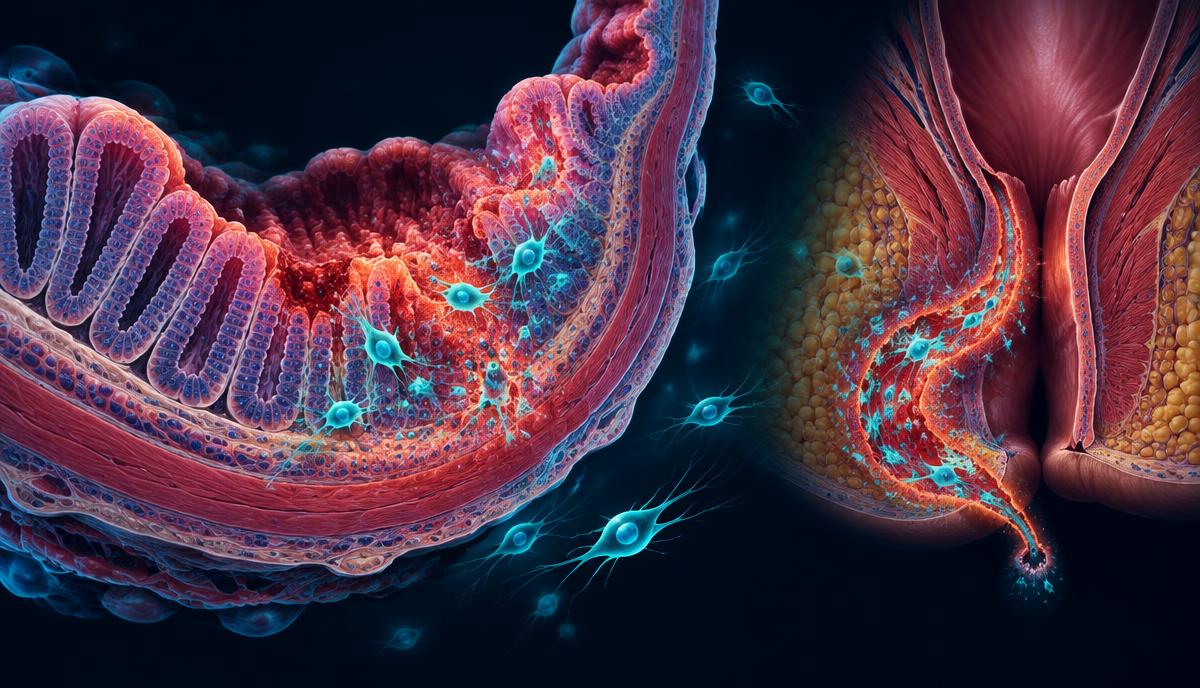
- For perianal fistulas, allogeneic (donor-derived) mesenchymal stem cells taken from adipose (fat) tissue are injected directly into and around the fistula tract. MSCs are thought to work locally by dampening the surrounding inflammatory and immune response and supporting tissue repair, rather than by regenerating bowel tissue outright.
- What the Evidence Shows
- The best-known success story starts with ADMIRE-CD, a phase 3 randomized trial published in The Lancet in 2016, which found that a single treatment of darvadstrocel produced combined remission of complex perianal fistulas in roughly 56% of patients at one year, compared to about 39% with placebo — a meaningful, clinically encouraging gap that led the European Medicines Agency to approve darvadstrocel (as Alofisel) in March 2018, the first allogeneic stem cell therapy approved anywhere for this use. S.
- Bottom Line
- Stem cell science has produced one of the field's genuine, well-controlled success stories in Crohn's disease — the original ADMIRE-CD trial's remission advantage for perianal fistulas was real and substantial — but the field's own confirmatory trial process then did its job: a larger follow-up study failed to replicate that benefit, and the therapy was voluntarily withdrawn from the market where it had been approved. That reversal is itself a useful data point about how early promise in regenerative medicine can look different at scale.
What This Article Covers
Crohn's disease has drawn real, credible interest in stem cell research, but the evidence differs sharply depending on what's being treated. The strongest data by far concern local mesenchymal stem cell (MSC) injections for complex perianal fistulas, a painful and hard-to-heal complication of Crohn's — an area where one product, darvadstrocel (Alofisel), actually reached regulatory approval in Europe before a larger confirmatory trial upended that story. Evidence for treating luminal (intestinal) Crohn's disease itself with stem cells, whether via local MSC infusion or high-dose hematopoietic stem cell transplant (HSCT), is far less settled and, in the case of HSCT, comes with serious safety concerns. This article walks through what the trials actually found, including the parts of the story that changed as recently as this year.
How It's Thought to Work
For perianal fistulas, allogeneic (donor-derived) mesenchymal stem cells taken from adipose (fat) tissue are injected directly into and around the fistula tract. MSCs are thought to work locally by dampening the surrounding inflammatory and immune response and supporting tissue repair, rather than by regenerating bowel tissue outright. This is a fundamentally different approach from HSCT, which uses a patient's own blood-forming stem cells to essentially "reset" a dysregulated immune system: the patient's stem cells are harvested, the existing immune system is wiped out with chemotherapy (conditioning), and the harvested cells are reinfused to rebuild it, with the hope that the new immune system no longer drives Crohn's inflammation.
What the Evidence Shows
The best-known success story starts with ADMIRE-CD, a phase 3 randomized trial published in The Lancet in 2016, which found that a single treatment of darvadstrocel produced combined remission of complex perianal fistulas in roughly 56% of patients at one year, compared to about 39% with placebo — a meaningful, clinically encouraging gap that led the European Medicines Agency to approve darvadstrocel (as Alofisel) in March 2018, the first allogeneic stem cell therapy approved anywhere for this use. It was never approved by the FDA, and a larger international confirmatory trial, ADMIRE-CD II, was launched partly to build the case for future U.S. review.
That confirmatory trial changed the picture substantially. Published in Gastroenterology in 2026, ADMIRE-CD II enrolled over 500 patients and found darvadstrocel was not significantly better than placebo — combined remission rates were roughly 49% versus 46% at 24 weeks, with placebo responding far more strongly than in the original trial (researchers pointed to factors such as changes in background biologic use as possible explanations). Following that result, Takeda withdrew Alofisel from the EU market in December 2024, stating that its clinical benefit could no longer be considered demonstrated. As of this writing, darvadstrocel is not approved for use in the EU.
Evidence for MSCs in luminal Crohn's disease is thinner still. Small early-phase trials of systemic (intravenous) or locally delivered MSCs for active intestinal Crohn's have reported safety and occasional response signals, but none has produced the kind of large, placebo-controlled confirmation seen in the fistula trials, and no MSC product is approved for luminal disease.
HSCT for severe, refractory luminal Crohn's has a longer and more sobering track record. The original ASTIC trial (JAMA, 2015) found no statistically significant advantage in sustained remission (8.7% vs. 4.5% with standard care) despite high rates of serious adverse events, including one death. A follow-up trial using a lower-intensity regimen, ASTIClite (The Lancet Gastroenterology & Hepatology, 2024), showed a real efficacy signal on endoscopic healing, but was halted early after every treated patient experienced a serious adverse event, including cases of thrombotic microangiopathy and two deaths — leading the investigators to conclude the regimen should not be used in practice.
Who Might Be a Candidate
- People with complex, treatment-refractory perianal fistulas who have not responded to conventional or biologic therapy were candidates for darvadstrocel where it was available, though it is currently withdrawn from the EU market pending further evidence.
- Anyone considering MSC injection for fistulizing Crohn's should ask specifically whether the product is regulatory-approved in their country, since availability has changed significantly since 2024.
- People with active luminal (intestinal) Crohn's disease are not current candidates for an approved MSC therapy; any MSC treatment for this indication should be understood as investigational.
- Patients with severe, refractory Crohn's who have exhausted biologic options may hear about HSCT, but the documented risk of serious, sometimes fatal complications means this is not a routine or low-risk pathway.
- Anyone offered stem cell treatment for Crohn's outside a registered clinical trial or an approved product should ask what specific evidence supports that exact protocol, not just "stem cells" as a general category.
- People interested in enrolling in ongoing research should look for registered trials (e.g., via ClinicalTrials.gov) rather than direct-to-consumer clinics offering unproven infusions.
Bottom Line
Stem cell science has produced one of the field's genuine, well-controlled success stories in Crohn's disease — the original ADMIRE-CD trial's remission advantage for perianal fistulas was real and substantial — but the field's own confirmatory trial process then did its job: a larger follow-up study failed to replicate that benefit, and the therapy was voluntarily withdrawn from the market where it had been approved. That reversal is itself a useful data point about how early promise in regenerative medicine can look different at scale. For luminal Crohn's disease, MSC infusion remains investigational, and HSCT — while capable of producing real remission in some severely ill patients — carries a risk of serious, sometimes fatal complications that has kept it out of routine practice. Anyone considering a stem cell approach to Crohn's disease should treat "stem cells" as a broad category covering very different products, evidence levels, and risks, and should confirm current regulatory status and trial data before deciding — not assume that what was true a few years ago is still true today.
Sources
- Expanded allogeneic adipose-derived mesenchymal stem cells (Cx601) for complex perianal fistulas in Crohn's disease: a phase 3 randomised, double-blind controlled trial — The Lancet, 2016 — https://www.thelancet.com/journals/lancet/article/PIIS0140-6736(16)31203-X/abstract
- Darvadstrocel in Patients With Crohn's Disease With Complex Perianal Fistulas: The ADMIRE-CD II Phase 3 Randomized Trial — Gastroenterology, 2026 — https://www.gastrojournal.org/article/S0016-5085(26)00024-7/fulltext
- Public statement: Alofisel — withdrawal of the marketing authorisation in the European Union — European Medicines Agency, 2024 — https://www.ema.europa.eu/en/documents/public-statement/public-statement-alofisel-withdrawal-marketing-authorisation-european-union_en.pdf
- Autologous Hematopoietic Stem Cell Transplantation for Refractory Crohn Disease: A Randomized Clinical Trial (ASTIC) — JAMA, 2015 — https://jamanetwork.com/journals/jama/fullarticle/2475462
- Safety and efficacy of autologous haematopoietic stem-cell transplantation with low-dose cyclophosphamide mobilisation and reduced intensity conditioning versus standard of care in refractory Crohn's disease (ASTIClite) — The Lancet Gastroenterology & Hepatology, 2024 — https://www.thelancet.com/journals/langas/article/PIIS2468-1253(23)00460-0/fulltext
Related Articles
- Clinical Applications
Stem Cell Therapy for Epidermolysis Bullosa
Epidermolysis bullosa causes skin to blister from minor friction. What bone marrow transplant and MSC infusion trials — including the 2025 MissionEB phase 3 study — actually show for severe recessive dystrophic EB.
- Clinical Applications
Stem Cell Therapy for Radiation-Induced Dry Mouth (Xerostomia)
Injecting MSCs into radiation-damaged salivary glands showed early promise — but the 120-patient MESRIX-III placebo-controlled trial did not confirm a significant benefit. What the evidence really says.
- Clinical Applications
Stem Cell Therapy for Peyronie's Disease
Small human studies of adipose-derived and placental stem cells show shrinking plaques and less distress in Peyronie's disease, but the best trial missed its curvature goal and nothing is FDA-approved.